Jogen Chowdhury (1939–2026): The Artist Who Gave Human Frailty a Line of Its Own
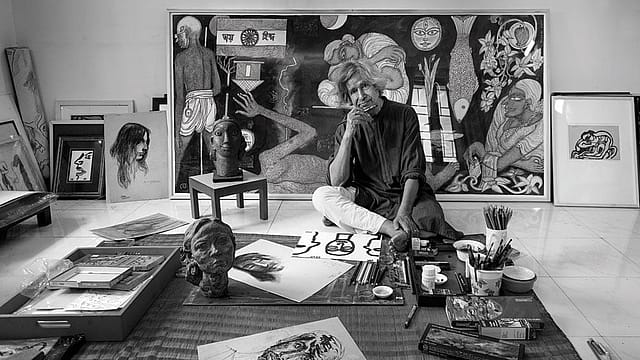
The lamp was small. The family gathered around it was large.
Through his art-college years, Jogen Chowdhury worked at night by a kerosene hand lamp, sharing its light with younger brothers and sisters studying beside him. There was little money and no room of his own. Black ink suited the dimness. Paper and ordinary writing ink were affordable; expensive canvases and oils were beyond his reach.
Years later, he would explain how those circumstances helped shape his practice. One of modern Indian art’s most recognisable visual languages had begun in the cramped arrangements of a refugee family trying to get by.
Chowdhury died in Kolkata on Sunday, October 25, aged 87. Gallerist Somak Mitra of Art Exposure confirmed his death following a prolonged illness. He had been undergoing treatment for blood cancer and was admitted to hospital on October 16, before developing an infection.
Losing Memory
16 Oct 2026 - Vol 05 | Issue 42
The making of a medical and social emergency
He leaves behind an art in which the human body could be tender, absurd, wounded and unsettling within the same frame. His figures bulged and sagged. Their contours wandered. Fine, intersecting lines gathered across flesh, giving it weight, texture and emotional pressure.
You could recognise a Chowdhury before you found the signature.
THE CHILD WHO WATCHED THE ARTISANS
Born in Faridpur in 1939, in what is now Bangladesh, Chowdhury’s earliest encounters with art came through the world immediately around him. His father drew; his mother made alpona. Village festivities brought theatre, images and the absorbing spectacle of artisans making gods.
He remembered watching the makers of Durga and Saraswati idols, collecting the natural colours they left behind and painting with them. Their treatment of Durga’s eyes stayed with him, resurfacing in the enlarged eyes of women in his own work.
Partition uprooted that childhood.
The family moved to Calcutta, where displacement brought financial hardship and a sharper awareness of the society around him. Those experiences remained part of his artistic consciousness. In later life, he explicitly connected the darkness of his early years with the work he made.
His art would keep returning to people and the pressures they carried.
FINDING A LANGUAGE
Chowdhury trained at Calcutta’s Government College of Art & Craft and subsequently studied at the École nationale supérieure des Beaux-Arts in Paris.
Europe complicated his sense of direction. Encountering its modern masters left him questioning what he should do himself. Their achievements came from their circumstances and ideas; he needed to understand his own.
After returning to India and joining the Handloom Board in Madras, he filled pages with reflections on that problem. His eventual direction drew him towards Indian society and the people whose lives he observed.
That search produced an extraordinary command of line.
Cross-hatching, the layering of intersecting strokes, became central to his work. It could make a body appear substantial while exposing its fragility. A curved outline might suggest comfort, then become faintly disturbing. Flesh seemed to bear the accumulated strain of living.
Auction-house accounts of his practice have noted both his refusal to imitate established European or Indian idioms and the distinctive relationship between his fluid contours, dense markings and dark backgrounds.
For a viewer, the effect could be intimate and uncomfortable. These bodies invited attention. They offered few easy reassurances.
POWER HAD A FACE
Chowdhury also spent an unusually long time observing power from nearby.
From 1972 to 1987, he served as Keeper of Art at Rashtrapati Bhavan. In August 2014, he returned as the inaugural artist under its writers’ and artists’ residency scheme.
The intervening years had taken him to Santiniketan, where he joined the teaching community in 1987. Another journey brought him to the Rajya Sabha as a Trinamool Congress member in 2014.
Parliament supplied a fresh assembly of faces.
As colleagues argued and proceedings grew turbulent, Chowdhury sketched. The artist watched expressions, postures and personalities. In a January 2015 interview, he described the enquiry with characteristic clarity: “But I am still to discover the man behind the politician.”
That sentence reaches beyond his parliamentary drawings. Looking closely at a person, and finding what an outward appearance concealed, was a sustained artistic concern.
His political affiliation belongs in any account of his public life. So does his willingness to examine authority through art. His work’s social consciousness had developed long before he entered Parliament.
A LIFE THAT MADE ROOM FOR OTHERS
His legacy also lives in the artists he encouraged.
At Santiniketan, Chowdhury bought students’ work, understanding the encouragement such purchases could provide. In 2019, he opened the Jogen Chowdhury Centre for Arts in Kolkata, seeking to draw more people towards visual art and cultural activity.
The teacher and institution-builder expanded the possibilities available to others. Recognition had given him the means to help sustain an artistic community.
Yet the enduring encounter will be with the pictures: the wandering contour, the crowded marks, the body made strange enough to demand another look.
Chowdhury gave vulnerability a physical presence. His figures could seem burdened by their own flesh, caught in relationships or exposed to forces beyond their control. They remained stubbornly, recognisably human.
The young man sharing a kerosene lamp had found a way to make people visible.