Could Diwali Crackers Get Louder in 2026? Supreme Court Firecracker Rules Explained
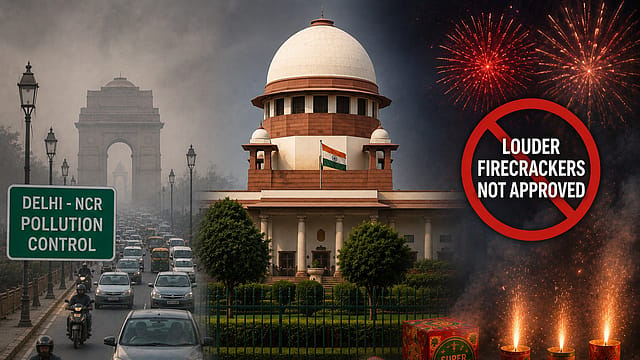
The Supreme Court has not given louder firecrackers a green signal. It has asked India’s pollution regulator whether some firecrackers can be granted a limited exception from the existing noise limits during Diwali.
A bench of Justices MM Sundresh and PB Varale asked the Central Pollution Control Board to examine the question well before the festival instead of confronting it through an urgent last-minute hearing. The request opens a fresh front in India’s long-running firecracker battle. Until now, much of the debate in Delhi-NCR has centred on smoke, particulate matter and toxic winter air. The court is now separately examining whether the decibel ceiling may be too restrictive for certain categories of legally manufactured crackers. What are the present limits, why is the court reconsidering them and could any relaxation weaken the rules governing green firecrackers?
What has the Supreme Court asked the CPCB to do?
The court wants the CPCB to examine whether a partial exception can be created for certain categories of firecrackers, specifically in relation to noise. “Please give some exception; we don’t want to rush it up just before Diwali,” the bench told the CPCB’s counsel. The court had first raised the question during a hearing on July 22 and directed Additional Solicitor General Aishwarya Bhati to obtain instructions from the pollution-control body. When the matter returned to court, Bhati sought an adjournment. The bench granted it but repeated that the CPCB should study the possibility of a limited relaxation. The case will be heard again after two weeks.
Zeroing In on ECI
09 Oct 2026 - Vol 05 | Issue 41
Constitutional legitimacy versus political opportunism
Has the Supreme Court already relaxed the noise limits?
No. The court has sought expert advice. It has not passed an order permitting manufacturers to produce louder firecrackers or allowing the public to use them. Bar & Bench reported that the bench asked the CPCB to explore whether a partial relaxation could be considered for particular types of crackers. The CPCB could support an exception, reject it or recommend conditions involving the type of cracker, maximum sound level, testing method, location or period of use. The Supreme Court will take the final decision after considering the regulator’s response and arguments from manufacturers, sellers, governments and environmental parties.
What are the current noise limits for firecrackers?
India prohibits the manufacture, sale or use of firecrackers generating noise above 125 dB(AI) or 145 dB(C) peak when measured four metres from the point of bursting. For a joined series of crackers, commonly called a lari, the permitted level is lowered according to the number of crackers connected. These standards were inserted into the Environment (Protection) Rules in 1999 and are reproduced in the CPCB’s firecracker-noise standards. Separately, the Noise Pollution (Regulation and Control) Rules prohibit sound-emitting firecrackers during night hours and within notified silence zones. The restrictions generally cover the area around hospitals, educational institutions and courts. A relaxation of the product-level decibel ceiling would not automatically remove those restrictions.
Why is the court considering an exception now?
The suggestion appears to arise from representations made by the firecracker industry in the long-running litigation over manufacturing, licences and permitted products. Senior advocate J Sai Deepak, representing firecracker sellers, told the court that businesses lacked clarity about the prevailing rules. He said his client’s licence had been cancelled and sought its restoration so that manufacturing could resume if the court eventually granted permission. For the industry, the uncertainty carries commercial consequences. Manufacturers and traders must plan production, certification, transport and licensing months before Diwali. A decision delivered immediately before the festival may arrive too late to provide meaningful relief. The bench’s remark indicates that it wants the technical question settled in advance. That does not reveal how the court will ultimately rule. It only explains why it wants the CPCB to examine the issue now.
Is the court reconsidering the entire firecracker ban?
No. The present query is narrower. The court has referred specifically to permissible noise levels for certain categories of firecrackers. It has not indicated that conventional high-emission crackers should return or that restrictions on toxic chemicals, manufacturing, sale and timings should disappear. The distinction between air and noise pollution is crucial. A cracker can comply with a chemical-emission standard and still produce excessive sound. Another product might generate less noise but release significant smoke or particulate matter. A possible concession on decibels would therefore not automatically convert a conventional firecracker into an approved green cracker.
What are green firecrackers?
Green firecrackers are lower-emission products developed under the supervision of the Council of Scientific and Industrial Research’s National Environmental Engineering Research Institute. They are designed to reduce particulate emissions by modifying the chemical composition, suppressing dust or using smaller quantities of polluting material. Genuine green crackers must be approved and bear traceable identification, including a QR code. They are less polluting than conventional crackers, but they are not pollution-free. During Diwali 2025, the Supreme Court temporarily permitted only certified green firecrackers in Delhi-NCR under tight conditions. Traditional crackers remained prohibited. The permission was framed as a trial rather than a permanent return to unrestricted firecracker use.
What happened under the 2025 Diwali relaxation?
The Supreme Court allowed the limited sale and use of certified green firecrackers in Delhi-NCR around Diwali. The court confined bursting to specified morning and evening windows on the day before Diwali and the festival itself. Sales were allowed only through licensed vendors at designated locations, and products from outside the NCR were barred. Manufacturers had to possess NEERI certification, while patrol teams were directed to conduct inspections and verify QR codes. Hindustan Times reported that the court described the arrangement as an attempt to balance festive sentiment and livelihoods with the right to clean air. Enforcement proved difficult. Firecrackers were reportedly burst beyond the permitted hours across parts of Delhi-NCR. Delhi’s air quality deteriorated sharply after the festival. Reuters reported that the CPCB placed the capital’s AQI in the “very poor” category, while another monitoring service classified conditions as hazardous. Firecrackers are not Delhi’s only pollution source. Vehicles, construction dust, industrial emissions, weather conditions and agricultural fires all contribute to the winter smog. But widespread non-compliance makes it harder to measure the impact of a tightly controlled green-cracker experiment.
If air pollution is the bigger crisis, why focus on noise?
Noise is a separate public-health concern and is regulated independently of chemical emissions. A firecracker produces an abrupt burst of impulse noise. The risk depends on intensity, distance and exposure. A product tested at four metres can sound far louder to someone standing close to the explosion. The World Health Organization says safe exposure time falls rapidly as sound intensity rises. The US Centers for Disease Control and Prevention warns that even a single loud sound, including a firecracker exploding near the ear, can cause noise-induced hearing loss. Children, older people, patients and people with sensory or hearing conditions may be particularly vulnerable. Animals can also experience severe distress. That is why a decibel relaxation cannot be evaluated solely as a question of tradition or commercial hardship.
Why is 125 decibels not directly comparable with residential noise limits?
The numbers measure different forms of exposure. Residential ambient-noise limits are generally expressed as an average over a period. CPCB standards prescribe 55 dB during the day and 45 dB at night in residential areas. The 125 dB limit for a firecracker measures a brief impulse from a product tested at a specified distance. A cracker may therefore legally produce a short sound far above the ordinary ambient limit. This does not mean 125 dB is harmless. It means the product standard accounts for the short duration and measurement method. Any proposal to raise that limit would need to consider how even a small numerical increase translates into a significant rise in sound energy.
Could the CPCB create different limits for different crackers?
That is one possible outcome. The regulator could examine whether sound standards should distinguish between individual crackers, aerial fireworks, joined series, children’s products and certified green crackers. It could also recommend that any exception apply only to products satisfying reduced-emission requirements, undergoing testing by authorised laboratories and carrying traceable certification. Another possibility is that the CPCB finds no scientific basis for a relaxation and advises the court to retain the existing limits. The bench has asked a question. It has not instructed the regulator to arrive at a particular answer.
Would a relaxation apply only to Delhi-NCR?
That depends on how it is structured. The case before the Supreme Court concerns firecracker restrictions imposed amid acute air pollution in Delhi and other northern states. A festival-specific judicial relaxation could therefore be confined to a particular region or category of approved products. But the 125 dB product ceiling arises from national environmental rules. A permanent alteration of that standard could have consequences beyond Delhi-NCR and may require action under the Environment (Protection) framework. The CPCB will have to explain whether the court can create a narrow exception without weakening the nationwide standard.
Why have firecracker rules remained so confusing?
Multiple layers of regulation overlap. National environmental rules govern noise. Supreme Court judgments regulate the manufacture, chemical composition, online sale and festival timings. NEERI certifies green formulations, while the Petroleum and Explosives Safety Organisation handles explosives-related approvals. State governments, pollution boards, district administrations and police enforce licences and local restrictions. The rules can also change as air quality deteriorates or courts pass festival-specific directions. For manufacturers and sellers, that produces uncertainty over what they may make and stock. For consumers, it creates confusion over which products are genuine and when they can legally be used. Fake green-cracker labels and weak enforcement further complicate the system.
What happens next?
The CPCB must first tell the Supreme Court whether any scientifically defensible relaxation is possible. The court will then decide whether to retain the existing cap, modify it for limited categories or impose additional safeguards. It may also address the sellers’ licensing concerns before manufacturers begin preparations for Diwali. Until a fresh order is passed, the current standards remain in force. The Supreme Court has not decided that Diwali should become louder. It has asked whether a carefully defined exception can coexist with the right to health, clean air and protection from excessive noise. The answer will depend on evidence, not the volume of the competing demands.
(With inputs from ANI)