Sonam Wangchuk’s Toughest Call
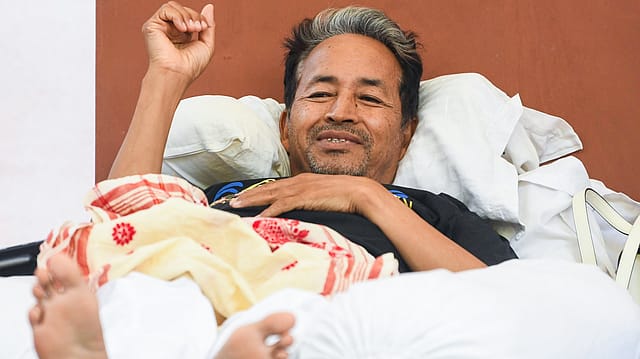
Sonam Wangchuk faces a huge dilemma: whether or not to end his fast, which has continued even after he has been arrested and shifted to hospital.
According to people close to the matter, the 59-year-old – whose fast, started in solidarity with Cockroach Janata Party (CJP) at Delhi’s Jantar Mantar, entered its 25th day on Wednesday – has expressed his worries in a letter he sent to BJP ministers JP Nadda and Jitendra Singh, who met him at Medanta Hospital in Gurugram on Tuesday. There is a real fear of his student comrades being persecuted and slapped with offences under draconian anti-terror laws such as the Unlawful Activities (Prevention) Act.
The youth-led CJP itself on Wednesday appealed to Wangchuk to end his hunger strike, promising that they would continue the protest over competitive exam irregularities until demands are met. These demands include the resignation of Union Education Minister Dharmendra Pradhan and financial compensation to nearly 20 students they say died by suicide after the question papers were leaked and the test cancelled.

Zeroing In on ECI
09 Oct 2026 - Vol 05 | Issue 41
Constitutional legitimacy versus political opportunism

Wangchuk, a Ramon Magsaysay Award recipient, engineer, activist, innovator, education reformer and environmentalist, said in a letter he wrote to Nadda and Singh that he will end his hunger strike if the Central Government gives an unequivocal assurance that no punitive or retaliatory legal action will be taken against students and protesters who participated in the nationwide movement over the NEET-UG 2026 paper leak.
In the letter, Wangchuk thanked the two leaders for visiting him and appealing to him to end his fast.
Wangchuk, along with CJP and other student organisations, continues to demand the resignation of Pradhan over the NEET 2026 paper leak and CBSE on-screen marking irregularity. Since 28 June, Wangchuk has been on an indefinite hunger strike along with six students from the All India Students Association (AISA).
The Wednesday letter reads: “Thank you for visiting me at the hospital last night and for your earnest appeal that I end my fast. During our discussion, you assured me that the Government would positively consider adequate compensation for the families of students who committed suicide following the examination paper leak, a meaningful discussion in Parliament to ensure accountability, including consideration of the resignation of the Hon'ble Education Minister... I respectfully request an unequivocal assurance from the Government that none of the young protesters will face any punitive or retaliatory legal action for participating in this movement. Their only ‘offence’ has been to raise their voice for a fair and accountable education system. If such an assurance is given, I shall end my fast with faith that the Government has heard not only my appeal but also the aspirations of lakhs of young Indians. In the absence of such an assurance, I will be forced to continue my fast indefinitely. I also hope that there will be no further use of excessive police force to repress the movement...”
Meanwhile, at least two people who visited Wangchuk on Wednesday also said the climate activist is deeply worried about what the government is going to do to his comrades-in-arms in this protest. Following the July 20 crackdown on students who were lathi-charged and tear-gassed by the police at Jantar Mantar after he was forcibly removed from the venue and initially taken to Safdarjung Hospital based on a court directive, Wangchuk had said that he would continue his fast, seeing the brutality with which the peacefully protesting students are being dealt with. In a handwritten letter that has since gone viral, he noted that he was “touched and moved by how the youth have held on to peace despite provocation” from the police.
The youth are protesting against a raft of irregularities in competitive exams and the non-implementation of expert panel recommendations to close the gaps that lead to manipulations, including leaks of question papers. Their sympathisers are also worried that the forces are using unnecessary force on protesters, treating the protesters as subhuman, and expressing hate in some instances. They also question the use of people in civvies to beat up students and the attitude that some senior officers have adopted towards the protesting students and CJP leaders.
For instance, Rapid Action Force Assistant Commandant Sonia Shehrawat wrote on her Instagram profile, along with a picture of a cockroach lying upside down, presumably dead: “They can’t fix themselves and want to fix the country.” Shehrawat was among the leaders of the RAF team that lathi-charged students on July 20. What her claim neglects to consider is that the National Eligibility cum Entrance Test (NEET-UG) is crucial for students since it is the sole gateway for admission into undergraduate medical courses. The country has seen repeated mishandling of several such crucial exams.
“At this point of time, you can’t ask Wangchuk not to be worried about the protesting students,” said an opposition politician who visited him. “The July 20 crackdown was carried out with extreme bias.” Anushka, a computer science student at Jamia Millia Islamia University, told Open that the experience was more traumatic than anyone could have imagined.
A friend of hers hastened to add, “The day was really bad for girls who had to face inappropriate touches and merciless thrashing.” Delhi Police, on their part, carried a statement on X, “Some segments from media have mentioned sporadic use of violence/detentions at Jantar Mantar by Delhi Police. It is informed that no such incident has taken place and protest is being handled professionally. All are requested not to fall pray to any rumour/ misgivings, and, to assist Delhi Police in maintaining peace and public order at and around the site.” (sic)
For now, the government’s response to Wangchuk’s demand will determine whether one of India’s most recognisable activists ends a fast that has become as much about protecting protesting students as about examination reforms.