SEMICON India 2026: Applied Materials’ $5-billion Plan Leads Chip Supply-Chain Push
India’s semiconductor ambitions drew a $5 billion commitment from Applied Materials on Thursday as SEMICON India 2026 opened with plans for research, equipment components and materials that could deepen the country’s chipmaking supply chain.
The programme, outlined by Applied Materials executive Prabhu Raja, was among the most significant announcements at the New Delhi gathering. Alongside it came updates on Lam Research’s proposed ₹10,000 crore investment, Tata Electronics’ planned supplier agreements and Micron’s expanding operations.
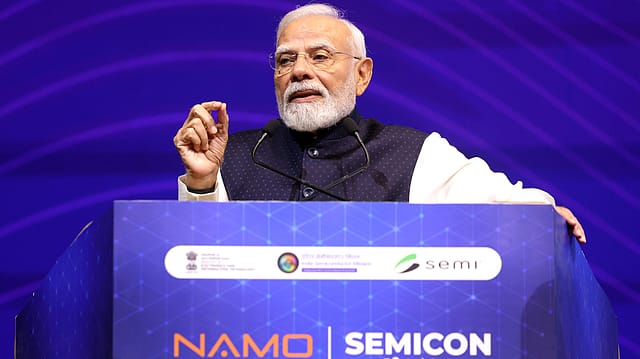
Prime Minister Narendra Modi also confirmed the start of commercial production at two more plants, in Mohali and Surat. Together, the developments show how the industry’s agenda is widening to include the factories, suppliers, research facilities and workers needed to sustain semiconductor production.
Applied Materials outlines $5 billion India Vision 2035
Applied Materials reportedly announced a $5 billion investment plan over the next decade under its India Vision 2035 programme, covering research, supplier development and talent.

Zeroing In on ECI
09 Oct 2026 - Vol 05 | Issue 41
Constitutional legitimacy versus political opportunism
Raja, president of its Semiconductor Products Group, outlined a proposed 140-acre advanced semiconductor research park and an ambition to expand India-based supply-chain capacity tenfold by 2035, according to media reports. These are forward-looking commitments; the headline amount is not investment already deployed.
For domestic suppliers, the opportunity lies in qualifying to serve a global equipment company. The commercial test will be whether the plan generates sustained orders and locally developed capabilities.
Lam’s ₹10,000 crore plan targets silicon components
Lam Research outlined plans to invest approximately ₹10,000 crore in India, including its first silicon-component manufacturing facility in the country and advanced R&D.
The proposal had been reported on September 16, before the conference opened. It therefore belongs in the opening-day picture as a pre-event announcement elaborated at the summit.
According to reports of chief operating officer Sesha Varadarajan’s remarks, the facility is intended to support global manufacturing and exports. Its location, capacity and operational start date were not disclosed in that account.
The description matters: this is a silicon-component manufacturing proposal from an equipment supplier. Calling it a newly operational chip fabrication plant would overstate what has been announced.
Fujifilm proposes ₹800 crore materials facility
Another pre-event development came from Fujifilm, which reportedly announced on September 16 a roughly ₹800 crore greenfield semiconductor materials facility.
The investment is planned in two phases, beginning in October 2026, with commercial production targeted for fiscal 2028. Later expansion would depend on the development of India’s semiconductor industry and customer demand, according to the company statement cited in reports.
Fujifilm had already disclosed a June 2026 MoU with the Gujarat State Electronics Mission to explore local semiconductor materials manufacturing. Its exhibition programme includes a demonstration of materials used to polish semiconductor surfaces, underlining the specialised inputs required around a fab.
The investment proposal advances that localisation story. Production remains a future milestone.
Tata Electronics plans 16 semiconductor MoUs
Tata Electronics chief executive Randhir Thakur said the company would sign 16 MoUs during SEMICON India, according to media reports.
The intended partners include Nexperia, BESI, JSR, Fujifilm, L&T Semiconductors and Inox Air Products, spanning different parts of the supply chain. Thakur also reportedly said Tata’s Dholera fab and Jagiroad packaging project were progressing against their scheduled commitments.
The statement establishes a planned signing programme. It does not establish that all 16 documents had been executed by the reporting cutoff, disclose their individual commercial terms or make them equivalent to purchase orders.
For Tata, developing this supplier network is central to the larger task of bringing its manufacturing projects into operation. The investment values of those existing projects should not be counted again as fresh summit commitments.
New production launches; Micron reports global shipments
Modi’s address confirmed commercial production starts at plants in Mohali and Surat. Media reports identified the facilities as Continental Device India Limited and Suchi Semicon, respectively.
Separately, Micron chairman and CEO Sanjay Mehrotra reportedly told the conference that finished DRAM and NAND products were shipping from Sanand to customers globally. He reiterated expectations of tens of millions of chips assembled and tested in 2026, rising to hundreds of millions in 2027.
Those volume targets were already in Micron’s February 28 opening announcement. Sanand converts wafers from Micron’s global manufacturing network into finished memory and storage products; assembly and testing should not be confused with fabricating the wafers themselves.
Semicon 2.0 widens the policy and skills agenda
The policy framework behind these developments also predates the summit. The India Semiconductor Mission lists Semicon 2.0’s ₹1,27,500 crore outlay and its six areas of focus: design, machines and materials, fabs, assembly and packaging, R&D, and talent. Cabinet approval came in July, with scheme notifications listed in August.
At the opening, electronics and IT minister Ashwini Vaishnaw reportedly outlined a target to develop one lakh people for technician, cleanroom and factory-floor roles, alongside support for at least 200 chip-design startups and companies. These are programme targets, not a tally of jobs already created.
The emerging picture is of an industry trying to build the support system around semiconductor manufacturing. Investment plans, supplier relationships and production milestones each mark a different stage of that effort. The next test is measurable: projects commissioned, suppliers qualified, products shipped and customers placing repeat orders.
With inputs from ANI & agencies