The Remaking of Kamathipura
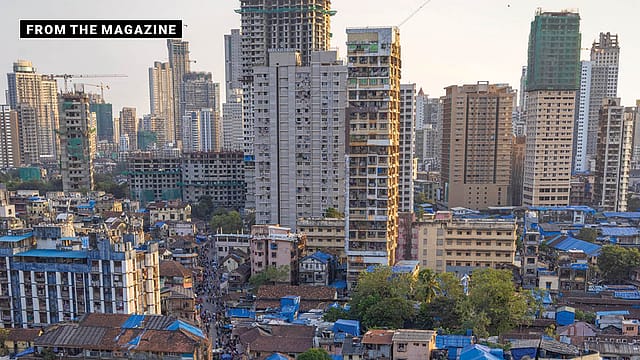
Kishore Tiwari raises his hands and shrugs. “Ram bharose (at God’s mercy),” he says. “That’s how we have been living all these years. Anything could have happened at any time.” Behind him stands the subject of his statement: the old, dilapidated building in Kamathipura where he lives with his family in a tiny one-room apartment. Living here, of course, means adjustments. All five family members can sit together inside their 10x12 feet home, for instance. But when night falls, Tiwari lies down in the building’s common passageway, alongside men from other homes, while the rest of his family sleeps inside.
Tiwari’s father migrated from Pratapgarh in Uttar Pradesh to Mumbai and settled here. Tiwari estimates the building is close to 100 years old. “I was born here in 1972, and it was already quite old even then,” he says.
Like many other residents of Kamathipura, Tiwari has tied his hopes to the proposed redevelopment of the locality. Its market value is undeniable. Located in South Mumbai, between the old business district of Fort and the newer one of Parel, its large cluster of dilapidated buildings has long enticed real estate developers. And yet, despite many proposals and conversations, nothing had materialised. There appeared to be far too many diverging interests, of landlords and tenants, of owners of commercial units and residents, along with much suspicion, and most developers baulked at the prospect of redeveloping the entire area at one-go. With their hopes constantly dashed, the likes of Tiwari had little option but to keep waiting, hoping their buildings wouldn’t give way.
This changed a few weeks ago when the Maharashtra Housing and Area Development Authority (MHADA) signed a Construction and Development Agency agreement with a developer consortium for Kamathipura’s cluster redevelopment project. The entire locality, nearly 800 old buildings and many cramped lanes stretching across about 34 acres, is to be pulled down and replaced by modern towers and skyscrapers. Residents and landlords are to get new apartments in these towers, their old, cramped dwellings of around 120 square feet replaced by flats of 500 square feet or more. There are to be wide roads, parks, schools, hospitals and commercial complexes. And residents are to receive advance rent and shifting expenses to manage the relocation.
“It’s been about 14 years of struggle (since residents and landlords began to actively pursue redevelopment) and so many broken dreams. But finally, we are going to get the benefits,” says Tiwari.
Kamathipura owes its name to the Kamathis, a community of Telugu-speaking migrant labourers who are said to have moved here from the Andhra region sometime in the late 18th century. The locality is, of course, most famous for its association with the sex trade. It is an image that many of its current residents detest and want to move away from, but until just a few decades ago it was considered among the largest red-light districts in Asia, with an estimated 20,000 sex workers living and working here. That has changed in recent years, and their numbers have fallen drastically.
The locality’s history is closely linked with the city’s rise as a commercial seaport and industrial centre. While communities like the Kamathis came to work in a rapidly growing city, its emergence as a prominent entrepôt connecting traders from Britain, China, Persia, and East Africa, from the late 17th to the 19th centuries, also made it a key destination in a transnational sex trade circuit. In Codes of Misconduct: Regulating Prostitution in Late Colonial Bombay, Ashwini Tambe writes that after the opening of the Suez Canal in 1869, women from as far away as Poland came to work in its brothels: “The city had a significant client base of European sailors as well as resident soldiers (it was the headquarters of troops in Western India) and British administrators (it was the seat of provincial government). By the turn of the twentieth century, Bombay hosted the largest number of European prostitutes of all Indian cities.”

Bombay also became an industrial powerhouse, with an expanding number of textile mills from the middle of the 19th century onwards. Tambe notes that the city’s population rose by over 65 per cent between 1901 and 1921 as migrant workers flocked to the mills. Most of the mills, and the buildings that housed their workers, were located in central Mumbai, next to Kamathipura. “Its brothels thus serviced the city’s growing ranks of male migrant workers, many of whom moved on a seasonal basis between the city and neighbouring rural areas,” Tambe writes.
As the city grew, so did the locality and its sex trade. Women came from afar, some trafficked and some choosing to come of their own free will; and then there was the network of dingy, cramped brothels, with their keepers, or gharwalis, their pimps and their customers. But this has been changing in recent years, with sex work slowly being pushed out.
“From 20,000 sex workers some years back, it is down to about 800 or so,” says Amin Patel, the member of the legislative Assembly from the locality. To him, the change is a matter of economics. “Most sex workers work and live out of tiny 10x10 feet homes. They pay about `10,000 in rent. Landlords can get more by renting these spaces to commercial units instead,” he says.
Ratoola Kundu, an assistant professor at the Tata Institute of Social Sciences’ School of Habitat, points to several waves of anti-sex work mobilisation among the inhabitants of Kamathipura. These ranged from the AIDS epidemic of the late 1980s and early 1990s, which prompted many landlords to empty out brothels, to frequent police raids, all of which have thinned out brothel-based sex work in the neighbourhood. “Many landlords were also in favour of renting out their units to small-scale businesses rather than deal with the risks associated with brothels... The strong moral stigma attached to the neighbourhood, making it a dangerous zone and social pariah in spite of it being located in the heart of the city, made many of its residents form vigilance committees to surveil and curtail sex work to particular inner lanes, ruing that the stigmatisation made it difficult for others in Kamathipura to carry out their daily lives or for private developers to sell the units to new inhabitants,” Kundu says. “The Covid pandemic affected the livelihoods of sex workers as well, pushing them into the peripheral reaches of the city. Although brothels have declined, replaced by commercial lodges where rooms can be rented by the hour, sex workers commute daily to Kamathipura to look for clients, this time soliciting in hyper-visible ways on the crowded streets, leading to further social friction with other residents of the neighbourhood,” she continues.
Seema Sayyed, a programme director at Aastha Parivaar, an NGO that works with sex workers, says many have moved to distant locations within and outside Mumbai, such as Nalasopara, Mira Road, Govandi, and Thane. Most of these women now work out of those places, although some come to Kamathipura by late evening and return home the next morning. “There have been lots of police raids, which have forced many to find new places to work from. But also, many of these women know that whoever they rent their spaces from in Kamathipura will throw them out one day when developers offer money for redevelopment. So they have been preparing for that eventuality,” Sayyed says.
Khushbu (name changed on request) is one who hadn’t prepared for that moment. “It was something people discussed here, but because it had been going on for so long, some of us didn’t bother much,” says the 48-year-old sex worker, who moved here from Kolkata. She has lived in the locality for over two-and-a-half decades, during which she had two children, both of whom study in nearby schools. “There is talk that they will shift long-term residents and tenants, but there is no talk of sex workers like us. Nobody to date has approached us. We have nowhere to go,” she says.
Sachin Karpe, treasurer of the Kamathipura Vikas Samiti, a residents’ body that has been advocating redevelopment, could not be happier at the prospect of the locality shedding its red-light image. “It’s the media that has given us this bad name,” he says. “All reports and movies have continued to focus on the sex work, when in reality sex work is just a tiny part of the locality.” He describes how residents find it difficult to get bank loans, jobs and even marriage alliances because of the stigma attached to the address. “There are so many issues here. The houses are so tiny, the buildings so old. Whenever it rained, we would worry about the buildings collapsing. And that has happened on many occasions. The bad name given to Kamathipura contributed to the problem, because developers were hesitant about touching buildings here.”
There had been several plans to redevelop Kamathipura in the past too. “In 1988 the government of Maharashtra carried out a comprehensive socioeconomic survey of the neighbourhood based on which proposals were drawn up. However, lack of finances and the complexity of the project led the government to shelve the plans… In early 2000, a private developer sought to redevelop the neighbourhood. Architect Hafeez Contractor drew up the plans. However, at that time, the landlords and longstanding tenants could not agree to the terms and conditions for rehabilitation or compensation… At the time, cluster redevelopment rules did not exist, which enabled private developers to redesign the entire neighbourhood and utilise higher FSI [Floor Space Index]… Underlying legal and bureaucratic hurdles existed around contested claims by pagdi tenants versus actual landlords to the same property. These attempts did not address the concerns of long-term sub-tenants who would not have received compensation and were reluctant to approve the project,” Kundu says.
The creation of the Kamathipura Landlords’ Association, followed by the Kamathipura Vikas Samiti, brought tenants and landlords to the table. Along with political help from Patel, the local MLA, it eventually created favourable conditions. “In 2020, we held meetings and the Kamathipura Vikas Samiti decided to have MHADA as the nodal agency for this redevelopment. But then Covid happened, and we had to wait again,” Patel says. The new agreement, he says, has the approval of almost all residents and landlords. “Ninety-five per cent have agreed, I would say. There might be a few asking for more, but they will come round too. This deal is good for everyone.”
Ashok Dhatrak is among those who are pleased. A retired state government employee originally from Nanded, Dhatrak moved into his wife’s house, a tiny 160-square-foot room she had inherited from her father in the 1980s. It was too small for his growing family, which came to include a son and a daughter, and he eventually moved to a larger house in Lalbaug a few years ago. “We had struggled in that tiny space. But now my son was going to get married. How would he bring his wife to that small space?” he says.
Not everyone is pleased. Laxmi Santosh Ghosalkar, 43, who lives in a shanty in one of Kamathipura’s lanes, dreads what will happen to her and her family. Ghosalkar has lived in Kamathipura all her life. An aunt and a cousin were sex workers here; the cousin died prematurely of liver failure caused by alcoholism. Today, Ghosalkar works with an NGO that uses art and theatre to aid sex workers, drawing on her insight and networks within the community to help them. But her fears are now about her own house.
“I have been here all my life. But my house is just a tiny shack. I don’t think they (developers) will give us anything,” she says. “So many sex workers have already left, and now many more are leaving. I’m afraid I will be thrown out too.”