‘J&K Will Always Remain Part of India’: New Delhi Rebukes Pakistan at UN
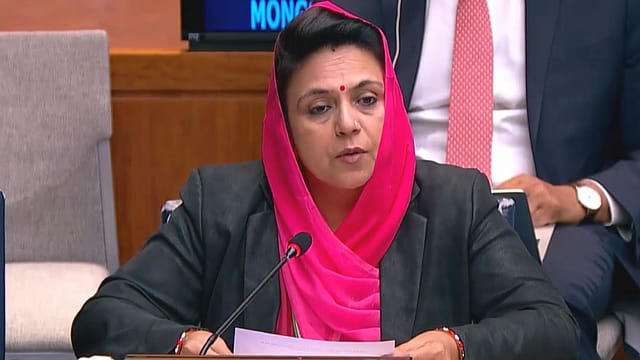
India rejected Pakistan’s remarks on Jammu and Kashmir at the United Nations, asserting that the Union Territory “is, and will always remain, an integral and inalienable part of India”.
Delivering India’s Right of Reply during a discussion on decolonisation in the UN General Assembly’s Fourth Committee, MP Mahima Kumari Mewar accused Islamabad of spreading misinformation and urged it to address alleged human rights violations in territories under its control.
“It is regrettable that Pakistan continues to abuse the UN platform to peddle lies and falsehoods about the Indian Union Territory of Jammu and Kashmir,” Mewar said, according to a statement shared by India’s Permanent Mission to the UN.
INDIA QUESTIONS PAKISTAN’S RIGHTS RECORD
Mewar accused Pakistan of military repression and illegal exploitation of resources in areas India considers illegally occupied by Islamabad.
Zeroing In on ECI
09 Oct 2026 - Vol 05 | Issue 41
Constitutional legitimacy versus political opportunism
“We call upon Pakistan to stop the grave and ongoing human rights violation in the areas illegally occupied by it,” she said, alleging that residents were protesting against military control and demanding basic rights.
She further alleged that Pakistani armed forces and their proxies had killed dozens of civilians in recent months during protests over rights, freedoms and essential services.
Questioning Pakistan’s standing to lecture other countries, Mewar cited its record of military dictatorship, disputed elections, imprisonment of elected leaders and religious extremism. She also accused Islamabad of sponsoring terrorism as an instrument of state policy.
She concluded by reiterating India’s position on Jammu and Kashmir.
SEPARATE CALL FOR ACCOUNTABILITY AT THE UN
In a separate address to the General Assembly’s Sixth Committee, MP Priya Saroj called for stronger cooperation between the UN and member states to investigate and prosecute alleged criminal conduct by UN officials and experts on mission.
“Accountability for criminal conduct is essential to the integrity and credibility of the United Nations,” Saroj said.
She noted that the UN Office of Legal Affairs had referred 93 cases involving 93 officials and experts to their countries of nationality between July 1, 2025, and June 30, 2026, for investigation and possible prosecution.
Saroj urged countries to act promptly on referrals, pursue prosecution where warranted and keep the UN informed of progress. She also called for better coordination across the organisation in reporting, investigating and following up on allegations.
DUE PROCESS AND VICTIM PROTECTION
Saroj emphasised that accountability must be accompanied by due process and respect for the rights of everyone concerned, including protection for victims and witnesses.
She urged member states to consider strengthening jurisdiction over serious crimes committed abroad by their nationals serving with the UN, consistent with their domestic legal systems.
Outlining India’s framework, she referred to provisions in the Bharatiya Nyaya Sanhita, 2023, concerning certain offences committed outside India by Indian nationals, and the Extradition Act, 1962.
Saroj reiterated India’s zero-tolerance approach to criminal conduct by UN personnel and supported sustained contributions to the Secretary-General’s Trust Fund for victims of sexual exploitation and abuse.
With inputs from ANI