Satya Niketan Collapse Sparks Safety Fears: Are Delhi’s Student PGs and Hostels Really Safe?
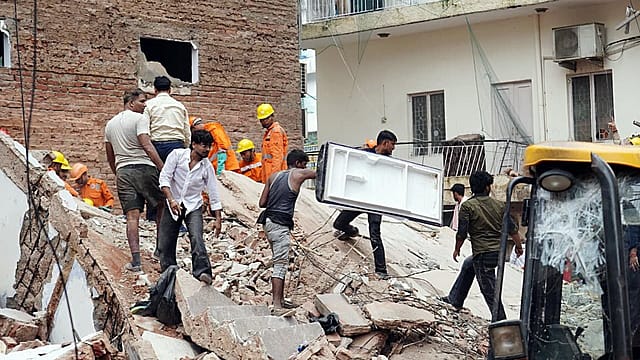
A room within budget. Decent food. Working Wi-Fi. A short commute to college. For students hunting for paying guest accommodation in Delhi, these have long been the essentials. The Satya Niketan building collapse has added a more urgent question: how safe is the roof over their heads?
The collapse of a five-storey building housing a boys’ PG in south Delhi on September 6, which killed seven people, has left students and young professionals across Delhi-NCR examining the places they call home.
Building approvals, damp walls and emergency arrangements have become immediate concerns. But finding safer accommodation is often constrained by the same factor that determined their first choice: the rent.
The Delhi government, meanwhile, is working on a policy to regulate PG accommodation, with proposed requirements covering operating licences, verification, security and rent bands.

Losing Memory
16 Oct 2026 - Vol 05 | Issue 42
The making of a medical and social emergency
A second home, a new fear
For Sneha Mishra, who moved from Deoghar in Jharkhand to a girls’ PG in Sant Nagar, the tragedy has unsettled her sense of belonging.
“When I came to Delhi from Deoghar, this PG became my second home. I eat, study and sleep here, but I never really thought about whether the place I call home is actually safe,” she said.
Now, that uncertainty follows her to bed.
“Earlier, I never thought about the condition of the building. Now, when I go to sleep, there is a question in my mind — what if the building we trust with our lives is not safe?”
The worry also travels home to families who believe their children have found somewhere secure to live.
“Our parents send us here believing we are safe. After Satya Niketan, many of us have started looking at the roof over our heads differently,” Mishra said.
When the budget decides the address
Recognising a problem does not necessarily give residents the means to leave. For students and young professionals on entry-level salaries, better-maintained accommodation can mean rent they cannot afford.
Shilpashree Mondal, who lives in a Noida PG, said financial constraints leave her with limited options.
“I don’t think even a working woman like me has much of a real choice when it comes to choosing where to live. Budget decides most of it, especially in a city like Delhi, where finding a safe and affordable place can be difficult.”
After the collapse, Mondal began looking more closely at her own accommodation. Water supply problems, poor hygiene and damp walls were already worrying her.
“The owner and caretakers often make things look safer and better than they actually are, but you only realise the real problems once you start living there,” she said.
Pallavi Joshi, from Haldwani in Uttarakhand, has lived in a Delhi PG for nearly two years. The collapse has changed her nightly routine, prompting her to examine the building’s design and consider what might happen in an emergency.
“I had never thought about the structure of my PG before. After Satya Niketan, I started noticing how my building is designed and wondering whether there are enough safety measures. Even at night, I sometimes think about what would happen if something went wrong here,” she said.
According to Joshi, neither the owner nor the management approached residents after the incident to discuss their concerns or offer assurances about the building’s safety. She said collecting rent on time often receives more attention than hygiene, safety and emergency preparedness.
Owners ask for documents. Where are theirs?
For Vijaya Roy, a student at Delhi University’s Ramanujan College preparing for the CAT examination, the uncertainty begins with paperwork.
Around 20 to 25 people live in her PG, she said, but residents do not know whether the property has the necessary approvals.
“We don’t even know whether they have permission from the Municipal Corporation of Delhi or not. When we first come to the PG, they demand documents from us, but they don’t show any papers to us,” Roy said.
She wants owners to be required to share documents so tenants can check whether a building has the proper permissions and follows regulations.
Roy also pointed to the shortage of affordable college hostels, which leaves students dependent on private accommodation.
“If adequate hostel facilities are available in colleges, students will have another option. PG owners will not have the same monopoly and may be forced to improve conditions,” she said.
What would Delhi’s proposed PG policy change?
Urban Development Minister Ashish Sood has outlined a proposed framework to strengthen safety, security and rent regulation in PG accommodation. The measures are proposals and have yet to take effect.
Under the framework, operators would need a PG Operating Licence and would have to complete police and municipal verification before running their establishments.
CCTV cameras would be mandatory at entrances and in common areas, with recordings preserved for 30 days. PGs housing 15 or more students would need a licensed night guard between 10 pm and 6 am.
Operators would also have to maintain visitor registers, with non-resident visitors allowed entry between 8 am and 9 pm.
Every PG would need a warden either living on the premises or maintaining an office within a 500-metre radius. In an emergency, the warden would have to be physically available within 15 minutes.
To address concerns over arbitrary and high rents, the framework proposes a Rent Regulation Committee to determine rent bands for different areas. These would take into account occupancy levels, amenities, prevailing market rates and proximity to colleges and public transport.
The draft also envisages an Institutional Accommodation Committee comprising college officials, student representatives, a municipal representative and a police liaison officer.
For residents, the demand begins with something basic: knowing whether the place they pay to live in has the permissions and safeguards it needs. After Satya Niketan, that question follows them all the way to bed.
With inputs from ANI