PM Modi’s 6 goals for India: From 25 years in public service to a 2047 vision
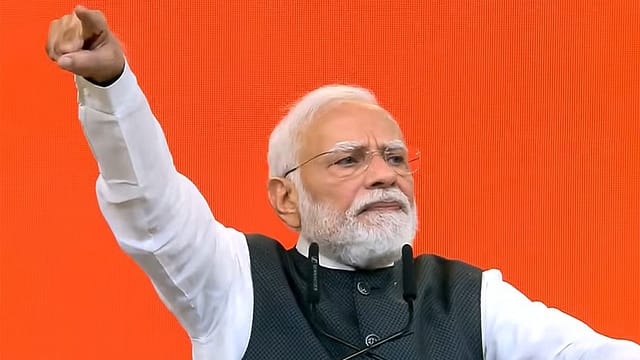
Twenty-five years after Prime Minister Narendra Modi first took oath as Gujarat chief minister, his message on Wednesday was less about looking back and more about what he wants India to achieve next. Addressing the Viksit Bharat Sankalp Sabha at Delhi’s Indira Gandhi Indoor Stadium, Modi repeatedly returned to one phrase: “We will do it.”
He reportedly used the slogan while laying out six ambitions for India’s future: becoming a top-three economy, building a Viksit Bharat by 2047, achieving an Atmanirbhar Bharat, becoming a global manufacturing hub, hosting the Olympics and entering the field of human spaceflight.
So, what exactly are these six goals, and why did Modi put them at the centre of his 25-year milestone speech?
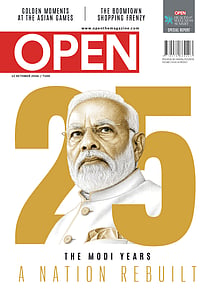
The Modi Years
02 Oct 2026 - Vol 05 | Issue 40
A Nation Rebuilt
What was Modi’s ‘We will do it’ message?
PM Modi said the completion of 25 years in public service should not simply be an occasion for memories or celebration. Instead, he described it as a moment to renew the country's resolve. He invoked his earlier call for “Sabka Prayas”, or collective effort, and argued that the confidence and enthusiasm of Indians could drive the country towards new heights.
His refrain was straightforward: “We will do it.” PM Modi used the phrase while presenting each of his national ambitions.
Goal 1: Can India become one of the world’s top three economies?
The first target is economic scale. PM Modi said India should become a top-three global economy, placing the ambition alongside the broader objective of building a developed India by 2047.
The goal builds on India's rapid economic expansion over recent years, but PM Modi presented it as a milestone that still requires sustained effort, policy and collective participation.
Goal 2: What does ‘Viksit Bharat 2047’ mean?
The larger umbrella goal is Viksit Bharat by 2047: a developed India by the centenary of Independence.
PM Modi linked the ambition to visionary policies, hard work and national confidence. The Prime Minister argued that India's journey towards 2047 would require the country to keep moving forward rather than becoming complacent about its progress.
In other words, 2047 is being presented as a deadline around which several of the other ambitions fit.
Goal 3: Why is PM Modi again stressing an Atmanirbhar Bharat?
The third goal is Atmanirbhar Bharat, or a self-reliant India. The idea is closely tied to reducing dependence on imports in strategically important areas while expanding India's own manufacturing, technology and production capabilities.
It also connects directly with another target PM Modi listed: making India a global manufacturing hub.
Goal 4: Can India become a global manufacturing hub?
PM Modi's fourth ambition is to turn India into a global manufacturing hub. This is about more than producing goods for the domestic market. The broader ambition is for India to become a major base for global production and supply chains.
The Union government's Cabinet resolution marking Modi's 25 years in public service highlighted growth in areas including electronics, defence production and semiconductor manufacturing as part of the country's self-reliance push.
Goal 5: When could India host the Olympics?
Another target stands out because it goes beyond economics and technology: hosting the Olympic Games. India has previously expressed interest in hosting the Olympics, with Mumbai having been proposed as a potential host for the 2036 Games. Modi has repeatedly spoken about the ambition of bringing the Olympics to India.
By including it in his six-point vision, he placed hosting the world's biggest sporting event alongside India's economic, industrial and scientific ambitions.
Goal 6: What does ‘stepping into space’ mean for India?
The sixth goal is perhaps the most futuristic: “Footsteps in space.” PM Modi said India should move further into human spaceflight, building on the country's existing space programme.
India's space ambitions have expanded considerably beyond satellite launches and robotic missions. The government has been developing the Gaganyaan human-spaceflight programme, while Chandrayaan-3's successful lunar landing has added to India's scientific capabilities.
The target, therefore, is not simply reaching space with machines, but taking the next step towards sending Indians into space.
Why did Modi announce these goals on his 25-year milestone?
PM Modi's political journey at the head of a government began on October 7, 2001, when he became Gujarat chief minister. He later became Prime Minister in 2014 and has since won three successive Lok Sabha elections.
Speaking on Wednesday, PM Modi said he viewed the 25-year journey not as a matter of personal glorification but as the result of people's trust and support. He also said those who supported him taught him the power of faith, while those who opposed him taught him the power of democracy.
That explains the emphasis on “we” rather than “I” in his latest message.
The six goals are ambitious and span very different fields: economy, development, self-reliance, manufacturing, sport and space. But PM Modi's central argument was that they share one requirement: sustained national effort.
His answer, repeated throughout the speech, was equally simple: “We will do it.”
(With inputs from agencies)