PM Modi Meets South Korean President Lee: Key Takeaways from Delhi Talks
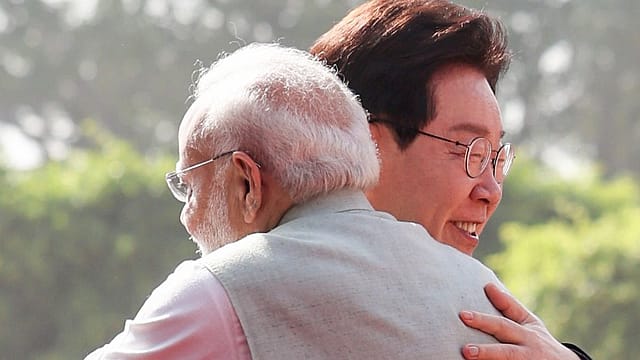
A carefully choreographed blend of symbolism and strategy unfolded in New Delhi as Prime Minister Narendra Modi welcomed Lee Jae-myung for high-stakes talks at Hyderabad House aimed at deepening a rapidly evolving partnership between the two Asian powers. Jae-myung is currently on a three-day state visit to India.
In a gesture underscoring sustainability and shared growth, both leaders were also seen planting a tree, symbolising long-term cooperation.
How did the visit begin with symbolic gestures?
Earlier in the day, President Lee, accompanied by First Lady Kim Hea-kyung, paid tribute to Mahatma Gandhi at Rajghat, where they laid a wreath at the memorial.
The visit followed a ceremonial welcome at the Rashtrapati Bhavan forecourt. President Lee was received by Droupadi Murmu and Prime Minister Modi, with children in traditional attire waving Indian and South Korean flags.
The Ministry of External Affairs described the visit as an “important milestone” in advancing the “Special Strategic Partnership” between India and South Korea.
The Korean leader had arrived in New Delhi on Sunday and was received at the airport by Union Minister of State Harsh Malhotra.
What are the global concerns shaping the talks?
In a written interview ahead of the summit, President Lee flagged geopolitical tensions impacting global energy and trade routes.

Open Minds 2026
26 Jun 2026 - Vol 05 | Issue 26
The power of ideas and arguments in 50 portraits
"Both the Republic of Korea and India depend on the Middle East for a significant share of their energy supplies, including crude oil and natural gas. Accordingly, ensuring the security of critical maritime routes is essential to the safety of our peoples and the very survival of our nations," Lee had said.
How will India and South Korea address energy and supply chain risks?
Lee emphasised joint efforts to secure maritime routes, particularly the strategically vital Strait of Hormuz.
"Korea will maintain close communication with India to ensure that all vessels can navigate the Strait of Hormuz safely and freely," he said. "We will also continue to work together in relevant international forums to uphold this shared commitment,” he added.
He also pointed to collaboration in diversifying energy supply chains amid global uncertainty.
What new areas of cooperation are being explored?
The South Korean President highlighted opportunities to build resilient critical mineral supply chains.
"By moving beyond the traditional model of importing raw material and combining Korea's technology with India's mining and refining industries, we can work together to establish stable critical-mineral supply chains," he said.
Lee also stressed expanding ties in artificial intelligence, defence, shipbuilding, and advanced technologies.
What role did early diplomatic engagements play?
External Affairs Minister S. Jaishankar met President Lee on Sunday ahead of the main talks.
He later said he was “honoured to call on President Lee Jae-myung of the Republic of Korea as he begins his State Visit to India.”
Jaishankar added that he "values his commitment to deepen India-Korea relations across multiple domains," expressing confidence that discussions with Prime Minister Modi would "further strengthen our Special Strategic Partnership".
What is on the agenda for the bilateral summit?
The leaders are expected to discuss cooperation across sectors such as trade, investments, semiconductors, AI, shipbuilding, and emerging technologies, alongside cultural and people-to-people ties.
Following the talks, Prime Minister Modi will host a lunch, while President Lee is also scheduled to meet President Murmu, who will host a state banquet in his honour.
How does this visit build on previous engagements?
This marks the third in-person meeting between Modi and Lee since the latter took office, following earlier interactions during the G20 Summit in Johannesburg and the G7 Summit in Canada in 2025.
The MEA highlighted that India and South Korea share a partnership rooted in “ancient civilisational ties and shared values of democracy and the rule of law.”
(With inputs from ANI)