India-South Korea Relations Get Futuristic Upgrade with New Agreements
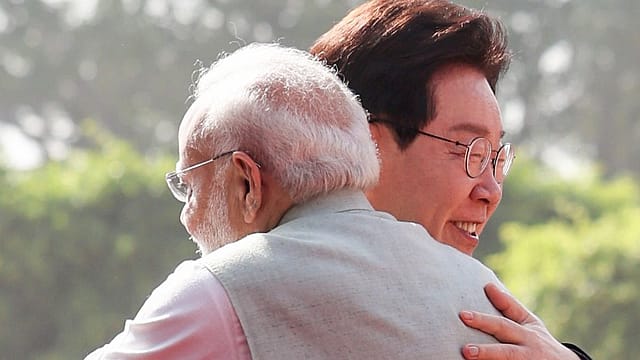
India and South Korea have pushed their strategic ties into a new phase, with Prime Minister Narendra Modi and President Lee Jae-myung unveiling an ambitious roadmap that blends trade, technology, and geopolitical alignment.
What makes this visit significant?
Prime Minister Modi on Monday welcomed President Lee Jae-myung on his maiden state visit to India, framing it as a defining moment in bilateral ties. The two leaders oversaw the exchange of multiple MoUs at Hyderabad House, signalling a deeper and more structured engagement across sectors.
Addressing mediapersons after the exchange of agreements, PM Modi said, "I am delighted to welcome President Lee on his first visit to India. President Lee's life is an inspiring example of struggle, service, and dedication. Every challenge has only strengthened his resolve to serve the people. Although this is his first visit to India, his affinity for India has been evident since our very first meeting."
How are shared values shaping the partnership?
The Prime Minister underscored that democratic ideals and economic alignment form the backbone of the relationship. "This visit of the President of Korea to India is extremely important. Democratic values, market economy, and respect for the rule of law are in the DNA of both our countries. We also have a common outlook in the Indo-Pacific region," he said.
Why is this being called a ‘futuristic partnership’?
Modi highlighted that the relationship is evolving beyond traditional cooperation into future-focused sectors.
"Based on all this, our relations have become more dynamic and comprehensive over the last decade, and today, with President Lee's visit, we are going to transform this trusted partnership into a futuristic partnership. We will realise new opportunities for cooperation in every field, from chips to ships, talent to technology, environment to energy, and together ensure the progress and prosperity of both countries," he remarked.

Exclusive: To the Heavens and Back
19 Jun 2026 - Vol 04 | Issue 76
Shubhanshu Shukla relives the space odyssey that put India into orbit
What are the key economic targets?
A major highlight of the visit was the push to nearly double bilateral trade.
"Today, bilateral trade between India and Korea has reached $27 billion. Today, we have taken several important decisions to increase this to $50 billion by 2030," PM Modi noted.
What new mechanisms have been introduced?
To support this ambitious target, both sides unveiled new institutional frameworks aimed at easing business and financial flows.
"To facilitate financial flows between the two countries, we have launched the India-Korea Financial Forum. To strengthen business cooperation, we have formed an Industrial Cooperation Committee," he added.
How will technology and industry ties deepen?
The leaders also focused on supply chains, critical technologies, and industrial expansion.
"To increase cooperation in critical technology and supply chains, we are starting the Economic Security Dialogue. To facilitate the entry of Korean companies, especially SMEs, into India, we will also establish Korean Industrial Townships and within the next one year, we will also upgrade the India-Korea Trade Agreement," PM Modi stated.
(With inputs from ANI)