India-Sri Lanka ties deepen: What VP Radhakrishnan’s visit means
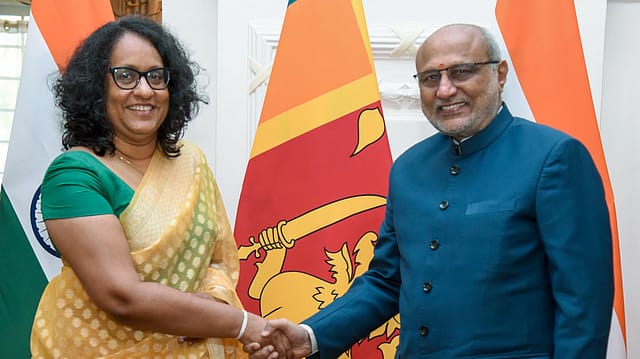
India’s relationship with Sri Lanka is being framed not just in strategic or economic terms, but as a long-standing cultural and historical partnership.
During talks between Vice President C. P. Radhakrishnan and Sri Lankan President Anura Kumara Dissanayake, both sides emphasised shared heritage as the foundation for future cooperation.
Foreign Secretary Vikram Misri highlighted this sentiment, saying, "The (Sri Lankan) President underlined the very strong civilizational bond between the two countries."
This framing helps position the partnership as deeper than transactional diplomacy, especially at a time of regional instability.
How has India positioned itself as Sri Lanka’s “first responder”?
India’s role in Sri Lanka’s recent crises has become central to the relationship.
President Dissanayake acknowledged India’s support across multiple emergencies, including the 2022 economic collapse and the aftermath of Cyclone Ditwah in 2025.
Misri said, "He referred on more than one occasion to the difference that Prime Minister Narendra Modi's Neighbourhood First policy has made in strengthening relations between India and Sri Lanka, especially by way of India's first responder role, first during the economic crisis faced by Sri Lanka in 2022 and then more recently after Cyclone Ditwah in December of 2025, and also referred to the assistance that India is providing at this moment as Sri Lanka deals with the fallout of the West Asia crisis."

Open Minds 2026
26 Jun 2026 - Vol 05 | Issue 26
The power of ideas and arguments in 50 portraits
This “first responder” positioning strengthens India’s strategic credibility in the neighbourhood.
Why is energy cooperation at the centre of talks?
A major focus of the discussions was turning Sri Lanka into a regional energy hub with Indian support.
The proposed development of the Trincomalee energy hub and a cross-border oil pipeline reflects a shift toward long-term infrastructure integration.
Misri explained, "The President also referred in this context to India's investments in various sectors in Sri Lanka, especially ports, and also the discussions that are now underway on several projects in the energy sector, in the digital sector, and in the connectivity area."
He further added, "The Vice President mentioned, as I said, some initiatives that are underway from the Indian side and some proposals that have already been discussed between the two countries. Notably, the project related to the energy hub in Trincomalee and the proposal to link India and Sri Lanka through an oil pipeline. And in fact, the point was made as to the value of such energy connectivity, especially at a time like now, when the entire world and this region, especially, is facing the fallout of an energy crisis generated by the situation in West Asia."
This signals a broader ambition: integrating Sri Lanka into India’s regional energy strategy.
What role does connectivity play in the partnership?
Beyond energy, both sides are exploring stronger digital and physical connectivity.
These include: Infrastructure links, Digital cooperation and Maritime and port investments
The goal is to transform proximity into seamless economic integration, making Sri Lanka a key node in India’s regional network.
How are humanitarian issues like fishermen disputes being handled?
The talks also addressed sensitive bilateral issues, particularly the long-standing fishermen dispute in the Palk Strait.
India welcomed the release of detained fishermen, with Misri stating, "Vice President (CP Radhakrishnan) also took the opportunity to express his appreciation to President Dissanayake and the Sri Lankan government for the recent release of several Indian fishermen who were in Sri Lankan custody. I believe a total of 47 fishermen have been released in recent weeks, some of them very, very recently, and who are expected to be repatriated to India in the next day or two."
Both sides agreed on the need for sustained engagement.
Misri added, "The Vice President also referred to the need to remain in constant communication and contact on this issue. President Dissanayake also mentioned on this subject that there was a need for India and Sri Lanka to work together to address the fishermen-related issue, something that the Vice President welcomed and once again underlined the need for more frequent contact between the concerned authorities of the two countries on this issue, for the joint working group on this subject to meet, as well as for engagement between the fishermen's associations on the two sides."
This reflects a shift toward collaborative conflict management rather than reactive diplomacy.
What does this mean for the future of India–Sri Lanka ties?
The emerging picture is of a relationship moving toward deeper strategic integration.
Energy projects like the Trincomalee hub and the proposed pipeline are not just economic initiatives, they are long-term geopolitical bets.
Combined with crisis support, connectivity plans, and cultural framing, they point to a future where India and Sri Lanka are more tightly linked than ever before.
(With inputs from ANI)