Not making carbon tax a sticking point with EU is smart diplomacy
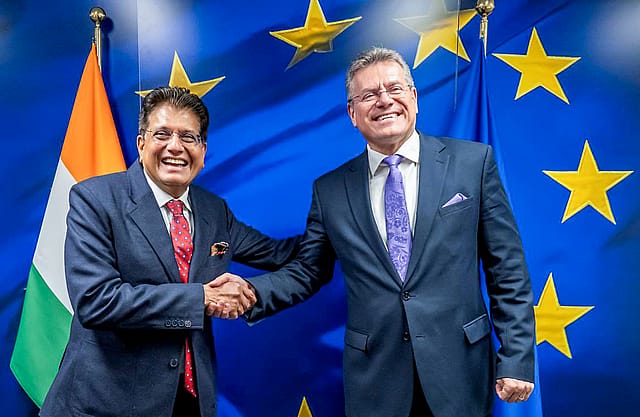
As Indian and European Union negotiators work urgently to seal a tread deal by January 26, the hurdle posed by EU’s carbon border adjustment mechanism (CBAM) or “carbon tax” appears to be well worth overcoming in the larger interests of a pact that eases commerce between the two large geographies even if requires offering a concession or two.
Commerce minister Piyush Goyal has heightened expectations by describing the like FTA as the “mother of all deals” and said India and EU are offering one another a “super deal” while holding that India’s “national interests” will not be affected. The carbon tax that came into effect on January 1, 2026, imposes a levy on embedded carbon in imports that, according to some studies, amount to around 10% of India’s exports such as iron and steel but could, it is speculated, apply to more products.
The carbon tax is replacing the earlier system of free industrial emission permits and is, from an Indian perspective an unfair non-tariff barrier that reduces the competitiveness of its exports. The EU rules are a fine example of “green bureaucracy” that the bloc seems to specialise in and presents a technical and regulatory maze of Indian industry while European businesses do not seem very enthused either.
The challenge lies in getting EU to reduce the levies – they cannot be sidestepped given the power of green lobbies in Europe – and improve processes in Indian industry particularly the MSME sector. The knotty issue is just one that can drag on but it is not in India’s interests to let it become a deal breaker. There is a powerful political momentum behind by the talks with Prime Minister Narendra Modi and EU leaders Antonio Luis Santo da Costa and Ursula von der Leyen pushing to close the deal. Leyen and da Costa will be chief guests at the Republic Day parade during their January 25-27 state visit.
The Abandoned Kejriwal
01 May 2026 - Vol 04 | Issue 69
Brain drain from AAP leaves Arvind Kejriwal politically isolated
The conclusion of the FTA may well require India to make some carbon commitments and absorb some of the levy. The 2025 India-United Kingdom FTA too does not include CBAM but India retains the right to respond if the carbon regime hurts India’s trade. As with UK, India’s concerns on dairy, agriculture and GM food have been respected and these no-go areas protect the Modi government’s political interests too. Yet, as in the UK case, there are significant benefits to EU nations by increased access to Indian markets for wines, spirits, automobile, precision engineering, chemicals and services. Similarly Indian pharma, leather and textiles should be benefitted as also the mobility of skilled Indian professionals.
Doing the deal, while important on its own accord, is needed from the Indian perspective at a time when the bilateral trade deal with the United States does not seem to be going anywhere. The new US ambassador to India Sergio Gor, a close ally of President Donald Trump, has said while both sides are committed to concluding the BTA it is not an easy task to get it across the finish line. He has said that there are several areas where the India-US relationship can be pursued such as security, counter-terrorism, energy, technology, education and health. He seemed to be working in these lines during a visit to Mumbai where he met chief minister Devendra Fadnavis, Reserve Bank of India governor Sanjay Malhotra, Reliance Industries chairman Mukesh Ambani and Tata Group chairman N Chandrasekaran.
India has signed FTAs with Australia, UAE, UK, New Zealand, Oman, European Free Trade Association (EFTA) and Mauritius. The one with the EU will no doubt be the biggest so far and very significant breakthrough for India’s trade diplomacy. EU rules and political emphasis on health, ethics, sanitation, climate and human rights can all add up to serious barriers in any trade negotiations.
The distress and alarm over Trump’s weaponisation of tariffs – his bid to use this to cow down opposition to his plans to take over Greenland are the latest example – has shaken EU nations. With Trump dismantling the trust that was the bedrock of America’s relations with even close allies, there is a sense of urgency amongst EU leaders to put in place stable and reliable trade and security mechanisms. India has defied pessimistic forecasts about the impact of tariffs by taking several reform and deregulatory decisions to keep the domestic consumer mood upbeat and attract the attention of investors. A deal with EU will be a big step in promoting India’s credentials as a rule-based democracy.
The India-EU trade talks were initiated in 2007 but went into a prolonged lull in 2013 and were revived in June, 2022. In a brief video of a brush past meeting between Leyen and Modi in 2025 the Prime Minister can be heard saying “I have confidence in you” as the two leaders shake hands. It is evident that the moment of a mega India-EU trade deal may have arrived, perhaps sooner than expected.