INS Kaundinya: Recreating India’s Ancient Maritime Past at Sea
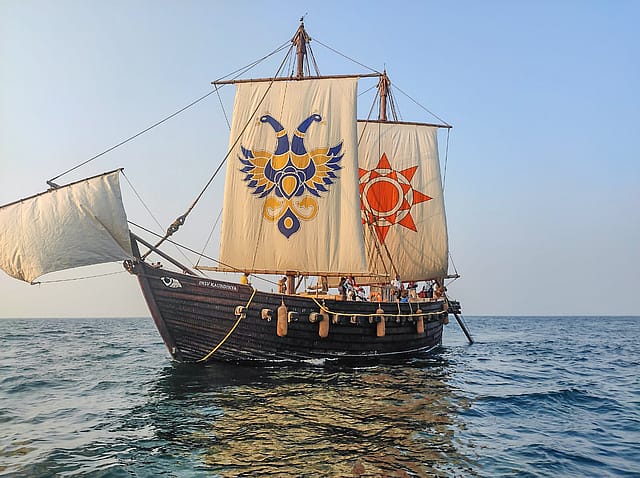
A fortnight after embarking on her maiden overseas voyage from Porbandar, Gujarat, the Indian Navy’s sailing vessel INS Kaundinya has entered Omani waters, marking a rare and symbolic journey that reconnects India with its ancient maritime heritage. Here’s what you need to know.
What is INS Kaundinya?
INS Kaundinya is a unique Indian Navy sailing vessel built without an engine and constructed using a 2,000-year-old stitching technique once common in ancient Indian shipbuilding.
The ship is based on a 5th-century CE vessel depicted in the Ajanta cave paintings, making it both a functional craft and a floating historical reconstruction.

Rise of the Pivotal Power
18 Sep 2026 - Vol 05 | Issue 38
The BRICS declaration is a strategic victory for Modi
What is the mission?
The voyage aims to recreate the ancient maritime trade route that once connected India with West Asia and beyond. The ship set sail from Porbandar on December 29, 2025, bound for Muscat, Oman, following pathways used by Indian traders centuries ago.
Economist and Prime Minister’s Economic Advisory Council member Sanjeev Sanyal, who is on board the vessel, said on Monday that Kaundinya is “well inside Omani waters, north of Sur.”
Who is sailing the ship?
The vessel is skippered by Commander Vikas Sheoran, leading a 16-member crew. Kaundinya is expected to reach Muscat around January 15, completing her first international voyage.
Why is this voyage significant?
Unlike modern naval missions, this journey is as much cultural and historical as it is nautical. The project seeks to demonstrate India’s deep-rooted traditions in maritime navigation, trade, and shipbuilding - long before the age of steam and steel.
The voyage also serves as a live experiment, testing how ancient shipbuilding techniques perform in contemporary sea conditions.
How was INS Kaundinya built?
The idea for the project originated with Sanjeev Sanyal, inspired by a painting in the Ajanta caves.
In July 2023, a tripartite agreement was signed between the Ministry of Culture, the Indian Navy, and Hodi Innovations, a Goa-based private boat builder, with funding from the Ministry of Culture.
After the keel was laid in September 2023, construction began using traditional stitching methods. A team of skilled artisans from Kerala - led by master shipwright Babu Sankaran - painstakingly stitched together wooden planks using coir rope, coconut fibre, and natural resin, replicating techniques used more than two millennia ago.
The ship was finally launched in February 2025 at Goa.
What makes the ship visually distinctive?
Every design element on Kaundinya reflects ancient Indian maritime symbolism. While sails feature motifs of the Gandabherunda and the Sun, the bow carries a sculpted Simha Yali. A Harappan-style stone anchor rests on the deck. Together, these details evoke India’s long and layered seafaring tradition
Why is the ship named Kaundinya?
The vessel is named after Kaundinya, a legendary first-century Indian mariner who sailed across the Indian Ocean to the Mekong Delta, where he married a Cambodian princess. His story symbolises early Indian maritime exploration and cultural exchange across Southeast Asia
What does this voyage represent?
INS Kaundinya is much more than a naval mission - it is a floating reminder of India’s civilisational reach: of trade winds, stitched hulls, and cultural exchange that once linked India to the wider world, long before modern borders and engines existed.
Why does this voyage matter for India?
The voyage reinforces India’s civilisational links with West Asia and Southeast Asia beyond modern diplomacy, reasserting its Indian Ocean presence when maritime influence matters most. Ports like Muscat become touchpoints for shared history, not just trade or security.
By blending archaeology, craftsmanship and naval expertise, India positions heritage as a geopolitical asset.