IndiGo Fiasco: Of Monopoly, Duopoly and Oligopoly
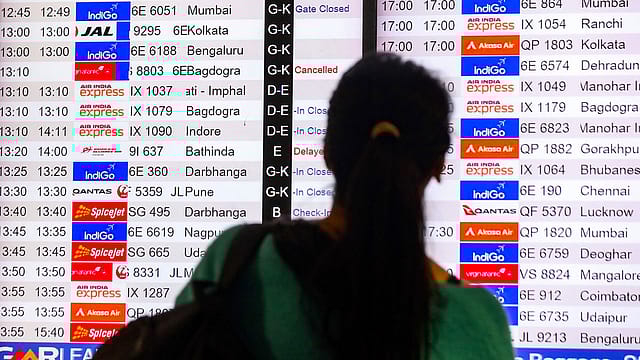
Whether it’s an act of defiance or genuine lapse will soon be revealed by the DGCA probe panel. But it’s a fact that over 2.6 lakh IndiGo passengers were stranded at various airports across the country between December 2-11 when this low-cost carrier cumulatively cancelled 4,290 flights without any explanation.
The hapless passengers in general and Modi haters in particular pinned the blame on the government. They asked: Was the regulator DGCA asleep at the wheel? Was the government encouraging duopoly to help IndiGo increase its market share? And where was the Competition Commission of India?
But if you look at things that touch our everyday lives, you will be surprised to note that our entire economy is thriving on duopolies and oligopolies.
Let’s start with the mobile phone; this sector is dominated by three private sector players Airtel, Jio and Vi. The government-run BSNL is a fringe player. The sector was thrown open to the private sector in 1994. Nearly a dozen companies like Bharati (Airtel), Sterling Cellular, Hutchinson Max (Vi), BPL Mobile, Modi Telstra, RPG Cellular, Skycell, Tata Cellular, Aircel and Spice entered the ring.
The whole business model was based on ARPU or average revenue per user. And the cost of the call per minute those days – incoming and outgoing – was Rs 16.80 per minute during peak hours and Rs 8.40 during non-peak hours. And all mobile players, going by their ad campaign, only targeted the affluent class.
The MissOil Strike
03 Apr 2026 - Vol 04 | Issue 65
The War on Energy Security
The legendary Dhirubhai Ambani, who had already disrupted the textile market with polyester or chamak, felt that mobile phone calls should be cheaper than the price of a postcard – Re 1. This move did not happen overnight. But it became the guiding principle to transform the country’s telecom sector leading to the digital revolution.
It was a paradox, the sector was a money guzzler (spectrum auctions, setting up towers, customer acquisitions etc) but consumers were price-sensitive. Result: many players logged out or were acquired by leading players like Airtel, Hutch/Vodafone, Idea etc. Today, this market is dominated by Jio with 41% market share, Airtel 34%, Vi 18% and BSNL 8%.
Clearly, the telecom sector’s shakeout and consolidation were not the government’s doing. It was market forces at play. The likes of Airtel survived and thrived because they were deep-pocketed, and had a robust business strategy that won them millions of customers. In other words, in spite of the best intentions of the government to broad base the market, the market forces drove the sector toward oligopoly.
Let’s turn to fuel. Historically, petrol and diesel in India are mainly sold through oil marketing PSUs -- IndianOil, BPCL and HPCL. All the three put together control 90%-plus market share. The private players – Jio-BP, Nayara Energy (Essar earlier) or Shell India have token presence. Reason: even though fuel is officially decontrolled, the government of the day can influence its pricing during elections. This is another example of oligopoly at full play.
Likewise, if you look at the platform companies -- E Commerce (Amazon, Flipkart), Ride-hailing Cabs (Uber, Ola), Food Delivery (Zomato, Swiggy) -- used by most of us on an everyday basis then it's either duopoly or oligopoly at play.
Then why this kolaveri over duopoly in the aviation sector?
To understand that we need to rewind a bit. Once upon a time, the country’s aviation sector was dominated by the government-owned entities Air India (foreign travel) and Indian Airlines (domestic). The private sector entered the scene post 1991 liberalisation. Surprise, surprise, most of them were grounded within three-four years of operations. They were: East-West Airlines (1992-96), Damania Airways (1993-97), ModiLuft (1993-96, later SpiceJet), NEPC Airlines and Archana Airways.
In 2000, some fairly big players entered the sky. Soon they too hit air pockets and had to be grounded within 5-7 years of their operations. They were: Air Sahara (1993-2007), JetLite (formerly Air Sahara: 2007-19), Kingfisher (2005-12), Air Deccan (2003-08 acquired by Kingfisher), Go Air (2005-23) and Jet Airways (1993-2019).
Since the 1990s the country has seen the collapse of over 25 private airlines due to financial insolvency.
Globally too, the scene is no different. This is why the legendary investment guru Warren Buffett has an aversion to investing in the aviation sector. Time and again, he has reiterated that the airline industry was a "death trap" for investors, as it was capital intensive and produced little-to-no profit for its owners.
To cut to the chase, IndiGo, the brainchild of Rahul Bhatia and Rakesh Gangwal, entered the scene in 2005, during the UPA 1 regime and became operational in 2006. In 19 years of its operations, it faced stiff competition from Air Sahara, Kingfisher, Air Deccan, Go Air, and Jet Airways. All of them went belly up as explained by Buffett.
Here, IndiGo, more than survived largely because of its business model – aircraft acquisition strategy, affordable fares, no frills, on-time arrivals (before time too) to mention a few. Like Jet, Kingfisher, it too redefined the airline industry. Today, it is the longest surviving airline company after Air India.
Duopoly happened because of disruption not because of political patronage. Political patronage may help you get a license, get concessions, tax breaks or even keep the competition at bay. But to win millions of passengers' hearts you need to give them a good experience 24X7, 365 days of the year.
That’s what IndiGo did -- consistent performance for decades. This helped them shore up their market share to 65%. This huge market share did not fall into their lap overnight. It was a gradual ascent.
Also, when people talk of duopoly one has not seen its staffers – airhostess, ground staff -- behaving rudely or arrogantly. Not many stories in the media about it. Sure, there may be a stray incident here and there.
In fact, more than an advertising campaign, the word-of-mouth publicity about its on-time performance has given them a big boost.
The devil needs to be given its due.
Sure, the December 2-11 fiasco was unprecedented. The airline which has been painstakingly built to this size – 2200 services every day to 138 destinations via 400 plus Airbus -- may perhaps take a beating in the short run, if lakhs of hassled and harassed passengers turn out to be their bad brand ambassadors. But one thing is loud and clear, the government will ensure that such fiasco is not repeated.