India's sustainability movement must begin with everyday choices, say experts
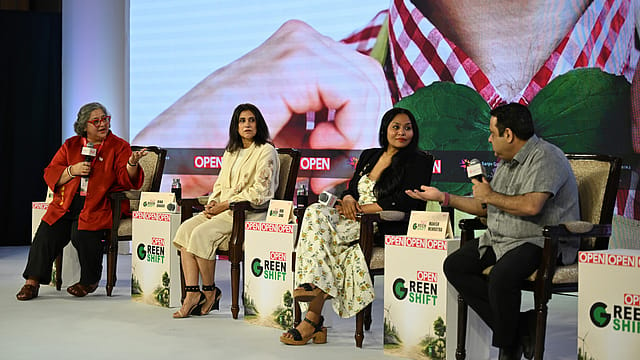
India's transition towards a circular economy will depend as much on individual choices as on government policy, with sustainability becoming a part of everyday decisions rather than remaining confined to climate targets and corporate commitments, speakers said during a panel discussion at OPEN Green Shift.
The discussion, titled Making the Conscious Choice: The New Cool of Circular Economy, brought together fashion designer Rina Dhaka, conservation biologist and author Neha Sinha, and chef and restaurateur Manish Mehrotra. While they represented three different professions, all argued that sustainability ultimately comes down to the choices people make every day—as consumers, creators and citizens.
For Mehrotra, the circular economy begins in the kitchen.
Rejecting the idea that sustainability is driven only by large policy interventions, he said households and restaurants can significantly reduce their environmental footprint through simple practices such as cooking seasonally, planning menus carefully and minimising food waste.

The Vanguard
21 Aug 2026 - Vol 05 | Issue 34
BJP Rearmed for 2029
"There is no restaurant in India which is farm to fork in a genuine manner," he said, adding that restaurants should focus instead on using ingredients efficiently, reducing waste and serving shorter, seasonal menus.
Dhaka argued that fashion, too, has long practised circularity, even before terms such as recycling and upcycling became mainstream.
Recalling her early years in design, she said leftover fabric, sequins and textile scraps were routinely repurposed into new garments—not as sustainability initiatives but as practical solutions that eventually evolved into distinctive design elements.
She also challenged the culture of disposable fashion, encouraging consumers to wear clothes repeatedly and rethink the belief that every occasion requires a new outfit.
"Our mothers and grandmothers recycled naturally," she said, pointing to how old sarees were transformed into quilts, cushions and household items long before circular economy became part of public discourse.
Sinha widened the conversation beyond products to the natural world, arguing that conscious consumption should also account for wildlife and biodiversity.
She cited examples of tigers moving through cotton fields in central India and elephants feeding in banana plantations, saying consumers should increasingly have access to information about whether the products they buy have been produced in ways that protect wildlife.
"I believe the consumer has a right to know what kind of cotton she is wearing and whether it is wildlife-friendly," she said, adding that informed purchasing decisions can create incentives for farmers and producers to conserve biodiversity while improving livelihoods.
The discussion also explored how cities can remain environmentally resilient despite rapid urbanisation.
Sinha highlighted Delhi's rich biodiversity, noting that the capital is home to more than 400 bird species despite being one of the world's largest cities. Protecting native tree species, she said, is essential not only for wildlife but also for improving the quality of urban life.
Across fashion, food and conservation, the panel converged on a common conclusion: building a circular economy is not only about new technologies or regulations but also about reviving habits that earlier generations practised instinctively—from reusing clothing and cooking seasonally to reducing waste and living more closely with nature.
As sustainability becomes part of everyday life, the speakers argued, the most meaningful climate action may begin not with sweeping policy announcements but with millions of conscious choices made by individuals every day.