Beyond the LAC: Why India and China Are Talking About Drawing the Border, Not Just Managing It
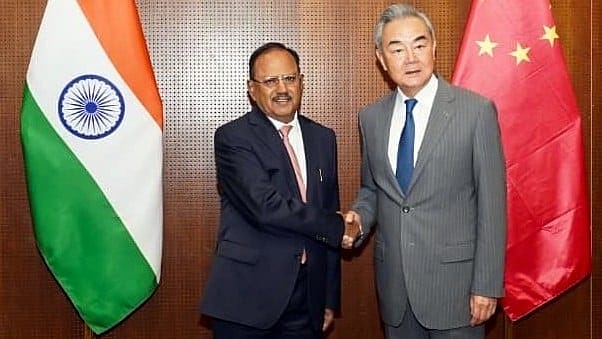
For years, India and China have been talking about how to keep the peace along their disputed Himalayan frontier.
This week in Beijing, they talked about something bigger.
At the 25th meeting of the Special Representatives on the India-China Boundary Question, National Security Adviser Ajit Doval and Chinese Foreign Minister Wang Yi discussed ways to advance boundary delimitation—the painstaking process of defining where the border should actually lie. Both sides also reviewed bilateral ties and reaffirmed the need to maintain peace and stability along the border.
That may sound like diplomatic jargon. But it signals a subtle shift in the conversation between Asia's two largest powers.
Here's what happened—and why it matters.
What happened in Beijing?
India's National Security Adviser Ajit Doval and Chinese Foreign Minister Wang Yi met in Beijing for the 25th round of talks under the Special Representatives (SR) mechanism, the highest-level political channel dedicated to resolving the boundary dispute.

Zeroing In on ECI
09 Oct 2026 - Vol 05 | Issue 41
Constitutional legitimacy versus political opportunism
According to the Indian Embassy in China, the two sides reviewed the recent improvement in bilateral ties, discussed ways to expand cooperation and focused on maintaining peace and tranquility in border areas. They also discussed advancing work related to boundary delimitation.
The next round of talks is expected to be held in India in 2027.
What is 'boundary delimitation' and why is everyone talking about it?
Think of it as moving from managing a disagreement to trying to define it.
For decades, India and China have largely focused on preventing tensions from escalating along their roughly 3,800-kilometre disputed frontier. Agreements signed in 1993, 1996 and later years were primarily aimed at maintaining peace while the larger dispute remained unresolved.
Boundary delimitation is a more ambitious step. It involves identifying and agreeing on where the boundary should run on maps before it can eventually be demarcated on the ground.
In simple terms, it is the difference between managing the border and settling it.
Why is this meeting significant?
Because the conversation appears to be moving beyond crisis management.
Since the deadly Galwan Valley clash in 2020, India-China ties have largely revolved around disengagement, military talks and restoring stability along the Line of Actual Control (LAC). Relations only began improving after the October 2024 disengagement agreement ended a prolonged military standoff.
The latest talks suggest both sides are at least willing to discuss the next phase: how to address the underlying boundary question itself.
That does not mean a solution is around the corner. The dispute has survived wars, crises and decades of negotiations.
But it does mean the conversation is no longer limited to preventing the next confrontation.
Is India changing its position?
No.
If anything, India reiterated a position it has repeatedly articulated since the 2020 border crisis: peace at the border is the foundation for normal relations.
According to reports, Doval told Wang Yi that the normalization of India-China ties is closely linked to maintaining peace and stability in border areas.
In other words, economic cooperation, political engagement and diplomatic warmth can advance only if the border remains calm.
That has become one of New Delhi's central messages in its dealings with Beijing.
Does this mean the border dispute could be resolved soon?
Probably not.
The India-China boundary dispute is one of the most complex territorial disagreements in the world, involving competing historical claims, differing perceptions of the LAC and politically sensitive regions across the western, middle and eastern sectors.
Even previous breakthroughs have taken years to negotiate. The Special Representatives mechanism itself was established in 2003 specifically to explore a political framework for settlement.
What the Beijing talks indicate is not an imminent solution, but a willingness to keep searching for one.
China's official readout described the goal as a "fair, reasonable and mutually acceptable settlement" of the boundary question.
Why now?
Timing matters.
The talks come amid a broader thaw in India-China relations following the easing of border tensions and ahead of a possible visit by Chinese President Xi Jinping to India for the BRICS Summit next month.
Diplomats on both sides appear keen to prevent the border issue from overwhelming every other aspect of the relationship.
That does not mean differences have disappeared.
It means both capitals may see value in creating enough stability to discuss them.
What is the bigger takeaway?
For the past few years, India and China have been talking about how to avoid conflict.
In Beijing this week, they also talked about how to eventually resolve its cause.
That is a much harder conversation.
And perhaps a more consequential one.
Because after years dominated by troop pullbacks, patrol confrontations and military stand-offs, the most important phrase to emerge from the latest talks may not have been "peace and stability."
It was boundary delimitation.
For two countries that have spent decades managing an unfinished border, that is a reminder that the border itself is back on the table.