How Delhi Is Tackling Rising Temperatures With a New Heat Strategy
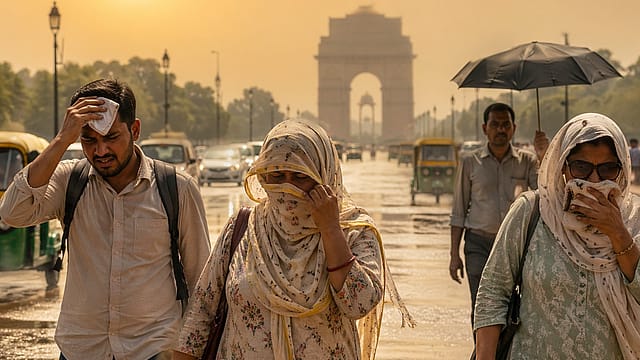
With temperatures rising sharply, the Delhi government has moved to strictly enforce its Heat Wave Action Plan 2026. Chief Minister Rekha Gupta highlighted a troubling pattern, noting that the city has experienced temperatures above 40°C for nearly 40 consecutive days in recent years.
She underscored the seriousness of the situation, pointing to a data-driven approach this year that uses satellite mapping to identify high-risk heat zones across the capital.
Which areas in Delhi are most vulnerable to extreme heat?
The government’s scientific assessment has flagged several hotspots. Ayanagar in South Delhi remains among the most extreme, having recorded 45.5°C in the past. Najafgarh and Safdarjung have also seen dangerously high temperatures, touching 43.7°C and 46.8°C respectively in recent years.
Newer thermal hotspots have emerged in Wazirpur, Jahangirpuri, Khayala, Shastri Park, Vishwas Nagar, Harkesh Nagar, Hari Nagar and Delhi Gate.

The Modi Years
02 Oct 2026 - Vol 05 | Issue 40
A Nation Rebuilt
Meanwhile, densely populated fringe areas such as Sawda, Mubarakpur Dabas, Bhalswa, Nand Nagri, Gokulpuri and Bakkarwala are witnessing intensified “heat island” effects, where built-up environments trap heat.
What measures are being taken in high-risk zones?
To mitigate risks, the government has rolled out targeted interventions in vulnerable areas. These include boosting ORS availability at health centres, deploying Quick Response Teams, and increasing the number of water tankers.
The plan also extends beyond human needs. The Chief Minister directed departments to ensure water and shade for animals and birds, with water containers being installed across parks, bus depots and schools.
How will school children and workers be protected?
Special precautions are being introduced for school children, who may be given ORS solutions before leaving school to prevent dehydration during their commute.
For construction workers, stricter rules are being enforced during peak heat hours. Outdoor work may be halted between 12 noon and 3 pm during severe conditions. Workers will be provided with drinking water, caps and gamchas, along with first-aid kits and ice packs at worksites.
What infrastructure changes are being introduced to reduce heat?
Delhi is pushing forward with its ‘Cool Roof Policy 2026’ to reduce indoor temperatures. Reflective coatings have already been applied over nearly 28,674 sq ft at the Kashmere Gate ISBT.
Additional cooling measures include installing high-pressure misting systems at bus stops and using anti-smog guns to cool densely built-up areas.
How prepared is the healthcare system?
The Health Department has placed more than 339 health centres on alert across 13 districts. Over 30 hospitals have established dedicated five-bed “cool rooms” for heatwave patients.
Residents can access emergency help through helpline numbers 1077, 1070 and 112. Additionally, 39 Quick Response Teams and ASHA workers are on standby, while cold drinking water and ORS will be made available at crowded public locations.
Will Delhi face power shortages during peak summer?
The government is anticipating record electricity demand this summer. Chief Minister Gupta said, “It is estimated that Delhi's peak power demand will exceed the 9,000 MW mark this season, a figure significantly higher than last year's maximum demand of 8,442 MW.”
She added a firm warning to power companies: “We have issued strict directives to the power distribution companies, making it clear that any cuts in supply will not be tolerated.”
To ensure uninterrupted supply, a priority protocol has been implemented for critical services like hospitals, water treatment plants and mobile towers.
Power companies have also been instructed to keep additional Quick Response Teams and mobile transformers ready to address faults swiftly.
(With inputs from ANI)