Hindi Diwas 2026: Amit Shah says Hindi connects India’s languages, helped him work across the country
If India’s languages were a railway map, Amit Shah’s message on Hindi Diwas was simple: every route matters, but some tracks help connect the network.
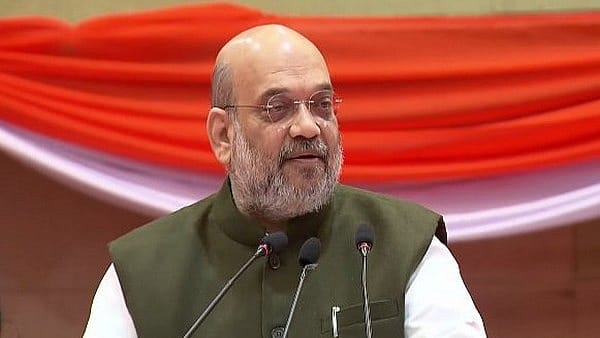
Addressing the Sixth All India Official Language Conference in Navi Mumbai on Monday, the Union Home Minister described Hindi as a language that links India’s diverse linguistic communities, saying it helped him work at a national level despite growing up in a Gujarati-speaking environment. The conference, attended by thousands of officials, scholars and language experts from across the country, was organised as part of Hindi Diwas 2026 celebrations.
Amit Shah says Hindi became his bridge to national public life
Sharing a personal example, Shah said Hindi gave him opportunities that extended far beyond his home state.
“The official language Hindi is connected to all the languages across the country. I come from Gujarat, where Gujarati is spoken, but due to Hindi, I have never faced any difficulty in working at the national level. The official language has given me a tremendous opportunity to work across the country,” he said.
Zeroing In on ECI
09 Oct 2026 - Vol 05 | Issue 41
Constitutional legitimacy versus political opportunism
The remark formed the centrepiece of his Hindi Diwas address, which focused on the role of Hindi as a link language rather than as a competitor to regional languages. Similar themes have featured in previous government statements on language policy, where Hindi has been described as complementary to other Indian languages.
Mother tongue remains the first classroom, says Home Minister
While speaking about Hindi, Shah repeatedly returned to another theme: the importance of learning in one’s mother tongue.
Referring to the National Education Policy, he said primary education in the mother tongue is essential because language is deeply tied to culture, values and identity.
“No one can understand a mother's affection and the love of siblings except through one's mother tongue. The values of one's land, one's language, one's religion, traditions, and culture can only be imbibed through the medium of the mother tongue,” Shah said.
He added that thinking, analysing and creating in one’s native language often produces stronger outcomes, arguing that linguistic roots and educational success are closely linked.
Maharashtra becomes the backdrop for a larger language conversation
Speaking in Maharashtra, Shah also highlighted the state’s multilingual character. He noted that Marathi enjoys deep respect in the state while coexisting with several other languages, including Hindi, Gujarati, Konkani, Sindhi and Kannada.
Referring to the Centre’s decision to grant Marathi classical language status, he credited Prime Minister Narendra Modi’s government for recognising the language’s historical and literary significance.
The comments came at a conference whose stated objective is to strengthen coordination between Hindi and other Indian languages while exploring their use in technology, translation, governance and education.
Modi’s use of Indian languages on global platforms comes into focus
Shah also pointed to Prime Minister Narendra Modi’s practice of addressing international forums in Indian languages instead of English.
“Whenever Modi-ji travelled anywhere in the world--to any major summit or country--he addressed audiences in the official language and in Indian languages. Listening to the Prime Minister of our country speak in his own language on global platforms instead of a foreign language fills one's chest with pride and honour,” he said.
The Home Minister argued that such moments have helped elevate the visibility of Indian languages internationally.
Why Hindi Diwas is observed every year on September 14
Hindi Diwas marks the adoption of Hindi in the Devanagari script as an official language of the Union by India’s Constituent Assembly on September 14, 1949. The day has since evolved into a wider conversation about language policy, multilingualism and the role of Indian languages in public life.
This year’s celebrations coincided with the Sixth All India Official Language Conference in Navi Mumbai, where discussions ranged from technology and translation to the future of Indian languages in governance and education.
The bigger message behind Amit Shah’s Hindi Diwas speech
Beyond the politics and policy, Shah’s speech revolved around a larger idea: that Hindi and India’s regional languages need not compete with each other.
The image he projected was of a multilingual India where a child begins in a mother tongue, grows through regional culture, and still finds a common language to communicate across states. On a day dedicated to Hindi, the message was ultimately about the place of every Indian language in a country that speaks in hundreds of voices at once.
(With inputs from ANI)