Gold Above ₹1.5 Lakh, Yet Indians Are Buying Again. What Is Driving the Festive Rush?
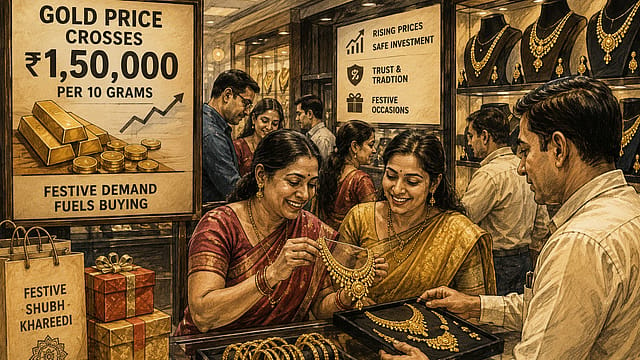
Gold has crossed ₹1.5 lakh per 10 grams. Jewellery has grown brutally expensive. A sharp rally has already rewarded investors who entered early. By the usual laws of consumption, Indian buyers should be stepping away from the counter.
Instead, they are beginning to return. Gold imports more than doubled in July, jewellers started replenishing inventories and exchange-traded funds continued to attract money. The World Gold Council’s latest India market update believes this recovery could gather strength as India enters its festive and wedding season.
But this is no return to the old gold rush. High prices are shrinking jewellery volumes, pushing families towards lighter pieces and turning more buyers into investors. India still loves gold. It is simply learning to buy it differently.
What has suddenly changed in India’s gold market?
Three parts of the market have begun moving together. Consumers have resumed some jewellery purchases after postponing them during the earlier price surge. Manufacturers are receiving more orders, while jewellers are rebuilding stock before the festive season. Investors, meanwhile, continue to buy gold through ETFs, bars and coins. The clearest signal has come from imports. India imported an estimated 40 to 45 tonnes of gold in July, more than double the roughly 20 tonnes brought in during June. The import bill jumped from $1.97 billion to $4.16 billion. Imports had weakened for two consecutive months. Their July rebound suggests that bullion dealers, manufacturers and retailers expect stronger sales ahead. However, imports measure the gold entering the country, not necessarily the amount already bought by consumers. Part of the jump reflects businesses stocking their shelves for expected demand. The festive recovery will become convincing only if households absorb those inventories.

Losing Memory
16 Oct 2026 - Vol 05 | Issue 42
The making of a medical and social emergency
Why are Indians buying gold when it costs more than ₹1.5 lakh?
The answer lies partly in how buyers read the price. Gold suffered a sharp correction in June, when international prices dropped more than 11 per cent and domestic prices fell by around 10 per cent. That decline brought Indian prices close to ₹1.41 lakh per 10 grams, a six-month low, according to an earlier World Gold Council market update. For a buyer comparing gold with its recent peak rather than its historical price, the correction looked like an opening. Deferred wedding and jewellery purchases began returning, while jewellers used the relative stability in July to restock. Gold then rallied again. International prices climbed 9 per cent during the first two weeks of August to $4,391 an ounce. Domestic prices rose nearly 7 per cent to ₹1,51,744 per 10 grams by August 14. That rebound appears to have activated two kinds of buyers. Jewellery customers who had waited for a correction finally entered, while investors returned because prices had begun climbing again.
Isn’t a rising price supposed to destroy demand?
It usually hurts jewellery demand because households buy gold within a fixed budget. When the price rises, the same money buys a smaller necklace, a lighter bangle or fewer grams. Investment gold behaves differently. A rising price can attract more investors by strengthening the belief that the rally has further to run. India is now witnessing both forces simultaneously. High prices are suppressing the quantity of jewellery purchased, but the promise of further gains is supporting demand for coins, bars and ETFs. This produced a historic reversal in the March quarter. Investment demand surpassed jewellery demand for the first time, according to Reuters. Indians bought 82 tonnes of investment gold against 66 tonnes of jewellery, with investment accounting for more than half of total consumption. Traditionally, investment products have represented only about a quarter of India’s gold demand. The shift shows that gold is increasingly being bought as a financial asset rather than only as jewellery.
So, has jewellery demand recovered completely?
No. It has improved from the weak opening quarter, but remains under pressure compared with last year. India consumed 75 tonnes of gold jewellery in the June quarter, a 14 per cent rise over the preceding quarter but a 15 per cent fall from a year earlier, according to the World Gold Council’s Q2 India report. It was the second-lowest June-quarter volume recorded by the council in its data series stretching back to 2000. Yet Indians spent ₹1.13 lakh crore on gold jewellery during the quarter, 34 per cent more than a year earlier. The contradiction captures what expensive gold has done to the market: purchase volumes have fallen, but the money required to buy those fewer grams has surged. India’s gold recovery, therefore, is a recovery in buying interest and spending. It is not yet a return to the heavy volumes seen when gold was significantly cheaper.
How are jewellery buyers coping with record prices?
They are cutting weight before cutting the occasion. Jewellers are selling more lightweight pieces, lower-carat jewellery and designs that use stones to create a larger look with less gold. Buyers are also exchanging old jewellery instead of paying the entire price in cash. The World Gold Council said retailers reported a 10 to 20 per cent increase in gold-exchange volumes during the June quarter. At some stores, old-gold exchanges accounted for as much as 70 per cent of sales. This has become the market’s pressure valve. A family can still buy jewellery for a wedding or festival by surrendering an older piece and paying only for the additional gold, making charges and applicable taxes. Recycled gold also supplements imports and gives jewellers another source of supply. For consumers, however, exchanging jewellery can involve deductions for impurities, stones and melting losses. The displayed gold rate is not necessarily the amount they receive for the old piece.
Why does the festive season matter so much?
Gold buying in India is tied to weddings, religious festivals and auspicious dates. The season beginning in late August and extending through Dhanteras, Diwali and the winter wedding calendar usually increases footfall and prompts retailers to build inventory in advance. The recent price correction also released some pent-up demand. Families that delayed purchases during the rally may have limited room to postpone weddings or ceremonial buying indefinitely. But tradition cannot completely defeat affordability. A strong festive season may lift the value of gold sold without producing an equally large increase in tonnage. Consumers can preserve the ritual while reducing the weight. That is why July’s import surge is encouraging but not conclusive. Jewellers have stocked up for the season. The next test is whether consumers buy that stock at current prices.
What are gold ETFs telling us?
They show that investment demand remains alive, although the frenzy has cooled. Indian gold ETFs received net inflows of about ₹1,560 crore in July. That was 55 per cent lower than June, but it still marked a second consecutive month of net buying after May’s outflow. The Association of Mutual Funds in India publishes the underlying monthly industry data. ETF holdings increased by one tonne to 120 tonnes, while assets under management rose 2 per cent to ₹1.73 lakh crore. Another estimated ₹1,179 crore entered gold ETFs during the first two weeks of August. The number of gold ETF accounts also climbed by 57,000 in July to 1.25 crore, according to the World Gold Council. That expansion suggests gold is reaching investors who may never walk into a jewellery showroom or bullion shop.
Why choose a gold ETF instead of jewellery?
An ETF gives an investor exposure to the price of gold without paying jewellery-making charges or storing physical metal at home. Units can be bought and sold through a demat and trading account. Jewellery serves a different purpose. It can be worn, gifted or used in ceremonies, but its purchase price includes making charges and taxes that are not fully recovered during resale. Its returns can therefore trail the movement in the underlying gold price. Bars and coins remove most of the ornamentation cost but require secure storage and careful checks on purity, billing and buyback conditions. For buyers seeking only investment exposure, ETFs can be more efficient. For ceremonial or personal use, physical gold remains the more relevant product. The choice depends on the purpose of the purchase.
Are traders also returning to gold?
Activity has picked up, but it remains below the peaks recorded earlier in the year. Average daily gold-futures volumes on the Multi Commodity Exchange rose to 14.9 tonnes in July from an average of 13.5 tonnes during the preceding three months. Daily turnover increased 9 per cent to ₹21,400 crore. Yet trading volumes remained 59 per cent below January’s peak and 8 per cent lower than in July 2025, the World Gold Council found. Turnover was higher largely because every tonne of gold now carries a much greater price. The futures data supports the recovery narrative, but does not signal another full-blown speculative rush.
What is pushing international gold prices higher?
Gold has drawn support from expectations of changes in US monetary policy, weakness in the dollar, renewed ETF inflows and geopolitical uncertainty. Lower interest rates generally help gold because the metal does not pay interest. When returns on bonds and cash decline, the opportunity cost of holding gold falls. A weaker dollar can also make gold cheaper for buyers using other currencies, supporting global demand. Conflict and financial uncertainty strengthen gold’s appeal as a perceived store of value. That safe-haven status has become particularly important as markets confront geopolitical tensions, volatile energy prices and doubts over the direction of global growth. But the relationship is not automatic. If US interest rates remain high, bond yields climb or the dollar strengthens sharply, gold can lose momentum. Investors who buy after a major rally remain exposed to sudden corrections such as the one seen in June.
How does the rupee affect the price Indians pay?
Indian gold prices do not move only with international bullion. The rupee-dollar exchange rate, import duties, taxes and local demand also shape the final price. Gold is internationally priced in dollars. If the rupee weakens, Indian importers must spend more rupees to buy the same amount of gold, even if the global price does not change. That currency effect helped keep Indian prices elevated during the June quarter. The average international gold price fell 8 per cent from the preceding quarter, but the domestic MCX spot price remained broadly flat as the rupee weakened and higher import duties took effect, the World Gold Council said. A falling international gold price, therefore, does not guarantee equivalent relief for Indian buyers.
Is India buying more gold or merely spending more on it?
It is spending dramatically more, but buying only slightly more metal overall. India’s total gold demand reached 281.5 tonnes in the first half of 2026, just 1.8 per cent higher than a year earlier. The amount spent on that gold, however, jumped 72.5 per cent to approximately ₹4.25 lakh crore. The June quarter sharpened the divide. Demand fell 6 per cent from a year earlier to 131 tonnes, while spending soared 50 per cent to a June-quarter record of nearly ₹1.98 lakh crore. The gold market is growing much faster in rupee value than in physical volume. For jewellers, this can lift revenue while squeezing the number of grams sold. For households, it means gold is consuming a larger share of the wedding or festive budget.
Could the festive recovery lose momentum?
Yes. Price is the biggest threat.
Another sharp rally could force households to defer non-essential purchases, exchange more old jewellery or reduce weight further. Weak rural incomes, persistent inflation or pressure on household finances could also restrict discretionary buying. Investment demand carries a different risk. Investors have supported the market partly because gold prices have risen strongly. If that momentum reverses, some buyers could pause or book profits, as the ETF outflows in May demonstrated. July’s import rebound could then become excess inventory rather than proof of lasting consumption. Jewellers may have to offer discounts or slow subsequent imports if festive sales disappoint.
Is this the right time to buy gold?
The market data cannot answer that question for every buyer. A family purchasing jewellery for a scheduled wedding faces a different decision from an investor chasing returns. Jewellery buyers can compare making charges, consider exchanging old gold and spread purchases rather than attempting to predict the lowest price. Investors need to account for gold’s volatility, the absence of regular income and the risk of buying after a powerful rally. Gold can diversify a portfolio and offer protection during periods of stress, but it can also remain flat or fall sharply when interest rates, the dollar or investor sentiment change. The World Gold Council’s update establishes that demand is recovering. It does not establish that prices will continue rising.
What is the real story behind gold’s comeback?
India’s gold appetite never disappeared. The price shock changed its shape. Jewellery buyers are returning with smaller budgets measured in grams. Families are unlocking old ornaments to fund new purchases. Investors are moving through ETFs, bars and coins. Jewellers are importing more metal because they expect festivals and weddings to release deferred demand. The festive season could strengthen that recovery, but the industry will be watching two different scoreboards. One will measure how much money Indians spend. The other will measure how much gold they actually take home. At ₹1.5 lakh per 10 grams, those two numbers no longer tell the same story.
(With inputs from ANI)