From Jungle Raj to World Trade Centre: Is Bihar rewriting its story as murder, robbery cases go down?
There was a time when the phrase most closely associated with Bihar's law-and-order story was “Jungle Raj.”
Now listen to the language coming from the state government. Murder cases are down. Robbery is down. Riot cases are down. Bihar says its Naxal-affected districts have fallen from 22 in 2013 to zero. Cybercrime units are tracking fraudsters. Economic offences are being pursued through property attachment and special courts.
And in Patna, the government is talking about something that would have sounded almost fantastical in a very different Bihar: a World Trade Centre.
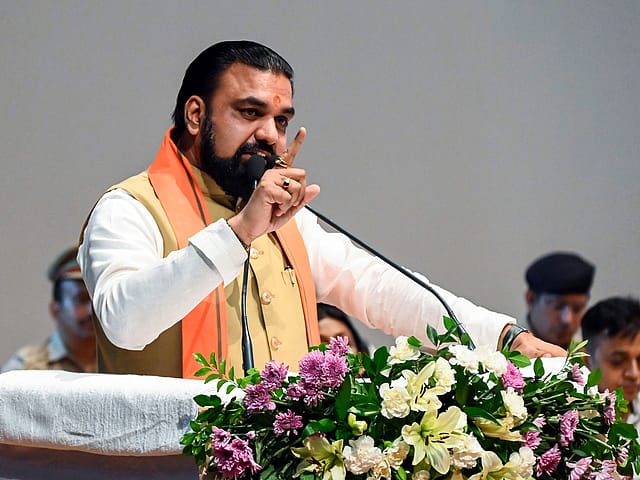
The proposal emerged at a high-level review meeting chaired by Chief Minister Samrat Choudhary at the Sankalp auditorium in Lok Sevak Awas. The National Buildings Construction Corporation, or NBCC, presented the proposal as part of a wider plan to redevelop government land and push Patna towards modern, high-tech infrastructure.

Losing Memory
16 Oct 2026 - Vol 05 | Issue 42
The making of a medical and social emergency
The question is not whether Bihar has changed. Clearly, it has. The more interesting question is: how far has it come?
First, the numbers
The Bihar Home Department says the state's crime picture is moving in the right direction. Compared with the previous year, murder cases have fallen by 10.1 per cent, robbery cases by 31.32 per cent and riot cases by 18.97 per cent, according to figures presented by the department.
That is the official picture. But numbers alone don't tell the entire story. So look at what the state says it is doing behind those numbers: intelligence gathering, faster police action, action against organised crime and a stated zero-tolerance approach to communal incidents. During 2025-26, prosecution was sanctioned in 263 cases related to communal incidents, the department said. And then there is the older, darker chapter in Bihar's security story.
From Naxal territory to zero affected districts
In 2013, Bihar had 22 Naxal-affected districts, according to the Home Department. The number is now officially zero.
That does not mean the history has disappeared. It means the state says the security challenge has changed enough for the Centre to identify Aurangabad, Gaya, Jamui and Lakhisarai as “Legacy and Thrust” districts following the decline in Naxal activity.
Up to July 31 this year, the state reported no encounter between security forces and Naxals, while 58 Naxals had been arrested. Security forces also recovered firearms, ammunition and explosives during anti-Naxal operations. That is a very different security map from the one Bihar was dealing with a decade ago.
The crime has moved online
But crime has not disappeared. It has changed shape. A fraudster no longer needs to stand outside your house. A phone is enough. Bihar says cybercrime has become a growing focus of policing, with 13,600 cyber-fraud and other cybercrime complaints reported up to July 2026.
The state says cyber police stations registered 2,942 cases and arrested 522 cyber criminals during the year so far. Through the National Cyber Crime Reporting Portal, around ₹104.05 crore was put on hold, while nearly ₹9.99 crore was returned to victims. The cybercrime helpline 1930 is also being expanded, with the call centre's capacity planned to rise from 50 to 75 lines.
The police are even taking the fight into the digital shadows: the Cyber Intelligence Team blocked 6,399 mobile numbers and 1,876 IMEI numbers linked to cybercrime, while the special “Cyber Prahar” campaign led to 153 arrests up to July.
The point is important. A state can become safer on the streets and still face a new kind of crime through a smartphone.
And then there is Patna
Now look at the other end of the transformation. A city once discussed largely through the vocabulary of congestion, infrastructure gaps and underdevelopment is being presented with a very different ambition.
A World Trade Centre
The proposal is part of a much larger redevelopment plan. Officials are looking at government land parcels in areas including Nehru Path opposite the Bihar Museum, Gardanibagh, Bhootnath Sector-6 and Boring Canal Road. Plans also include development of around 2,000 acres in Pataliputra Township and another 1,000 acres in other township areas, according to the proposal discussed by the government.
The government says the projects could attract around ₹4,000 crore in investment and generate roughly ₹8,000 crore in revenue. But the World Trade Centre is still a proposal. It is not a completed building, and the technical and financial details of the project have not yet been fully disclosed.
That distinction matters. A blueprint is not a skyline.
The bigger ambition: change what Bihar feels like
Choudhary has framed the urban push in unusually expansive terms: modern technology, environmental standards and a “Zero Waste Model” for Patna's development.
The government is also looking beyond the capital. A separate Vision 2030 plan for fisheries aims to strengthen Bihar's position among India's leading inland fish-producing states. The proposal includes eight priority projects, 1,848.75 hectares of direct intervention area and 9,357 hectares of project impact area, with a proposed fish-production target of 50,200 metric tonnes.
The idea is to build the entire chain — production, processing, value addition and markets — rather than stopping at the pond. It is the same language running through the state's larger pitch: jobs, investment, infrastructure, technology and productivity.
From the old Bihar to the proposed Bihar
There is a temptation to turn this into a neat before-and-after story.
Old Bihar: Jungle Raj.
New Bihar: World Trade Centre.
Reality is rarely that tidy.
Crime falling in official statistics does not mean crime has vanished. A proposal for a landmark building does not mean Patna has suddenly become a global business hub. And a zero-Naxal-affected-district count does not erase the years when parts of the state were deeply affected by left-wing extremism.
But something undeniably interesting is happening in the way Bihar is trying to describe itself. The story is no longer only about controlling crime. It is increasingly about what comes after control — what you build when roads are safer, when old security challenges recede, when government land can be redeveloped and when a state begins to think about investment rather than merely survival.
So perhaps the most revealing image of Bihar's changing story is not a crime graph. It is a proposed tower in Patna.
A World Trade Centre may still be only an idea on paper. But the ambition behind it says something about where Bihar wants the conversation to go next.
From Jungle Raj to a World Trade Centre. The distance between those two phrases is the story Bihar is now trying to tell about itself.
(With inputs from ANI)