A Burning Winter
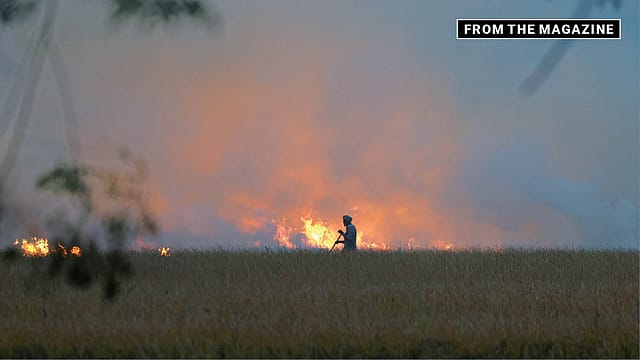
Even before the first cracker had been burst in New Delhi on Deepavali, the capital’s air quality had deteriorated severely. The annual ritual of ineffective steps to tackle air pollution had begun some days earlier. In the second week of November, even after Deepavali celebrations had ended, Delhi remained engulfed with a thick layer of smog, replete with toxic fumes and chemicals most not of its making.
The Air Quality Index (AQI) data spoke for itself. On the morning of that day, at 6:30AM, the AQI at India Gate touched 398, classified as ‘very poor’ air quality. At the All India Institute of Medical Sciences (AIIMS) around 7AM, AQI levels breached the 400 mark and touched 421, categorised as ‘severe’ in the Central Pollution Control Board’s (CPCB) system of classification. The story repeated itself across different air quality observation centres across the capital.
The government’s response to the approaching air pollution crisis began 19 days earlier on October 21 when it set in motion the first stage of the Graded Response Action Plan (GRAP). GRAP is a four-stage “action plan” to check air pollution depending on AQI readings. The third stage of GRAP kicked in on November 6 when the AQI reading touched 382.The Commission for Air Quality Management (CAQM), the agency that deals with air pollution in the National Capital Region (NCR), anticipated AQI to breach the severe level (greater than 400) and hence unrolled the third stage of GRAP.
Conceived as a step-by-step response to the problem of air quality in NCR, especially in the winter months, GRAP is rational on paper. But it has proven inadequate ever since the CAQM was launched in the winter of 2020 when the problem had already crossed acceptable bounds. Unlike many other problems solved by administrative means, air pollution is a different issue. The easiest parts of the problem can be shut off in a tap-like fashion. These include halting construction activities in NCR, controlling vehicular flows based on emission norms of different vehicles and when AQI enters the hazardous range (greater than 450), severely restricting all manner of air polluting activities.
Unlike, say, the problem of inflation where the problem-solving agency (the central bank) has most variables under its control, the CAQM has no control over one key source of air pollution: crop residue burning or stubble burning. For that, it must rely on state governments in states adjoining NCR. Here, the record speaks for itself.
Crop residue burning, or stubble burning, a major source of air pollution in NCR has continued unabated during recent months and was particularly intense on Deepavali. Punjab stood out among the northern states for its share in the number of incidents of stubble-burning. While the absolute number of crop residue fires from the state has declined since 2021, compared inter se with other northern states, Punjab stands out. In 2020, until November 10, Punjab had reported 72,499 cumulative residue burning events, a figure that fell to 4,195 by the same date in 2025. This year, by November 10, that figure has gone up a bit compared to 2025 at 5,002. In contrast, Haryana, another state big on residue burning, witnessed a decrease from 4,937 events in 2020 to 206 this year.
NCR’s problem of air pollution is not about apportioning blame for who is responsible for a greater share of pollution but one of minimising it. The easiest parts of the problem can be shut off in a tap-like fashion

Data released by the Consortium for Research on Agroecosystem Monitoring and Modeling from Space (CREAMS) showed that on November 9, Punjab reported 4,657 fire incidents, more than the combined number of stubble-burning incidents reported until that date from Madhya Pradesh (1,769), Rajasthan (1,271), Uttar Pradesh (570), Uttarakhand (204), Haryana (192) and Delhi (2).
Deepavali on November 8 was a particularly bad day in this respect. That day, Punjab reported 1,152 fires from crop residue burning, the single largest number since mid-September. The very next day, November 9, the number of these reported fires fell dramatically to 198. Either the farmers of Punjab were celebrating Deepavali in their own way on November 8 or they were clearly sending a message to “Delhi” that they will do what they please.
Even within Punjab, the spatial spread of these incidents is interesting. The largest number—657—was reported from Tarn Taran, a middling district in terms of area. Calculated in terms of area for every fire incident, Tarn Taran stood out. The district had a rice crop acreage of 1.795 lakh hectares this year. There was a fire report for every 673 acres of rice crop planted. The number in the largest district of the state—Ludhiana—was one fire report for every 3,296 acres. In terms of raw numbers, there were more crop residue burning fires reported from Tarn Taran than entire Uttar Pradesh (UP), cumulatively, until November 9. Tarn Taran was a hotbed of Sikh separatism in the 1980s and remains attracted to religious politics of a particular kind even today. It is currently represented in Lok Sabha by Amritpal Singh, an MP who has remained under detention for several years.
The CREAMS data is the official data on crop residue burning. But the data has been questioned by Hiren Jethva, a remote sensing scientist at Morgan State University and the NASA Goddard Space Flight Center. On November 9, Jethva posted on X that the number of these fires as discerned from the Visible Infrared Imaging Radiometer Suite (VIIRS) aboard the NOAA-20 satellite was 4,089. But this is a substantially low count of fires. Jethva reported that after empirical adjustments to the VIIRS 375-metre resolution fire-count baseline, “the total reaches to 34,000 fires—a conservative estimate.” Farmers in the state have figured out the time when satellites make an overpass above their area and have accordingly shifted the time when crop residue is burnt. This leads to a severe undercounting of these incidents as Jethva pointed out.
The trouble in Punjab is an unwillingness to come to terms with the problem, let alone address it. On November 6, while speaking to reporters in Chandigarh, Harpal Singh Cheema, the state’s finance minister, said, “I want to ask the Bharatiya Janata Party (BJP) once again: Why are you taking revenge on the farmers of Punjab? There is a distance of 300 kilometres between the Punjab-Delhi border. Is this smoke, which they keep talking about, being transported to Delhi in trucks or buses? The entire state of Haryana lies in between; yet, according to them, there is no pollution in Haryana, but the pollution in Delhi is somehow attributed to Punjab... they level entirely fabricated and baseless accusations against the AAP government in Punjab...” On November 9, he said, “Punjab farmers do not indulge in any illegal activity...” This was a day after Punjab reported the largest number of stubble burning incidents since September.
“The solution to the problem (air pollution) is not difficult,” Chandra Bhushan, a well-known environmentalist, tells Open. Bhushan says the sources of pollution at the national level and the local (Delhi NCR and Mumbai) are well-known. Fifty per cent of the air pollution is due to biomass burning and stubble burning. One-third comes from industrial activities that use coal and oil and 10 per cent is due to automobile emissions. The remaining issue is that of dust, the responsibility for managing which lies with municipal authorities.
“The biggest problem is biomass burning and stubble burning. Solve the big-ticket issues of air pollution and you will make a dent in it. The focus in Delhi-NCR is on automobiles which are only 10 per cent of the problem,” he adds. “The problem is not complicated. You know the sources of pollution. You just have to act on them,” Bhushan says.
In all these problem areas, regulatory responses have kicked in. Vehicular emission standards have been improved and every year one of the first steps taken is to stop lower emission standard vehicles from entering Delhi. Halting construction activities, enforced in various steps under GRAP, takes place every year almost without fail.
The most intractable issue remains: the inability of the CAQM and the Punjab government to dissuade farmers in that state from burning crop residue. Other states such as Haryana and UP have managed to reduce stubble burning by a combination of incentives and firm steps. In Haryana, for example, stubble is often weeded out using modern machinery and bundled into bales then used for different purposes. That practice, even after incentivising its use, has not picked up in Punjab. There, farmers demand “compensation” for not burning residue. The sums demanded range from Rs 1,500 to Rs 10,000 per acre.
“We want Delhi (Centre) to pay us Rs 10,000 per acre for not burning parali (stubble). Otherwise, we cannot hire the labour to undertake those operations,” Ajaib Singh, a farmer who was burning crop residue on his farm near Chohla Sahib in Tarn Taran district, recently told Open. When questioned if it was not better to ask the state government for compensation instead of “Delhi”, Singh said it was Delhi that was against Punjab’s farmers and hence the responsibility for compensation lay with Delhi.
NCR’s problem of air pollution is not about apportioning blame for who is responsible for a greater share of pollution but one of minimising it. But until very recently, the debate on winter pollution was largely about who took which side of the ideological spectrum. It was fashionable to do “Diwali bashing” even as no one denied that crackers caused pollution. Instead, farm practices were considered almost non-polluting. The data shows something else.