From Chandrayaan to a Home in Orbit: Can ISRO Build India’s Space Station by 2035?
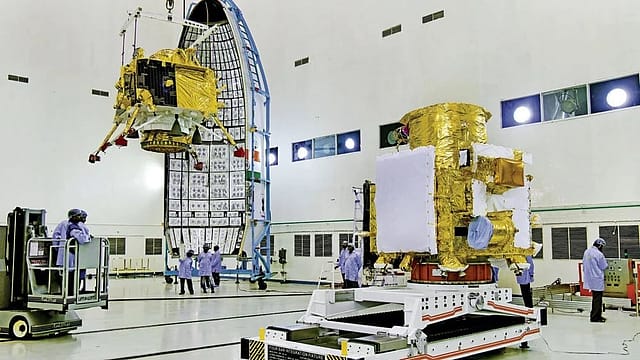
India’s first rockets were transported on bicycles and bullock carts. Its first satellite travelled aboard a Soviet launcher. Six decades later, the country is preparing to build a permanent Indian address nearly 400 kilometres above Earth.
The distance between those moments cannot be measured merely in kilometres. It runs through Aryabhata, the PSLV, Chandrayaan, Mangalyaan, the GSLV, Chandrayaan-3, Aditya-L1 and SpaDeX. Gaganyaan is expected to become the next bridge. If every link holds, India will launch the first module of the Bharatiya Antariksh Station by 2028 and assemble a complete orbital outpost by 2035.
ISRO Chairman V Narayanan has reiterated that ambition during India’s third National Space Day celebrations. The 2035 target itself is not new. The Union Cabinet approved the first station module in 2024. What has changed is that the dream has begun moving from speeches and illustrations into hardware, tests and budgets.

Zeroing In on ECI
09 Oct 2026 - Vol 05 | Issue 41
Constitutional legitimacy versus political opportunism
The real question is no longer whether India wants a space station. It is whether ISRO can master, in nine years, everything required to build one.
What exactly is India planning to build?
The Bharatiya Antariksh Station, or BAS, is intended to be India’s own modular research station in low-Earth orbit. Unlike a satellite launched as a single unit, the station will be assembled gradually. Separate modules will have to be launched, manoeuvred through orbit, brought close to one another and joined without a collision. Power, air, data and other services must then flow safely between them.
The first module, BAS-01, is targeted for launch by December 2028. The complete station is expected to have five modules and be operational by 2035. A model reportedly unveiled by ISRO indicated that BAS-01 would weigh approximately 10 tonnes and orbit Earth at an altitude of around 450 kilometres. The proposed module incorporates an indigenous environmental-control and life-support system, Indian docking and berthing mechanisms and an automated hatch. Later elements are expected to expand the station’s accommodation, laboratory and research capacity. Once completed, BAS could support microgravity experiments, Earth observation, technology demonstrations and longer astronaut stays. It would also become a testing ground for the systems India will need if it is to send astronauts to the Moon by 2040.
Why is 2028 more important than the headline-grabbing 2035 deadline?
Because 2035 describes the destination. The 2028 launch will reveal whether India is actually on the road.
When the Union Cabinet approved BAS-01 in September 2024, it expanded the scope of the Gaganyaan programme. The revised plan included the first station module and four additional missions intended to demonstrate and validate technologies required to build and operate it. The Prime Minister’s Office said the government added ₹11,170 crore to the programme, taking Gaganyaan’s total approved funding to ₹20,193 crore. That makes BAS-01 more than the first physical section of a future station. It will be a test bed for docking, life support, power management, crew habitability and the ability to operate a large Indian spacecraft for extended periods. If BAS-01 slips substantially, the seven-year window for launching and assembling the remaining modules will become much tighter.
How did India travel from Aryabhata to an orbital station?
ISRO’s journey has been an exercise in accumulating capabilities. Aryabhata, launched in 1975 aboard a Soviet rocket, gave India early experience in designing and operating satellites. The Satellite Launch Vehicle-3 placed the Rohini satellite in orbit in 1980, establishing indigenous launch capability. The PSLV subsequently became ISRO’s workhorse. It launched Indian remote-sensing and navigation satellites, carried foreign payloads and dispatched Chandrayaan-1 and Mangalyaan towards the Moon and Mars.
Mangalyaan, which entered Martian orbit in 2014, made India the first country to succeed in reaching Mars on its first attempt. More importantly for ISRO’s development, it demonstrated long-distance navigation, autonomous spacecraft operations and deep-space communication. The GSLV and LVM3 programmes addressed another weakness: India’s need to lift heavier satellites without depending upon foreign launchers. The LVM3 would later launch Chandrayaan-2 and Chandrayaan-3 and was selected as the launch vehicle for Gaganyaan.
Chandrayaan-3 then delivered ISRO’s most visible triumph. On August 23, 2023, India became the first country to land near the lunar south polar region and only the fourth to complete a controlled landing on the Moon. But the achievement that may matter most to the space station came almost unnoticed beside the national spectacle of the Moon landing. It was called SpaDeX.
Why could SpaDeX prove more important than Chandrayaan-3?
Chandrayaan-3 showed that India could land on another celestial body. SpaDeX demonstrated a technology without which India cannot assemble a station in orbit.
In January 2025, two small Indian satellites approached each other and docked in space. ISRO subsequently separated them, docked them again autonomously and transferred electrical power between the two spacecraft. According to ISRO, the second docking was performed autonomously from an inter-satellite distance of 15 metres. Power was then transferred in both directions. That made India only the fourth country, after the US, Russia and China, to demonstrate space-docking capability.
The experiment solved the problem on a small scale. BAS will demand a larger and more complex version of it. Ten-tonne modules travelling at orbital velocity will have to meet with extreme precision. Their connections must remain airtight, structurally secure and capable of transferring electricity, information and, eventually, fluids. Docking will also be essential for crew capsules and cargo vehicles visiting the station. Every astronaut rotation, supply delivery or emergency evacuation will depend upon it. SpaDeX was therefore less a standalone experiment than the first rehearsal for building India’s home in orbit.
Why must Gaganyaan succeed before the station can?
A country cannot run a space station until it can reliably carry its own astronauts into orbit and return them safely. Gaganyaan is designed to place an Indian crew in an orbit of approximately 400 kilometres and bring the astronauts back through a splashdown in the sea. That requires a human-rated launch vehicle, a habitable crew module, an emergency escape system, life support, navigation, re-entry protection, parachutes and a coordinated recovery operation. Each component must work with exceptional reliability. A satellite-launch failure can destroy expensive hardware. A human-spaceflight failure can kill a crew.
ISRO’s recent tests show how many apparently small systems stand between launch and safe return. In April 2026, the agency dropped a simulated 5.7-tonne crew module from an Indian Air Force Chinook helicopter to test its descent and recovery. Ten parachutes deployed in sequence before the module landed in the sea and was recovered with the Indian Navy’s assistance, ISRO said.
Another major parachute test was completed in July. The system uses four kinds of parachutes, while two of its three main canopies are designed to bring the module down safely even if the third fails. This painstaking redundancy illustrates the difference between launching a machine and launching human beings. Before India can maintain a laboratory in space, it must prove that it can rescue its astronauts when systems malfunction.
Has an Indian already trained for life aboard a space station?
Yes, and that experience is central to the larger plan. Group Captain Shubhanshu Shukla became the first Indian to visit the International Space Station during the Axiom-4 mission in 2025 and only the second Indian citizen to travel into space after Rakesh Sharma. Shukla conducted seven microgravity experiments proposed by Indian research institutions. ISRO later said it was drawing on his experience in astronaut training, mission procedures and the design of experiments for Gaganyaan, according to the agency’s review of its 2025 achievements.
His journey gave India something that could not be reproduced entirely in simulators: direct experience of living and working inside an operational station. But travelling to the ISS aboard an American spacecraft is different from designing, launching, supplying and maintaining an Indian station. Shukla’s flight supplied knowledge. BAS will require an entire national ecosystem.
What are the hardest technologies India still has to master?
Keeping human beings alive may be harder than sending them into orbit. A space station must continuously supply breathable air, remove carbon dioxide, regulate pressure and temperature, recycle water, manage human waste, detect fires and control microbial contamination. These systems must remain functional even when replacement components are hundreds of kilometres away.
Reuters reported that development of India’s indigenous environmental-control and life-support system had taken longer than expected because the technology was new to the country and could not be obtained from abroad as initially envisaged. Radiation and space debris create further dangers. The station will require shielding, collision monitoring and the ability to manoeuvre if an object threatens it. India will also need reliable communications, onboard medical protocols and an emergency return vehicle available to the crew.
Then comes maintenance. Equipment behaves differently in microgravity. Pumps, seals, filters, toilets, exercise systems and scientific instruments wear out. A station is never truly finished. It has to be repaired and resupplied for as long as it remains inhabited. India has mastered missions lasting days, months and even years without crews. BAS will demand that it master people, logistics and machinery together.
Can India’s existing rockets build the station?
The LVM3 can launch Gaganyaan and the initial station module, but India’s ambitions are already pushing against the limits of its present launch architecture. A five-module station requires multiple heavy launches. It also needs cargo flights, crew rotations and enough redundancy to prevent a single rocket problem from paralysing the programme.
ISRO is developing a Next Generation Launch Vehicle that is expected to be more powerful, reusable and better suited to future human-spaceflight and lunar missions. India is also building a third launch pad at the Satish Dhawan Space Centre in Sriharikota. The Union Cabinet’s approval placed the cost of the new facility at ₹3,984.86 crore. ISRO said the pad would support the next-generation rocket, upgraded versions of the LVM3 and future crewed missions.
The new rocket is expected to use liquid methane and require a very different launch infrastructure. A government statement in Parliament said the vehicle could stand around 90 metres tall and weigh approximately 1,000 tonnes at lift-off. The sequencing produces another deadline test. The third pad is expected to become fully operational around 2029, after the intended launch of BAS-01. India can use existing infrastructure for the first module, but the expansion of the station will increasingly depend upon the new vehicle, the new pad and the industrial supply chain supporting them.
Why does India need its own station?
The most immediate answer is scientific independence. Microgravity allows researchers to study biological and physical processes that gravity masks on Earth. Experiments can examine changes in human muscles, bones and immune systems; the behaviour of fluids and combustion; crystal growth; new materials; plant biology and possible methods of manufacturing medicines or specialised components in orbit.
The PMO said BAS would expand Indian microgravity research, promote technological innovation and create high-skilled employment in space and allied industries. A national station would allow Indian researchers to design longer experiments without depending entirely on access granted by foreign agencies. It could also host experiments from universities, startups and international partners.
There is a strategic dimension too. The International Space Station is nearing the end of its planned operational life, although Reuters reported that American lawmakers were considering extending it beyond 2030. China already operates Tiangong and is planning to expand it. If the ISS retires before commercial replacements are fully ready, China could temporarily possess the only continuously inhabited government-run station in orbit. India’s 2035 target must be viewed against that changing geography of space power. BAS would not rival the ISS in size. Its importance would lie in autonomy. India would control the launch schedule, research priorities, crew access and technology developed aboard it.
Is this science, strategy or prestige?
It is all three. Every major space station has served scientific and geopolitical purposes. The Soviet Salyut and Mir stations displayed technological endurance. The ISS became both a laboratory and an extraordinary symbol of post-Cold War cooperation. Tiangong demonstrates China’s ability to sustain an independent human-spaceflight programme.
BAS would announce that India has graduated from occasional human missions to a permanent orbital presence. That matters diplomatically. Countries with launch vehicles, astronauts, docking systems and orbital laboratories influence the rules and partnerships governing the next phase of exploration. They can offer training, carry foreign experiments and form alliances around lunar or deep-space missions.
There is also an economic wager. A station could create demand for private launch services, electronics, robotics, specialised materials, medical technologies, software and cargo vehicles. Indian companies would have to become partners in building the programme rather than remain vendors supplying isolated components. A government-built station alone will not transform India into a major space economy. But it can become the anchor around which a commercial ecosystem grows.
Is the 2035 deadline realistic?
It is possible, but there is little room for complacency.
ISRO has repeatedly demonstrated an ability to solve difficult engineering problems with comparatively modest resources. Chandrayaan-3 turned the lessons of Chandrayaan-2’s failed landing attempt into a successful mission. SpaDeX progressed from its first docking to autonomous redocking and power transfer. The Gaganyaan programme has continued accumulating successful ground, parachute, recovery and escape-system tests.
But human spaceflight moves slowly for a reason. Reliability cannot be rushed. Reuters pointed out that Gaganyaan was originally announced with a much earlier crewed-flight target. Covid disruption, global shortages of space-grade components, additional safety work and spacecraft redesign contributed to delays. The life-support system presented a further challenge.
The first BAS module is supposed to fly by the end of 2028. The third launch pad is expected around 2029. The new heavy launcher is still under development. India must then send up, dock and commission four more modules before 2035 while simultaneously operating Gaganyaan missions and preparing for Chandrayaan-4, a Venus orbiter and the proposed 2040 crewed lunar landing.
That is an exceptionally crowded calendar. The strongest argument for the deadline is that India is no longer beginning from zero. The Cabinet has approved funding. Docking has been demonstrated. BAS-01 has entered development. A new launch pad has been sanctioned. An Indian astronaut has worked aboard the ISS. Private industry is being drawn into the programme. The strongest argument for caution is that every one of these foundations must now converge on schedule.
Is the space station ISRO’s final destination?
Far from it. BAS is best understood as a bridge between Gaganyaan and the Moon. A crewed lunar mission will demand many of the same capabilities on a much harsher scale: docking spacecraft far from Earth, supporting astronauts for extended periods, transferring crew and supplies, operating life-support systems and bringing people safely home. Chandrayaan-4, India’s proposed lunar sample-return mission, will itself require complex operations that could include docking in lunar orbit. The space station will allow ISRO to test hardware, conduct biomedical research and learn how Indian astronauts respond to longer periods in microgravity.
It will also change the rhythm of India’s space programme. ISRO has traditionally prepared for one major mission, launched it and moved to the next. A station never leaves the agency’s hands. It must be monitored, repaired, supplied and protected every hour of every day. That may be the most profound leap of all. Chandrayaan allowed India to touch the Moon. Gaganyaan will teach it to carry Indians into orbit. The Bharatiya Antariksh Station will decide whether India can stay there.
(With inputs from ANI)