Five New Cubs, 60 Cheetahs: What Kuno’s Latest Litter Means for Project Cheetah 60
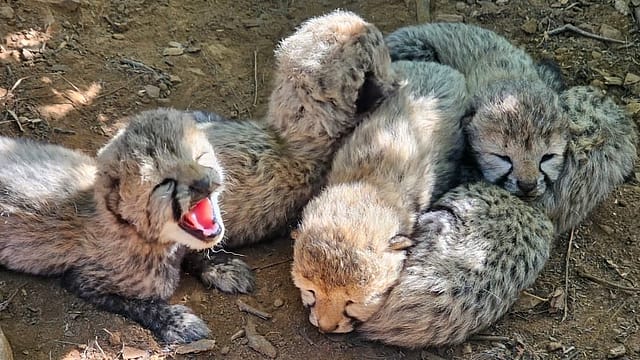
Five cubs. An Indian-born mother. A Botswanan father. Kuno’s newest litter takes India’s cheetah population to 60 and adds another milestone to an ambitious wildlife experiment: cheetahs born here are now producing the next generation. But births tell only part of the story.
Adult deaths and cub losses underline the challenge of turning a growing headcount into a population that can sustain itself in the wild. What makes this litter significant—and what will it take for Project Cheetah to deliver?
WHAT HAS HAPPENED AT KUNO?
Five cubs have joined India’s cheetah population. KJP21, a 32-month-old Indian-born female, gave birth at Kuno National Park in Madhya Pradesh’s Sheopur district on Monday.
Announcing the births, Union Environment Minister Bhupender Yadav said India now has 60 cheetahs, including 41 born in the country.
WHY IS THIS LITTER A BIG DEAL?
The mother was herself born in India. She is now the third Indian-born female to produce cubs, following Mukhi and KGP12.

The Modi Years
02 Oct 2026 - Vol 05 | Issue 40
A Nation Rebuilt
That takes the story beyond imported cheetahs having offspring: animals born here are reaching breeding age and producing another generation. It is an important milestone for a programme seeking to rebuild a population after decades of extinction.
WHERE DOES BOTSWANA COME IN?
The father is a Botswanan male. Yadav described the births as the beginning of the Botswanan lineage in India.
The project’s original founders came from Namibia and South Africa. Nine cheetahs arrived from Botswana in February 2026. This litter brings that group into India’s breeding population, broadening its founder ancestry.
HOW DID INDIA GET HERE?
Cheetahs were declared extinct in India in 1952. The reintroduction began seven decades later:
September 2022: Eight cheetahs arrived from Namibia.
February 2023: Another 12 came from South Africa.
February 2026: Nine arrived from Botswana.
Breeding has since become a major driver of population growth. The animals are now spread across Kuno and Gandhi Sagar Wildlife Sanctuary, both in Madhya Pradesh.
WHO WAS THE FIRST INDIAN-BORN CHEETAH TO BECOME A MOTHER?
Mukhi, a daughter of Namibian cheetah Jwala.
Born in March 2023, she survived after being hand-reared by Kuno staff. Around the end of 2025, she delivered five cubs, becoming the first Indian-born cheetah to breed under the project.
Her journey marked a crucial transition: a cub raised at Kuno had become a mother herself.
HAVE CUBS BEEN BORN IN THE WILD TOO?
Yes, but that milestone came with a painful setback.
KGP12, a daughter of South African-born Gamini, delivered four cubs in April 2026—the first recorded birth in the wild since the reintroduction began.
All four were found dead on May 12. Kuno’s field director said a leopard may have killed them. The suspected cause was not a confirmed finding.
DOES A POPULATION OF 60 MEAN THE PROJECT HAS SUCCEEDED?
It is a milestone, rather than a final verdict.
Official plans envisage a connected population of 60–70 cheetahs across the Kuno–Gandhi Sagar landscape. The latest total reaches the lower end of that numerical range, but includes newborn cubs.
A headcount alone cannot establish a self-sustaining population. The longer test is whether enough animals survive, reach adulthood and reproduce over successive generations.
WHAT IS THE BIGGEST CHALLENGE NOW?
Keeping that next generation alive.
Of the original 20 adults brought from Namibia and South Africa, 11 have died. Reported causes include septicaemia, mating aggression and accidental drowning. Cub deaths have also accompanied the breeding milestones.
Officials say survival among Indian-born cubs compares favourably with global averages, although that assessment comes from government statements rather than independent analysis.
The five births give Project Cheetah another reason to celebrate. Their journey to adulthood will tell us much more.
With inputs from ANI