Faith, Festivity & ₹65,000 Crore: How Durga Puja Puts Bengal to Work
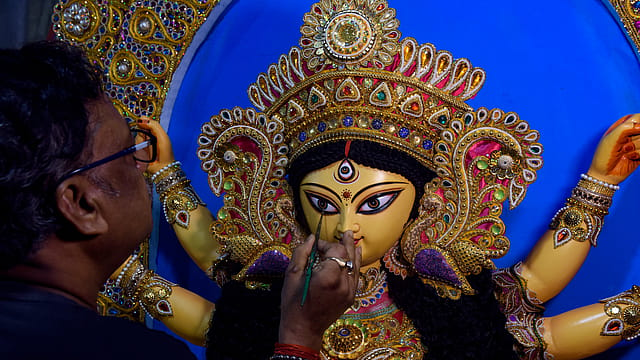
Before the goddess arrives, the bills do.
Clay must be bought. Bamboo secured. Electricians booked. Someone has to stitch the clothes, print the banners, string the lights and build the temporary world into which Bengal will pour.
For the visitor, Durga Puja begins with anticipation. For the people who make it possible, it begins with an order.
That distinction explains why Bengal’s most cherished homecoming also commands such economic attention. The spectacle lasts days. The work stretches across months, connecting workshops, neighbourhood committees, suppliers, sponsors, shops and households through a common deadline.
A reported estimate put West Bengal’s festival-linked economy at ₹65,000 crore in 2025, with Kolkata accounting for roughly 65–70 per cent of the business. It is a broad estimate of economic activity, encompassing much more than the money spent organising worship.

Zeroing In on ECI
09 Oct 2026 - Vol 05 | Issue 41
Constitutional legitimacy versus political opportunism
The number is arresting. The more interesting story is how the money travels—and where it fails to reach.
THE FESTIVAL BEGINS WITH WORK
An idol is the visible centre of a much larger production chain.
Behind it stand sculptors, painters, suppliers and transport workers. Around it grows another network: pandal builders, lighting technicians, decorators, sound operators, security personnel and cleaners. Beyond the pandal, food sellers prepare for crowds, retailers stock festive collections and families plan purchases around the occasion.
UNESCO’s account of Durga Puja describes artisanal workshops preparing clay images in the months preceding the festival. Its recognition of Kolkata’s Puja as intangible cultural heritage in 2021 acknowledged a living practice sustained through collaboration and craftsmanship.
The economic value lies partly in that collaboration. A committee’s spending becomes a contractor’s order, a craftsperson’s payment and a worker’s wage. Visitors then bring another stream of expenditure into the surrounding streets.
The pandal becomes a temporary destination. The neighbourhood becomes its marketplace.
WHAT DOES ₹65,000 CRORE REALLY MEAN?
Festival economies are difficult to fit into a single ledger.
Industry stakeholders quoted in September 2025 placed Bengal’s Puja economy at ₹46,000–50,000 crore, estimating a 10–15 per cent recovery from the previous year. The separate ₹65,000-crore assessment appeared after the festival. These are different estimates, rather than successive entries in one audited series.
An earlier, detailed mapping exercise offers a useful foundation. Commissioned by the British Council on behalf of West Bengal’s tourism department, it estimated the economic worth of Puja-linked industries at ₹32,377 crore in 2019. Its coverage included retail and food and beverages alongside activities such as idol-making, decoration and advertising.
That matters because the phrase “creative economy” can conjure up only artists and craftspeople. The study also captured the shopping and consumption surrounding their work.
Nor should total festival-linked business be read as an equivalent addition to the state’s GDP. A purchase brought forward for Puja may have happened later anyway. Sales, expenditure and economic value added measure different things.
Puja’s importance is nevertheless tangible: it concentrates demand, sets production schedules and creates a selling season around which businesses organise themselves.
THE BIGGEST MARKETPLACE IS BEYOND THE PANDAL
The 2019 study estimated Puja-linked retail at ₹27,364 crore—roughly 85 per cent of its overall ₹32,377-crore valuation. That share is calculated from the report’s figures.
The implication is striking. The artistic spectacle draws people together; the spending spreads much further.
New clothes, footwear, gifts and household purchases turn anticipation into transactions. Pandal-hopping adds meals, snacks and journeys. A family outing can move money through several businesses before anyone returns home.
For 2025, industry estimates put restaurant revenue across Bengal at ₹1,200–1,500 crore. Kolkata’s eight major malls reportedly generated ₹900 crore in business.
The festival also gives businesses something difficult to manufacture through ordinary advertising: a shared reason to buy now.
A retailer knows the occasion is approaching. A customer has a date in mind. A sponsor knows where crowds will gather. Thousands of independent decisions begin moving towards the same week.
A BOOM DOES NOT REACH EVERY COUNTER
Yet a crowded city can conceal an uneven season.
Reporting on the 2025 recovery described strong corporate sponsorships and healthy mall traffic alongside a more subdued experience for hawkers and small traders. Organised retail and online shopping were attracting spending that did not necessarily reach neighbourhood sellers.
This is the tension beneath the celebratory headline. A bigger festival economy does not guarantee a better year for every business within it.
A mall can offer shelter from rain, food, entertainment and shopping under one roof. A street vendor depends more directly on weather, passing crowds and the willingness of customers to linger. An established retailer can spread costs over a longer season; a small seller with festive stock has less room for a disappointing week.
The same distinction applies to artisans. A large order creates work, but the value of that order alone does not reveal the maker’s eventual earnings. Materials, hired labour, transport and the time taken to receive payment all matter.
Turnover describes the scale of celebration. Livelihoods depend on what remains after the costs.
WHO FINANCES THE SPECTACLE?
Community committees sit at the junction of faith, fundraising and production.
For 2025, committee expenditure on idols, decoration, illumination and rituals was estimated at around ₹450 crore across Bengal, including approximately ₹200 crore in Kolkata, according to figures attributed to Forum for Durgostav founder-member Partha Ghosh.
Those orders help create the spectacle around which a much larger consumer economy gathers. They should not, however, be treated as proof of a specific spending multiplier.
Corporate sponsorship helps finance that gathering while giving brands access to its audience. Advertising reaches beyond the pandal itself, following the festival into television, print, outdoor displays and digital media.
The British Council study estimated advertising at ₹504 crore in 2019. That is a historical figure, separate from the 2025 estimates, but it shows how long businesses have recognised Puja’s commercial reach.
For organisers, sponsorship can support ambition. For sponsors, a popular Puja offers attention rooted in community and emotion—an association a routine sales promotion would struggle to reproduce.
THE RISK OF DEPENDING ON A FEW DAYS
A compressed selling season brings urgency and exposure.
Businesses commit money before they know precisely how much customers will spend. Materials are purchased, workers hired, stock accumulated and spaces prepared. Rain or weaker demand can arrive after those commitments have become difficult to reverse.
That makes resilience part of the economic story. Better transport, drainage, sanitation and crowd management help keep a festival functioning. Reliable payments and manageable production costs matter to the people building it.
UNESCO recognition gives Kolkata’s Puja an international cultural platform. Turning that visibility into lasting opportunity requires attention to the workshops and workers who sustain the experience, as well as to the crowds who come to see it.
The goddess will leave. The accounts will remain.
For the sculptor, the decorator, the drummer and the shopkeeper, the season’s success will eventually be measured in something more personal than a statewide estimate: payments received, debts cleared and enough left to begin again.