Delhi AQI at 249, Punjabi Bagh Among Worst-Hit as CAQM Flags Pollution Control Gaps
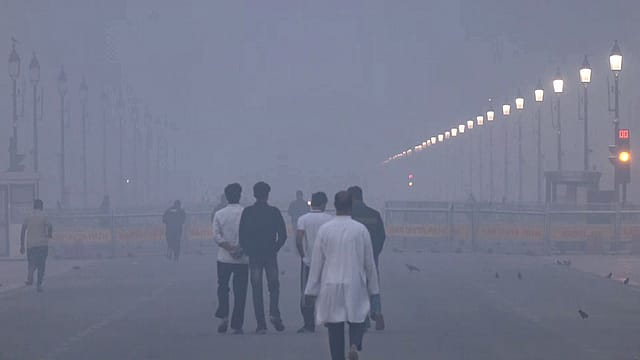
Delhi continued to breathe polluted air on Monday, with the national capital recording an overall Air Quality Index (AQI) of 249 at 8 am, according to the Central Pollution Control Board (CPCB). Punjabi Bagh was among the worst-affected areas, registering an AQI of 282, followed by Bawana at 273 and Chandni Chowk at 271.
All three locations fell in the 'poor' category, as did most of the other monitoring stations across the city. The readings come amid continuing concerns over the implementation of pollution-control measures in Delhi and neighbouring states, with a recent assessment by the Commission for Air Quality Management (CAQM) identifying significant gaps in several areas.

The Wealth Issue 2026
06 Nov 2026 - Vol 05 | Issue 45
Portraits of Dreamers and Doers under 35
MOST DELHI MONITORING STATIONS RECORD POOR AIR
Apart from Punjabi Bagh, Bawana and Chandni Chowk, several other parts of the capital also reported poor air quality. Rohini and RK Puram recorded AQI readings of 252 each, while Alipur stood at 246, Ashok Vihar at 240 and Narela at 239.
Anand Vihar recorded 237, Mandir Marg 225, IGI Airport Terminal 3 217, Sonia Vihar 215, Okhla Phase 2 213, Patparganj 208 and Major Dhyan Chand Stadium 202.
Vasundhara Enclave was the exception among the listed stations, with an AQI of 170, placing it in the 'moderate' category.
According to CPCB's classification, an AQI between 0 and 50 is 'good', 51-100 'satisfactory', 101-200 'moderate', 201-300 'poor', 301-400 'very poor' and 401-500 'severe'.
MIST AND FOG LIKELY OVER DELHI-NCR
The India Meteorological Department (IMD) has forecast mainly clear skies across Delhi-NCR over the next five days, with mist and shallow fog likely during the morning hours on November 23 and 24.
The Regional Meteorological Centre's district-wise forecast indicates that mist and shallow fog could persist at many places on November 25 and 26. Moderate fog is likely at isolated places on November 25 and at a few locations the following morning, potentially affecting visibility across parts of the region.
CAQM FLAGS GAPS IN POLLUTION-CONTROL MEASURES
The latest air quality readings come as the CAQM assesses how Delhi and neighbouring states are implementing measures under the State Action Plan-2026. Its report card, based on progress up to October 31, identifies shortcomings in areas including industrial inspections, waste management, public transport and pollution-control infrastructure.
One of the most striking gaps concerns green crematoriums. Against a combined target of 421 across Delhi, Haryana, Rajasthan and Uttar Pradesh, none had been established by October 31, according to the assessment.
Industrial inspections have also fallen short of the combined annual target of 11,607 across the four states. Only 2,584 inspections had been completed, leaving a gap of 9,023.
Delhi was the exception, exceeding its target of 979 inspections by conducting 1,609. Haryana completed 177 of its targeted 3,865 inspections, Rajasthan recorded 68 against 2,974, while Uttar Pradesh completed 730 of its 3,789 targeted inspections.
The CAQM has classified achievement of 100 per cent of targets as satisfactory, progress between 75 per cent and less than 100 per cent as needing improvement, and performance below 75 per cent as unsatisfactory.
The assessment is not the final evaluation for the year. CAQM is scheduled to release its final report card in January 2027, giving Delhi and the neighbouring states time to accelerate the implementation of pollution-control measures.
The findings underline the gap between monitoring air pollution and addressing its sources through infrastructure, enforcement and better urban services.
With inputs from ANI