Explained: GRAP Stages, Pollution Curbs as Delhi Air Quality Improves
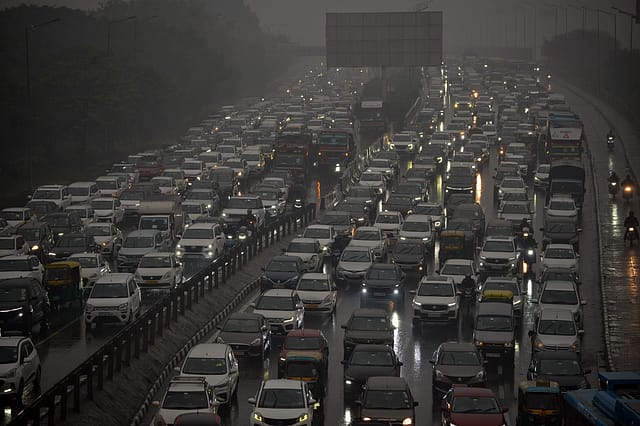
Light rain and gusty winds brought a temporary breather to Delhi’s pollution-weary residents on Friday, nudging air quality out of the ‘very poor’ zone and allowing authorities to roll back emergency curbs. However, with unstable weather and an IMD orange alert in place, officials cautioned that the relief could be short-lived.
AQI sees marginal improvement
Light rain accompanied by a thunderstorm brought marginal relief to Delhi’s choking air on Friday morning, with pollution levels easing slightly even as weather agencies warned of unstable conditions through the day.
According to data from the Central Pollution Control Board (CPCB), Delhi’s Air Quality Index (AQI) stood at 297 earlier in the day, placing it in the ‘poor’ category. This marked a modest improvement from Thursday morning, when the AQI had slipped into the ‘very poor’ range at 312.
Orange Alert issued
Despite the easing of pollution curbs, weather conditions remained a key variable.
The IMD issued an orange alert for Delhi, warning of light to moderate rainfall accompanied by thunderstorms, lightning and gusty winds. The nowcast alert was valid till 10 am, with wind speeds expected to range between 40 and 60 kmph during this period.
In its detailed forecast, the IMD said weather conditions were likely to remain unstable through the day, predicting a generally cloudy sky with one or two spells of light rain, along with thunderstorms and gusty winds reaching 30–40 kmph, particularly during the early morning to forenoon hours.
Survival Instinct
22 May 2026 - Vol 04 | Issue 72
India navigates global economic turmoil with austerity and smart diplomacy
The city recorded a temperature of around 16.4 degrees Celsius at 7 am, adding to the chill. Officials noted that while rain and stronger winds can help disperse pollutants temporarily, sustained improvement in air quality will depend on consistent meteorological support and long-term emission control measures.
GRAP Stage III Curbs Revoked
The improvement prompted the Sub-Committee on the Graded Response Action Plan (GRAP) under the Commission for Air Quality Management (CAQM) to revoke all Stage III restrictions across Delhi-NCR with immediate effect on January 22.
In a statement, the Ministry of Environment, Forest and Climate Change said Stage III measures had been imposed on January 16, 2026, following a sharp deterioration in air quality. Since then, pollution levels have shown a steady downward trend. CPCB’s daily AQI bulletin indicated that Delhi’s average AQI improved from 378 on January 20 to 330 on January 21 and further to 322 by January 22.
Based on this improving trend, and favourable meteorological forecasts from the India Meteorological Department (IMD) and the Indian Institute of Tropical Meteorology (IITM), the CAQM sub-committee decided to ease restrictions.
Here’s a lowdown on GRAP and the relevance of all its four stages:
The Graded Response Action Plan (GRAP) is an emergency pollution-control framework activated when Delhi’s air quality deteriorates beyond defined thresholds. It prescribes a set of pre-approved measures that are implemented in phases, depending on the severity of pollution.
GRAP categorises air quality in Delhi-NCR into four stages: Stage I – ‘Poor’ (AQI 201–300), Stage II – ‘Very Poor’ (AQI 301–400), Stage III – ‘Severe’ (AQI 401–450) and Stage IV – ‘Severe Plus’ (AQI above 450)
The system was first notified by the Ministry of Environment, Forest and Climate Change in January 2017, based on a proposal submitted by the CPCB in November 2016.
The framework gained statutory backing after the CAQM Act, 2021, which established the Commission for Air Quality Management in NCR and adjoining areas.
‘Poor and very poor’: GRAP I and II explained
At the ‘poor’ and ‘very poor’ stages of air quality, authorities focus primarily on preventive actions and dust-control measures aimed at limiting further deterioration. One of the key interventions includes daily water sprinkling and mechanical or vacuum sweeping on identified roads, particularly in areas prone to high dust accumulation.
To further suppress particulate matter, regular water spraying and the use of dust suppressants are mandated, especially across pollution hotspots and high-traffic corridors. Dust collected during these operations is required to be disposed of at authorised sites, ensuring it does not re-enter the air.
Traffic-related emissions are addressed through coordinated traffic management measures, along with higher parking fees designed to discourage the use of private vehicles. At the same time, public awareness campaigns are rolled out across multiple media platforms to encourage citizens to adopt cleaner and less polluting behaviours.
Authorities also enforce strict regulations on the use of diesel generator sets (DG sets), which are a significant source of emissions during power outages. Citizens are advised to opt for public transport wherever possible, choose less congested routes, and ensure regular maintenance of vehicles to reduce exhaust emissions.
Additionally, restrictions are placed on dust-generating construction activities between October and January, a period when weather conditions typically trap pollutants near the ground. A complete ban on the burning of biomass and solid waste in open areas is also enforced to prevent avoidable spikes in air pollution.
What are the Restrictions Under GRAP Stage III?
At GRAP Stage III, pollution control measures are significantly tightened, with authorities enforcing a blanket prohibition on older four-wheelers across the Delhi-NCR region in an effort to sharply curb vehicular emissions.
In addition, restrictions are imposed on diesel-operated Medium Goods Vehicles (MGVs) registered in Delhi, as well as on select Light Commercial Vehicles (LCVs) registered outside Delhi, unless they are engaged in the transportation of essential commodities and services.
As part of efforts to reduce traffic volume and commuter-related pollution, residents are strongly encouraged to work from home wherever feasible, particularly in sectors where remote working can be implemented without disrupting essential services.
What Happens Under GRAP Stage IV (‘Severe Plus’)?
One of the key measures under stricter pollution control involves a complete ban on the entry of non-essential trucks into Delhi, with exemptions granted only to vehicles carrying essential commodities or engaged in emergency and critical services.
With the implementation of GRAP Stage IV, in-person classes are suspended for most students, barring those studying in Classes 10 and 12, who may continue attending school subject to further advisories.
The Government of the National Capital Territory of Delhi (GNCTD), in coordination with NCR state governments, will take a call on whether 50 per cent of employees in public offices, private establishments and municipal bodies should be permitted to work from home to reduce commuter-related emissions.
Under GRAP Stage IV, the movement of medium and heavy goods vehicles powered by diesel and compliant with BS-IV norms or below, and registered in Delhi, is prohibited, except for vehicles involved in the transport of essential goods and services.
In addition, vehicles are not allowed to enter Delhi unless they are carrying essential supplies. The Commission for Air Quality Management (CAQM), however, permits the movement of LNG, CNG, electric vehicles and BS-VI compliant diesel vehicles, given their comparatively lower emission levels.
Under GRAP Stage III, all construction and demolition (C&D) activities are barred, including those related to linear public infrastructure projects such as roads, highways, flyovers, overbridges, electricity transmission lines and pipeline works.
The state government may also consider additional emergency interventions depending on the severity of pollution. These could include closure of colleges and other educational institutions, suspension of non-essential commercial activities, further restrictions on vehicular movement, and the implementation of the odd-even vehicle rationing scheme to curb traffic-related emissions.
(With ANI and yMedia inputs)