Does A Conference In Tawang Reveal India’s Thoughts On The Dalai Lama’s Reincarnation?
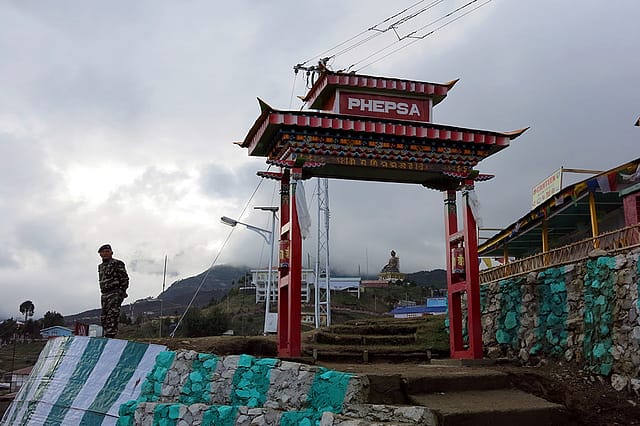
Every Dalai Lama visit to Arunachal Pradesh follows a certain pattern. China, which claims the state as its own, lodges a strong protest with India. There are warnings of serious damage to bilateral ties, and editorials about New Delhi playing its ‘Tibet card’. India’s response is usually to frame it as a purely religious visit.
It is clear to see what animates China’s anxiety. It claims Arunachal Pradesh as its own, as southern Tibet, and views every visit by the Dalai Lama as New Delhi deliberately challenging that claim and emphasizing its own sovereignty over the region. It's helpful to remember that it was independent Tibet, under the previous Dalai Lama that settled this part of the border by ceding this region in an agreement to British India, notably in the absence of China, in 1914. Tawang has historically also shared ties with the Tibetan capital of Lhasa and remains an important location within Tibetan Buddhism, and China views this as a vulnerability to the absolute control it asserts towards Tibet and Tibetan identity today. It also more specifically worries that its plans of appointing the next Dalai Lama, and thereby finding what it hopes will be a final solution to its so-called Tibet problem, will face a major challenge if the exile Tibetan Buddhist community recognises someone from this region as the next Dalai Lama.
It is thus likely that while Beijing did not issue a protest to the recently-concluded four-day conference on the 6th Dalai Lama, Tsangyang Gyatso, in Tawang. (The 14th Dalai Lama was after all not visiting, even though a representative of his, in Yangteng Rinpoche, a scholar and secretary at the Office of His Holiness the 14th Dalai Lama, was. And the conference was anyway about someone born in this region in the 17th century.) But it would no doubt have been following the proceedings with more than mild irritation.
The conference, which took place quietly, without much media attention, was a first of its kind. Organised by the Thubten Shedrubling Foundation, Department of Karmik and Adhyatmik Affairs, the Government of Arunachal Pradesh, and Centre for Cultural Research and Documentation, it took place between the 3rd and 6th October, and an array of scholars dropped in from India and abroad. There were discussions on the historical life and importance of the 6th Dalai Lama, who led an unconventional and colourful life and remains a much loved figure among Tibetans; there was talk of preserving and promoting the sites connected with his early life in Arunachal Pradesh; and how the main purpose of the conference, among other things, was to foster a closer connection with the institution of the Dalai Lama. On the last day of the conference, Pema Khandu, Arunachal Pradesh’s chief minister, said, “We came together to rediscover a heritage that belongs not only to Tawang or Arunachal Pradesh or Tibet or the wider Himalayas, but to the entire world… Let this event mark the beginning of a renewed commitment to honouring our past and shaping a future rooted in our heritage.”

The Liberation of Bengal
05 Jun 2026 - Vol 04 | Issue 74
A silent revolution ends the reign of fear
Beijing wouldn’t have been happy. Many China watchers will view the conference as a symbolic gesture on the part of India to not just consolidate its own control over the state, but also to embrace its own connection with the institution of the Dalai Lama. Interestingly, when some climbers from the National Institute of Mountaineering and Adventure Sports, which was established by the defence ministry, climbed a 20,942 foot-tall peak near Tawang for the first time last year, the ministry named the peak after the 6th Dalai Lama. This had drawn strong protests from China.
The conference comes at a time when there is much anxiety about a future when the current Dalai Lama passes away. After years of not spelling out if he wanted the institution of the Dalai Lama to continue or not, the 14th Dalai Lama confirmed earlier this year on his 90th birthday that there would be a reincarnation, and that the next would be born in a free world, identified by a trust founded by him, thereby deligitimising whoever China picks as the next Dalai Lama. Many believe that there is a high probability that the 15th Dalai Lama could be born in India, perhaps in an exile Tibetan family, or maybe even an Indian citizen, among the Tibetan Buddhist communities that live in India. Arunachal Pradesh, with its large Tibetan Buddhist population and historical ties with Tibet, could thus be a strong contender for the location of such a Dalai Lama.
At the Dalai Lama’s 90th birthday in Dharamshala, New Delhi sent a fairly prominent contingent, including Kiren Rijiju, the Union minister for minorities, who is also a Buddhist. He issued a quite unambiguous and strong vote of support for the Dalai Lama’s decision to reincarnate, saying, “nobody else has the right to decide it except him and the conventions in place.” But a day later, after a diplomatic kerfuffle ensued, with China protesting, a clarification was issued that the statements were made in the personal capacity of a ‘follower and devotee’ and that India does not take positions on religious matters.
Tibetans of course will be cautious about preserving their heritage and protecting the institution of the Dalai Lama while navigating the geopolitical competition between China and India. But could one read the conference as the groundwork being laid for a future where a new reincarnation of the Dalai Lama will have to be found? It will be too early to say that, especially given New Delhi’s caution at not revealing what is on its mind about the issue of reincarnation. But many will be watching what is going on keenly.