Devil's Trumpet was just a click away: How datura triggered Karnataka's crackdown on Amazon, Instamart, BigBasket
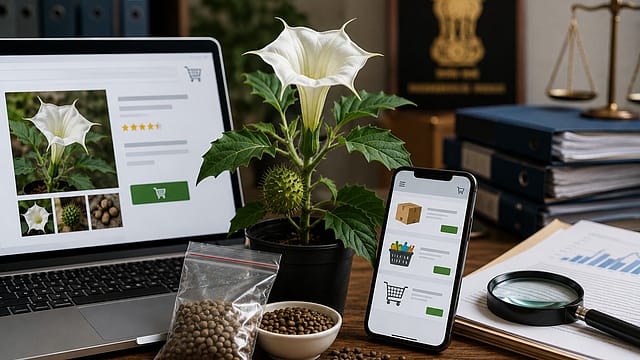
Imagine opening a grocery app to order milk, bread and vegetables.
Now imagine finding a poisonous plant on the same platform.
That is the bizarre reality that has landed Amazon, Swiggy Instamart and BigBasket in regulatory trouble in Karnataka after state food safety officials found datura fruits and seeds being sold online as food products. The Karnataka Food Safety and Drugs Administration Department has suspended the food licences of the platforms until further orders and directed them to immediately remove all listings and advertisements related to datura meant for human consumption.
The story sounds strange. But it raises a much bigger question about India's booming quick-commerce and e-commerce ecosystem: who is making sure that everything sold online is actually safe to consume?
What exactly is datura, the so-called Devil's Trumpet?
Datura is not a new discovery.
In India, the plant is commonly known as dhatura and has existed in folklore, religious traditions and traditional medicine for centuries. Its trumpet-shaped flowers have earned it nicknames such as "Devil's Trumpet" and "Moonflower" in different parts of the world.

Zeroing In on ECI
09 Oct 2026 - Vol 05 | Issue 41
Constitutional legitimacy versus political opportunism
The problem is that datura is highly toxic.
According to health authorities and toxicology experts, the plant contains powerful compounds known as tropane alkaloids, which can cause hallucinations, confusion, rapid heart rate, delirium, seizures and, in severe cases, death. The seeds are considered particularly dangerous. Karnataka's food safety department described the sale of datura as a food product as a serious public-health risk.
How did Karnataka discover it was being sold online?
The controversy began after food safety officials found datura fruits and seeds being listed and sold through major e-commerce and quick-commerce platforms.
According to the Karnataka Food Safety and Drugs Administration Department, some of these products were being displayed with food licence or registration numbers and were available through online grocery channels. Officials also found datura products stored in warehouses for distribution.
For regulators, that crossed a red line.
Selling a poisonous plant as a food item is fundamentally different from selling a decorative or botanical product. The department concluded that the listings posed a potential danger to consumers and ordered immediate action.
Why are Amazon, Instamart and BigBasket facing action?
The issue is not merely that datura existed on the platforms.
The issue is that it was allegedly being sold and displayed in a manner suggesting it could be consumed.
Following hearings with company representatives, Karnataka authorities found the responses inadequate and ordered the temporary suspension of food licences issued to Amazon, Swiggy Instamart and BigBasket until further orders. Officials also directed the platforms to stop selling, advertising or distributing datura as a food product.
According to reports, BigBasket informed authorities that it had already halted sales and would change labelling to clearly state "Not for Human Consumption." Swiggy Instamart sought additional time to submit documents, while officials noted that Amazon had not submitted a response during the proceedings.
Is this really a story about one poisonous plant?
Not quite.
The real story is about trust.
Most consumers assume that if a product appears on a grocery app, somebody has already verified that it is safe.
That assumption becomes more important as millions of Indians increasingly rely on quick-commerce services for everything from vegetables and medicines to daily essentials.
The Karnataka crackdown highlights a challenge regulators around the world are grappling with: digital shelves can be virtually infinite. Unlike a traditional supermarket, an online marketplace can host thousands or even millions of listings. Monitoring every product becomes significantly harder.
What happens next?
The platforms have been asked to submit compliance reports and remove all datura-related food listings. Karnataka authorities have also ordered action against suppliers and vendors associated with the products. Any decision on restoring licences will come only after further hearings and compliance reviews.
For now, the message from regulators is clear: if a product can harm consumers, it cannot hide behind an app interface.
The bigger question India may have to answer
For years, India's food-safety debates focused on restaurants, street food and packaged products.
The datura controversy points somewhere new.
As grocery shopping moves from neighbourhood stores to smartphone screens, the next big food-safety challenge may not be what is sitting on a supermarket shelf.
It may be what is quietly sitting in an online cart, waiting to be delivered in 10 minutes.
(With inputs from ANI)