Delhi Grapples with Toxic Air and Dense Fog, Flights Disrupted
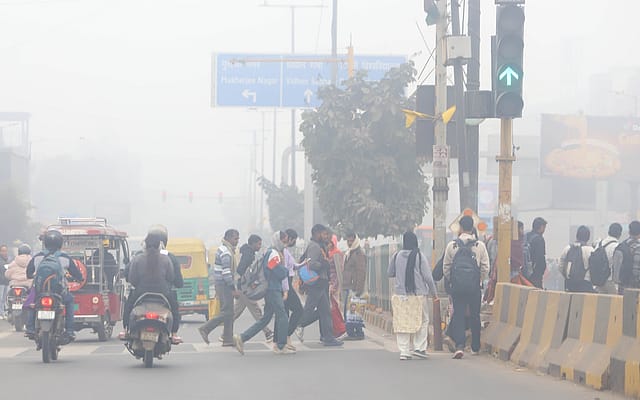
The national capital continued its battle with hazardous air quality as the AQI in Delhi reached 387 on Friday morning, firmly placing the city in the 'very poor' category and raising urgent questions about long-term public health implications.
According to data from the Central Pollution Control Board, air quality deteriorated from Thursday's reading of 373, with several neighbourhoods slipping into the 'severe' zone. As thick smog blanketed the capital, residents woke to a grim reality that has become synonymous with Delhi winters.
The crisis extends beyond mere discomfort, disrupting essential services and forcing authorities to implement emergency measures that highlight the city's vulnerability to seasonal pollution patterns.
The pollution map of Delhi reveals a troubling pattern of inequality, with certain pockets experiencing significantly worse conditions.
Anand Vihar recorded an AQI of 437, placing it firmly in the 'severe' category, while Vivek Vihar (436), R.K. Puram (436), and Nehru Nagar (425) faced similarly dangerous levels. Punjabi Bagh and Wazirpur also crossed into severe territory with readings of 412 and 406 respectively.
According to CPCB classifications, the 'severe' category begins at 401, indicating emergency conditions that can affect even healthy individuals.
However, some areas showed marginal improvement, with Dilshad Garden registering 356, Mandir Marg at 342, and North Campus at 349, though all remained in the 'very poor' bracket.

Travel Issue 2026
15 May 2026 - Vol 04 | Issue 71
The Cultural Traveller
Beyond Breathing: How Poor Delhi Air Disrupts Daily Life
The air quality crisis triggered a cascade of operational challenges across the capital. Dense fog in the early morning hours forced Indira Gandhi International Airport to implement CAT III procedures, the most advanced instrument landing system designed for near-zero visibility conditions.
Delhi International Airport Ltd issued advisories warning passengers of potential delays and schedule changes.
The specialized landing procedures, while ensuring safety, often result in operational bottlenecks as they require specific pilot training and equipment capabilities that not all aircraft possess.
To combat the rising AQI of Delhi, Environment Minister Manjinder Singh Sirsa conducted surprise inspections at fuel stations, including the Janpath and Delhi-Gurugram border, to enforce the 'No PUCC, No Fuel' rule.
Emphasizing public health over penalties, Sirsa noted that improving Delhi air is the priority: "This is not a matter of issuing challans; it is a question of clean air."
The initiative has sparked a massive response. On December 17, nearly 29,938 certificates were issued, with another 31,974 following by 5:20 pm on December 18. With over 61,000 PUCCs processed in less than two days, the government remains committed to tightening enforcement to lower the AQI.
What This Means for Delhi's Future
The recurring nature of Delhi's winter air crisis suggests that seasonal interventions, while necessary, remain insufficient to address the underlying structural issues. The convergence of vehicular emissions, construction activity, industrial pollution, and stubble burning creates a perfect storm that emergency measures can only partially mitigate.
As Delhi air continues to deteriorate annually, the capital faces a fundamental question: whether short-term fixes can ever substitute for comprehensive, year-round solutions. For residents, this means another winter of health risks, disrupted travel, and temporary measures that fail to address the root causes of pollution.
The pattern has become predictable, yet effective, long-term solutions remain elusive.
As AQI readings fluctuate between very poor and severe categories, the crisis represents a bigger challenge facing India's urban centres, where economic growth and environmental sustainability must find a sustainable balance.
(yMedia and ANI are content partners for this story)