Cabinet Clears ₹9,585 Crore Scheme to Cut Delhi-NCR Pollution, Boost Clean Mobility
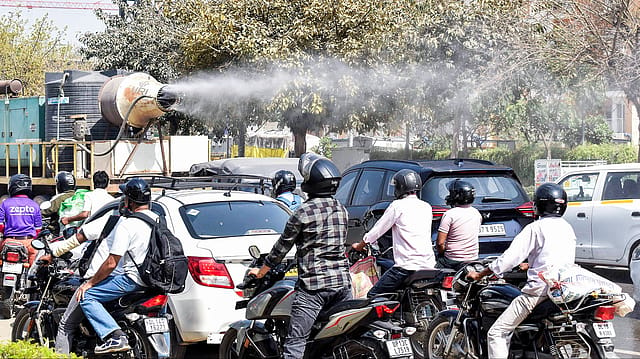
The Union Cabinet, chaired by Prime Minister Narendra Modi, has approved a landmark two-year scheme aimed at reducing air pollution in the Delhi-NCR region and promoting cleaner mobility.
The scheme will be funded through the National Capital Region Planning Board (NCRPB) under the Ministry of Housing and Urban Affairs (MoHUA) and implemented by the Ministry of Road Transport and Highways (MoRTH) and the Ministry of Petroleum and Natural Gas (MoPNG).
It will be implemented in collaboration with the participating States and Union Territories of Delhi, Haryana, Rajasthan, and Uttar Pradesh.

Zeroing In on ECI
09 Oct 2026 - Vol 05 | Issue 41
Constitutional legitimacy versus political opportunism
Briefing the media on the decisions of the Union Cabinet, Information and Broadcasting Minister Ashwini Vaishnaw said the scheme seeks to incentivise owners of trucks and buses registered in the Delhi-NCR region that comply with BS-IV or earlier emission norms to replace them with BS-VI or stricter emission-compliant vehicles, or electric vehicles (EVs).
The scheme seeks to accelerate the transition to cleaner transport technologies and has a total financial outlay of Rs.9,585 crore, including Rs.5,041 crore from the Central Government and an estimated Rs.1,601 crore in tax concessions from the participating States.
Why Is Vehicular Pollution a Major Contributor to Delhi-NCR’s Air Pollution Crisis?
Air pollution in the Delhi-NCR remains a severe public health challenge, particularly during the winter months.
As per the report 'Source Apportionment of Particulate Matter (PM 2.5 and PM 10) in the NCR' prepared by the Automotive Research Association of India (ARAI) and The Energy and Resources Institute (TERI), published in August 2018, the transport sector contributes 14% of PM 2.5, 40% of Carbon Monoxide (CO), and 63% of Nitrogen Oxide (NOx) emissions in the Delhi-NCR.
Within the transport sector, trucks and buses account for 36% of PM 2.5 emissions with only 3% of the total fleet.
It is estimated that a single Pre-BS heavy-duty vehicle emits as much as 14 BS-VI compliant vehicles. Even a BS-IV vehicle emits 2.7 times more than a BS-VI counterpart. Hence, the newer fleet is expected to reduce vehicular pollution substantially.
An official release said that the scheme will benefit approximately 2.07 lakh (1.91 lakh trucks and 16,329 buses) owners in Delhi-NCR (comprising Delhi, Haryana, Rajasthan, and Uttar Pradesh).
For BS-III or older vehicles, scrapping at Registered Vehicle Scrapping Facilities is mandatory, while BS-IV vehicles may either be scrapped or sold outside NCR in non-NCAP cities and towns.
Owners must then purchase and register a BS-VI or stricter norms compliant or electric vehicle within NCR.
However, in Delhi, Light Goods Vehicles purchased under the scheme must be electric, while buses must be BS-VI CNG or electric only. Government vehicles are excluded from the scheme.
(With inputs from ANI)