BRICS Backs Greater UN Role for India, Condemns J&K Terror Attack and Unilateral Tariffs
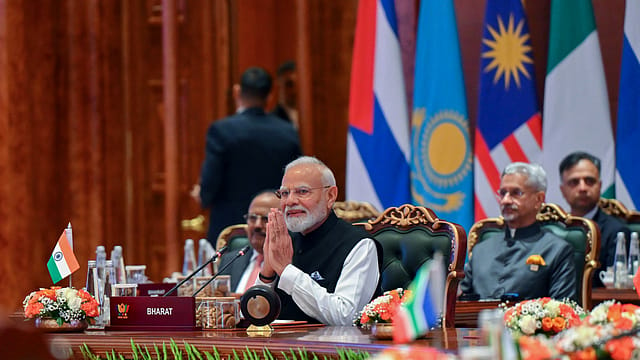
BRICS nations on Saturday adopted the New Delhi Declaration 2026, bringing together support for India’s greater role in the United Nations, a strong condemnation of the April 2025 terrorist attack in Jammu and Kashmir, and warnings against unilateral trade barriers and escalating conflict in West Asia.
Prime Minister Narendra Modi announced the declaration’s unanimous adoption at the 18th BRICS Summit in New Delhi. The document calls for reforms to global institutions while urging countries to resolve disputes through diplomacy and protect the flow of trade, energy and essential supplies.
For India, a significant provision was the reiteration by China and Russia, both permanent members of the UN Security Council, of their support for India and Brazil to play a greater role in the UN, including its Security Council.
A More Representative Security Council
The declaration reaffirmed the need to reform the Security Council to make it more democratic, representative, effective and efficient, with greater representation for developing countries.

Zeroing In on ECI
09 Oct 2026 - Vol 05 | Issue 41
Constitutional legitimacy versus political opportunism
Within that broader commitment, China and Russia reiterated their backing for the aspirations of India and Brazil to assume a larger role in the institution.
The document also called for a fairer international order and a reformed multilateral system, linking stronger representation with the development priorities of emerging economies.
Zero Tolerance for Terrorism
BRICS condemned “in the strongest terms” the April 22, 2025, terrorist attack in Jammu and Kashmir, which killed 26 people and injured several others.
The grouping reaffirmed its commitment to combating terrorism in all its forms, including the cross-border movement of terrorists, terror financing and the provision of safe havens. It demanded zero tolerance and rejected double standards in counterterrorism efforts.
The declaration also urged concerted action against all UN-designated terrorists and terrorist entities. It called for the early finalisation and adoption of the Comprehensive Convention on International Terrorism under the UN framework.
West Asia: Restraint, Civilian Protection and Nuclear Safety
Expressing deep concern over escalating tensions in West Asia, the leaders urged maximum restraint and warned against actions that could worsen the conflict.
They called for the protection of civilians and civilian infrastructure, respect for sovereignty and territorial integrity, and sustained diplomacy towards lasting regional peace.
The declaration also stressed the need to keep global trade, supply chains and energy flows moving in accordance with international law.
It expressed serious concern over deliberate attacks on civilian infrastructure and peaceful nuclear facilities under full International Atomic Energy Agency safeguards.
“Nuclear safeguards, safety, and security must always be upheld, including in armed conflicts, to protect people and the environment from harm,” the declaration said.
Gaza: Uphold the Ceasefire, Allow Aid
On Gaza, BRICS voiced deep concern over continued violence despite the October 2025 ceasefire agreement. It urged all parties to maintain the ceasefire and ensure full, unhindered humanitarian access.
The grouping called for relevant UN General Assembly and Security Council resolutions to be implemented and demanded a halt to policies aimed at forcibly displacing Palestinians from Gaza.
It also expressed concern about arrangements that could undermine Palestinian rights or legitimise or prolong occupation.
A just and lasting settlement of the Israeli-Palestinian conflict, the declaration said, must be achieved peacefully and fulfil Palestinians’ legitimate rights, including self-determination and return.
Tariffs and Sanctions Under Scrutiny
The declaration warned that rising unilateral tariff and non-tariff measures distort trade, threaten global supply chains and create uncertainty for international economic activity.
BRICS reaffirmed support for an open, fair, inclusive and rules-based multilateral trading system, alongside reform of the World Trade Organization. It called for the immediate restoration of a fully functioning, two-tier binding WTO dispute settlement mechanism.
The leaders also condemned unilateral economic and secondary sanctions that they described as contrary to international law, citing their adverse consequences for development, health and food security.
More Diplomacy, Stronger Arms Control
Beyond individual conflicts, the declaration warned of growing polarisation, distrust and fragmentation in the international order.
It urged political and diplomatic measures to reduce tensions and address the root causes of conflict. Members agreed to explore cooperation in conflict prevention, UN peacekeeping, African Union peace support operations and mediation.
The grouping also expressed alarm over rising global military spending, arguing that it was coming at the expense of adequate development financing for poorer countries.
Concern over nuclear risks prompted a renewed call to strengthen disarmament, arms control and non-proliferation mechanisms. The leaders reaffirmed support for existing nuclear-weapon-free zones and efforts to establish a zone free of nuclear weapons and other weapons of mass destruction in West Asia.
The declaration concluded by committing the expanded BRICS grouping to deeper political, security, economic, financial and people-to-people cooperation. It commended progress under India’s 2026 chairship, calling for practical, inclusive and development-focused action.
With inputs from ANI