BRICS 2026: India Sets the Agenda with New Logo and Digital Platform
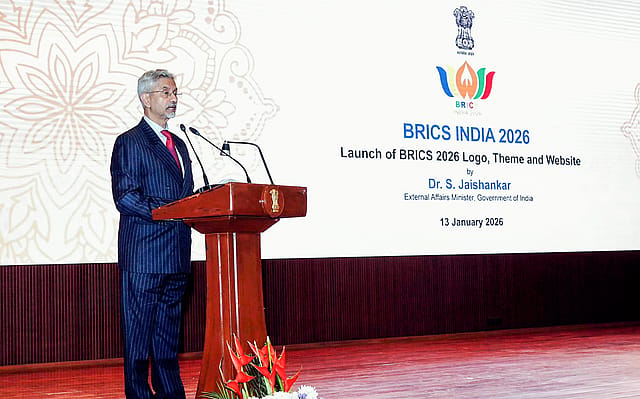
External Affairs Minister S Jaishankar on Tuesday unveiled the official logo and website for BRICS 2026, marking the formal start of India’s preparations to chair the influential grouping later this year.
The launch signals India’s intent to deepen engagement, coordination, and communication among BRICS nations as the forum approaches a significant milestone—its 20th anniversary in 2026.
Inspired by the lotus, the newly unveiled logo reflects India’s civilisational ethos while symbolising resilience and renewal. The petals carry the colours of BRICS member nations, representing diverse voices united by a shared purpose. At the centre sits the Namaste gesture, underscoring respect, inclusivity, and collaboration—values India plans to foreground during its chairship.
The Modi Years
02 Oct 2026 - Vol 05 | Issue 40
A Nation Rebuilt
The logo is accompanied by the tagline: “Building for Resilience, Innovation, Cooperation and Sustainability.” According to officials, the emblem captures a people-centric vision of BRICS, placing emphasis on solidarity, mutual respect, and collective progress.
Alongside the logo, Jaishankar also launched the official BRICS 2026 website, which will serve as a central digital platform for information on initiatives, projects, events, and official documents related to the grouping. The portal is intended to improve transparency and coordination as India steers BRICS through a year of expanded global expectations.
Speaking after the launch, Jaishankar said India’s chairship would focus on advancing global welfare, particularly at a time when multilateral institutions are under strain and emerging economies are seeking a stronger collective voice.
BRICS—comprising Brazil, Russia, India, China, and South Africa—has expanded significantly in recent years. Egypt, Ethiopia, Iran, and the UAE joined as full members in January 2024, followed by Indonesia in January 2025. Several countries, including Belarus, Bolivia, Kazakhstan, Cuba, Malaysia, Nigeria, Thailand, Uganda, and Uzbekistan, have since been inducted as partner nations.
According to the Ministry of External Affairs, the expanded BRICS grouping now represents around 49.5% of the world’s population, about 40% of global GDP, and nearly 26% of global trade, cementing its status as a major force in the global economic and geopolitical landscape.
The idea of BRIC was first articulated in 2001 by Goldman Sachs, which projected that Brazil, Russia, India, and China would emerge as dominant forces in the global economy. The grouping took formal shape in 2006, held its first summit in 2009, and expanded to include South Africa in 2011, becoming BRICS.
Over the years, BRICS has evolved into a platform for cooperation across trade, investment, technology, sustainable development, and reform of global governance institutions. With India set to lead the forum in 2026, expectations are high that New Delhi will push for a more inclusive, development-oriented agenda and strengthen the bloc’s global footprint.
(yMedia and ANI are content partners for this story)