Ayodhya’s 7D Ramkatha Museum Explained: Inside the World’s First Immersive Ramayana Experience
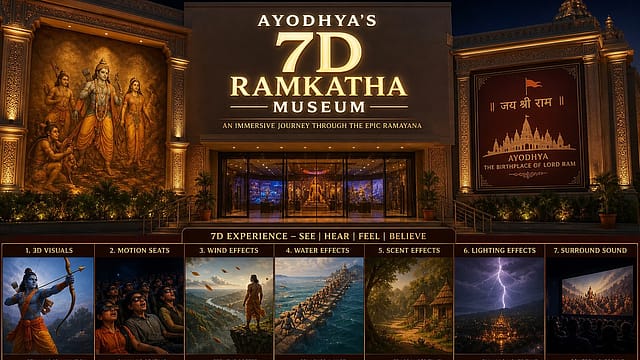
What if you didn’t just read the Ramayana—but walked through it?
Ayodhya is building exactly that. A museum that doesn’t just display history—it stages it. With 7D technology, AI-driven storytelling and holographic recreations, the upcoming International Ramkatha Museum aims to turn one of India’s oldest epics into a fully immersive, sensory experience.
Construction has entered its final phase. The ambition? Global.
Here’s everything you need to know.
What is the Ramkatha Museum?
The International Ramkatha Museum in Ayodhya is an upcoming cultural space dedicated to narrating the life and legacy of Lord Ram. But this isn’t a conventional museum. It combines traditional storytelling with advanced technologies like 7D effects, artificial intelligence, and holograms to recreate key moments from the Ramayana—turning static exhibits into lived experiences.

Zeroing In on ECI
09 Oct 2026 - Vol 05 | Issue 41
Constitutional legitimacy versus political opportunism
What does “7D experience” actually mean here?
Think beyond 3D visuals. The museum’s 7D setup layers motion, sound, environmental effects, and interactive elements to simulate scenes from the Ramayana. Visitors won’t just watch events unfold—they’ll feel them, as if placed inside the story. It’s being positioned as a first-of-its-kind application of 7D technology in a museum setting globally.
What is the ‘Sankat Mochan’ Hanuman Gallery?
At the heart of the experience is a dedicated space inside the “Sankat Mochan Vithika”—a gallery focused on Lord Hanuman. Hanuman takes centre stage here through a 20-minute immersive 7D film that showcases his most iconic feats—from devotion to battlefield heroics. The name “Sankat Mochan” (Remover of Troubles) isn’t incidental—it frames Hanuman as both the narrative anchor and emotional core of this immersive journey.
What will the museum showcase?
The museum will feature 20 galleries, each mapping a different phase of Lord Ram’s life, including birth and early years, education and training, exile (Vanvas) and the war in Lanka. These galleries combine storytelling with visual technology to recreate the arc of the Ramayana in sequence.
Will there be historical artefacts too?
Yes—and this is where the museum bridges mythology and history.
It will display over 100 artefacts and sculptures unearthed during the excavation of the Ram Temple site; documents linked to the 500-year-long Ram Temple movement; and a rare 233-year-old manuscript of the Valmiki Ramayana, recently gifted to the museum. So, while the experience is immersive, it’s also archival.
Who is building the technology behind it?
The project brings together both Indian and international expertise. Teams from IIT Madras are working alongside technical collaborators from France—handling both the technology stack and narrative scripting for the immersive experience.
What stage is the project at right now?
The museum is in its final phase of civil construction, with a target to complete structural work by the end of May. After that, the focus shifts to installing exhibits and setting up galleries. Some display pedestals are already ready, while others are being prepared in conservation labs.
Why is the construction being done in phases?
Because the artefacts are fragile. Manuscripts, textiles and stone objects are highly sensitive to dust and environmental exposure. Authorities chose to complete all heavy civil work first to minimise the risk of damage before installing these items.
What about the building itself?
Interestingly, the structure wasn’t originally designed for this purpose. It was built in a British architectural style—but has since been redesigned to reflect traditional Indian aesthetics, aligning the physical space with the cultural weight of the content it will house.
What makes this museum globally significant?
Two things stand out. First, the scale of immersion—using 7D technology and AI not as add-ons, but as the core storytelling medium. Second, the fusion of mythology, history and technology—placing ancient narrative, archaeological evidence, and modern experience design in one space. The ambition is clear: not just to attract visitors, but to position Ayodhya as a global cultural destination.
When will it open?
There’s no official public opening date yet. But with civil work nearing completion and display installations set to begin soon, the museum is moving steadily toward launch.
(With inputs from ANI)