Ashwini Vaishnaw Unveils India’s Roadmap for AI and Semiconductors
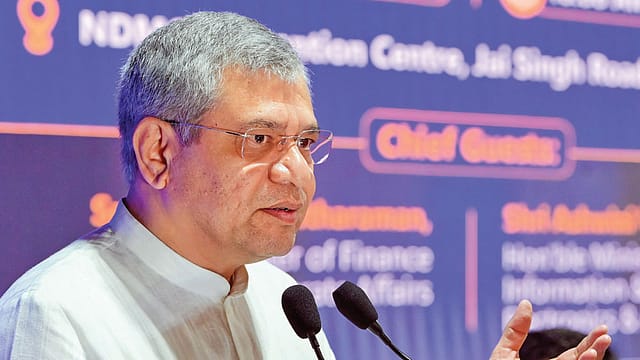
Highlighting India’s expanding digital infrastructure, Ashwini Vaishnaw said the country has already attracted nearly $70 billion in data centre investments, with total commitments nearing $90 billion. He expressed confidence that this figure could soon exceed $200 billion.
Speaking at a Qualcomm event in New Delhi, the minister said data centres would become a major pillar of India’s growth journey. These facilities will provide the high-end computing power needed for artificial intelligence, cloud services, and next-generation digital solutions.
According to Vaishnaw, stronger data centre capacity will allow Indian startups and service providers to develop advanced technologies at home and compete globally. He stressed that access to reliable computing infrastructure is essential for building all five layers of the AI stack.
Boosting India’s AI and Startup Ecosystem
The data centre boom is expected to directly benefit India’s fast-growing startup ecosystem. Vaishnaw said many young companies are eager for affordable and scalable computing facilities to develop innovative products and offer solutions worldwide.

The Modi Years
02 Oct 2026 - Vol 05 | Issue 40
A Nation Rebuilt
With India positioning itself as an AI-driven economy, data centres will play a critical role in enabling research, product development, and deployment across sectors such as healthcare, mobility, finance, and smart cities.
The minister noted that this digital expansion aligns with the broader India-US trade framework, which aims to strengthen supply chains and technology cooperation between the two countries.
Semicon 2.0 and the Push for Advanced Chips
Alongside data centres, Vaishnaw announced the upcoming Semicon 2.0 mission, focused on strengthening semiconductor design, manufacturing equipment, materials, and talent development.
The mission aims to expand fabrication plants and ATMP units while helping India move from 28-nanometre technology to advanced 7-nanometre chips. A 20-year roadmap is being prepared to support long-term growth in the sector.
He said the next phase will prioritise deep technical training, enabling students to design complete systems and strengthening India’s self-reliance in chip manufacturing.
Building a Global Talent and Innovation Hub
Showcasing India’s progress, Vaishnaw displayed a silicon wafer containing up to 30 billion transistors per chip, capable of powering AI applications in devices, vehicles, and industrial systems.
He highlighted the success of Semicon Mission 1.0, under which 67,000 semiconductor engineers have been trained in just four years. Today, 315 universities and colleges offer advanced design tools, allowing students to develop and validate real-world chips.
Sharing this model at global forums such as Davos, the minister said India is well placed to bridge the worldwide semiconductor talent gap. He added that recent budget reforms and IT-sector simplifications will further attract international investment.
Vaishnaw also underlined India’s transition from being a back-office destination to an end-to-end semiconductor innovation hub, covering design, testing, validation, and manufacturing.
(With inputs from ANI)