AI Summit 2026: Learn 10–15 AI Tools to Stay Relevant, Says Info Edge Founder Sanjeev Bikhchandani
Info Edge founder Sanjeev Bikhchandani on Monday said Artificial Intelligence is both inevitable and transformative, warning young professionals that those who fail to adapt risk being left behind.
Speaking at the AI Impact Summit 2026 in the national capital, the Info Edge founder described AI as “relentless” and unavoidable. “It is happening whether you like it or not. If you don’t do AI, AI will be done to you,” he said.
Bikhchandani stressed that AI should not be seen merely as a job destroyer but as a powerful tool for expanding productivity and reaching untapped markets. “AI is both a threat and an opportunity. Some jobs will be lost, and many will be created. The way forward is to upskill and learn AI platforms,” he told ANI.

Zeroing In on ECI
09 Oct 2026 - Vol 05 | Issue 41
Constitutional legitimacy versus political opportunism
Explaining how companies are using technology to serve previously unviable segments, he cited the example of deploying AI-powered voice bots to connect with thousands of low-paying clients. “It doesn’t make financial sense to have a person calling them. So we put a chatbot, a voice bot. You can’t even make out it’s not a human being,” he said. “Now what is happening is stuff that was not getting done is getting done. We have served an underserved market by using AI.”
He added that such applications have improved efficiency without replacing workers. “Nobody is thrown out of a company because of AI. Right now, it’s being used to increase productivity and do stuff better,” he said.
Sharing a personal anecdote from his early career, Bikhchandani recalled how learning to use computers and presentation software during his MBA made him indispensable at work. “While others were making slides by hand, I was building digital presentations. Not because I was smarter, but because I knew a new technology,” he said. “That is what AI feels like today.”
Addressing students and young professionals, he urged them to focus on practical skills rather than grand technological debates.
“You don’t need to build large language models. Learn five to fifteen useful AI tools. The older generation won’t adopt them as quickly. If you become AI-enabled, you become more productive, more valuable, more relevant,” he said.
Echoing similar views, Vineet Nayyar, Founder-Chairman of Sampark Foundation and former CEO of HCL Technologies, said AI would significantly reshape employment. “Fifty per cent of jobs are going to go away because they will get automated, but there will also be fifty per cent more jobs,” he said. “India is now seeking global attention by articulating AI use cases for social impact.”
Chief Economic Advisor V Anantha Nageswaran said India has the potential to become one of the world’s largest societies where human capability and machine learning reinforce each other. He stressed that this would require political will, strong institutions and collaboration among the private sector, academia and policymakers.
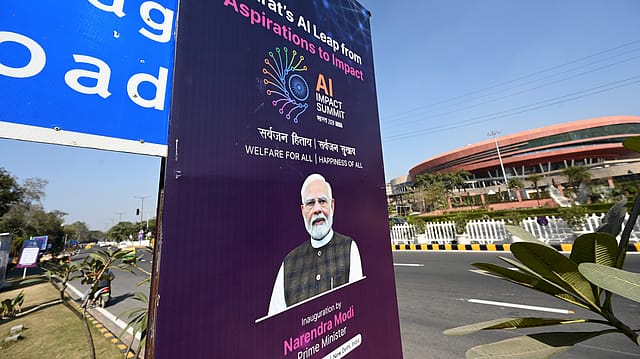
The summit, which began on Monday in New Delhi, will host leaders from over 20 countries, including French President Emmanuel Macron, Brazilian President Lula da Silva, Sri Lankan President Anura Kumara Dissanayake and UN Secretary-General Antonio Guterres.
As debates continue over automation and employment, Bikhchandani’s message remained clear: “AI is expanding the pie. It is not about replacing people. It is about empowering those who are willing to learn.”
(With inputs from ANI)