A quiet revolution is taking place in Punjab through Mothers Against Drugs
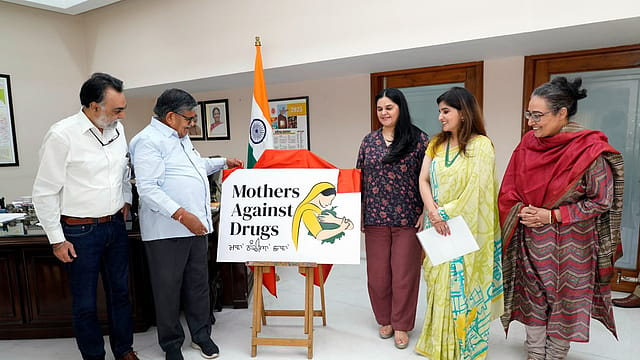
American thinker Ralph Waldo Emerson once said, “Men are what their mothers made them.” It is perhaps on the foundation of this premise that the campaign Mothers Against Drugs in Punjab is built. Mothers Against Drugs, or MAD as some people refer to it, has its origin in Punjab amidst such quiet madness, for the drug consumption situation in the state has outgrown a mere public health crisis and become the frightening prospect of losing a generation.
The autumn of 2023 was giving way to winter. I was lounging and doom scrolling through social media reels when I came across two videos of drug overdose deaths. While it was unfortunate that, instead of trying to save the boys, people were recording videos of their last moments to score a point against the Punjab government's anti-drug campaign, the videos triggered a sense of frustration and rage at everything around me. It struck me that Punjab had become a spectator to its own tragedy.
Losing Memory
16 Oct 2026 - Vol 05 | Issue 42
The making of a medical and social emergency
In the heat of the moment, I resolved to start walking against drugs as my own expression against the situation. Until then, my expression of rage had found its way only into the pages of my writing. But this needed action. Civil society had to build a narrative against drugs and not leave it to politicians, who, in Punjab, have used the issue only to attain or retain power. I can say this in writing: they would abandon their anti-drug narrative the day they found a hotter issue to win votes.
Called The People's Walk Against Drugs, the ninety-five-kilometre walk, which began with a simple ardaas, started from New Chandigarh and ended at Bhagat Singh's native village, Khatkar Kalan. I was told I would fail and that the walk would be meaningless. Someone said I needed to turn it into a carnival to make it effective. But then someone sent water, someone packed paranthas for the walkers, someone got sweatshirts printed, and an editor saw the resolve and carried the headline: "Author Khushwant Singh to Lead The People's Walk Against Drugs." There we were, about a score of us on the first day, walking a lap of nineteen kilometres.
Soon, eminent personalities began joining the walk. Held every year since then, it has covered nearly 170 kilometres and is joined annually by the Governor of Punjab, Shri Gulab Chand Kataria, who has lent his moral support to the initiative. "Khushwant ji, main aap ke saath chaloonga," he said to a complete stranger he was meeting for the first time.
While walking through villages and schools, one question kept troubling me. Who is the first person to know that something is wrong with my child before anyone else? The answer lay right in front of me. Of course, mothers. The large turnout of women at the walk, their questions, and their searching eyes looking for answers said it all. Some women that the governments over the years had turned a bling eye to the prevalent drug pedaling, while some asked where they could take their husbands, children or brother for rehabilation. The conversations were free flowing.
It was from these walks and conversations that Mothers Against Drugs was born. Perhaps an idea that was waiting to be found. Interestingly, the Meir Paibi movement of the ninenteen seventies was in Manipur was very akin to this, which I found later while researching to develop the project.
Soon these initiatives, the annual walk and Mothers Against Drugs were brought the banner of Punjab Lit Foundation, a Section 8 non-profit company co-founded by me and another go-getter, Sanna Kaushal. It had to make a shift from an individual effort to an organizational strength. Hailing from my hometown of Hoshiarpur, Sanna had earlier brought the city's first literary festival to life.
"We are taking this path for now," I told her. "We will build mothers as the first line of defence against drugs in Punjab and call our programme Mothers Against Drugs (MAD)." She was a tad circumspect. How would we build it? Who would support us? Why would people listen to us? "Let's give it a shot," I said, for I have always believed that well begun is half done.
There we were, meeting the Hoshiarpur Deputy Commissioner, Komal Mittal, with our idea. She immediately grasped what we intended and lent her full support. Mothers Against Drugs made its debut in September 2024 in the Bullowal subdivision of Hoshiarpur. There was a turnout of hundreds of women, and I remember overhearing a police officer tell his colleague, "Sir, je eh programme dhooh phad gaya, aag laga dao" (Sir, if this programme catches on, it will spread like wildfire). We knew we were on the right path.
The programme is centred on a simple idea. A mother's instinct is unmatched. If empowered with knowledge and information to recognise the early signs of addiction, she can become a very powerful pehli deewar against drugs in Punjab. It is something like patriotism. We are all patriotic, but the moment we receive military training, we begin to think differently. This is exactly what we have seen unfold.
Scores of women started walking up to us saying, "Kithe si?" (Where were you?). "We could have saved our husband, brother or child had we known these things earlier."
Confident of our approach, where every session includes a behavioural expert to empower mothers, each programme left us with a new learning. The first was that we could ill afford to hold events in villages. The cost of putting together a stage, microphones, projectors, generators, tents and chairs was prohibitive. In the absence of financial support from Punjab's corporates or philanthropists, this model was simply not sustainable.
Soon, we started approaching schools, urging principals to hold special meetings for mothers of children from Classes VIII to XII. It was an ideal model. We reached the exact target group, and schools already had the infrastructure required to hold such sessions. Some principals were very receptive. Others, especially in private schools, were dismissive. They felt that talking about drugs would damage their brand by suggesting that drug abuse was common in their schools.
Our argument was exactly the opposite. We assumed their children were clean. But the spread of addiction was so rapid and pervasive that it was time to equip both parents and students with the knowledge to ensure they never became victims. Their reluctance did not discourage us. We held on to our cheerleaders, self-funded the initial programmes and simply refused to let the idea die because some people were not supportive.
Every programme gave us a new learning. At a recent consultation organised by Punjab Lit Foundation in Chandigarh to strengthen the initiative, perhaps the most valuable feedback was that we should begin meeting mothers of children younger than Class VIII. By the time teenagers reach Class VIII, a mother's influence may already be beginning to wane.
Over the last two years, Punjab Lit Foundation has sensitised more than eight thousand mothers, the details of which can be found at www.punjablitfoundation.com. For us, each mother sensitized is a child saved. Its programmes have criss-crossed Punjab and the Union Territory of Chandigarh and continue to gather momentum. Sessions have been held in schools across both rural and urban areas. The Foundation is now organising a Governor's Special Session to build further momentum, while simultaneously strengthening the campaign at the grassroots.
Sanna Kaushal, who spearheads the programme, has also structured the Ludhiana Homes Outreach Programme. Through it, Punjab Lit Foundation is creating resource persons who can take these conversations into kitty parties and the drawing rooms of mothers. If successful, the model will be expanded to other cities and eventually to villages through Anganwadi workers.
All that the movement now needs is Punjab's support, and people willing to act, rather than remain mere spectators.
(Khushwant Singh is an author, co-founder Punjab Lit Foundation and has been State Information Commissioner, Punjab)