3 Years After Hamas Attack, Israeli Family Walks India in Son's Footsteps
There is a photograph Ela Bahat keeps.
In it, she is standing beside her son, Dror. Around his neck hangs a necklace, unusual, one of a kind, bought years earlier from a jewellery designer in a small shop on a beach in India.
In February 2025, Ela went looking for the woman who made it.
THREE YEARS, NO CLOSURE
On the third anniversary of the October 7 Hamas attack, Idan Bahat doesn't need a date to remember his son.
"It has been three years, but we are trying to continue with our lives," he told Open Magazine. "There is an emptiness in our family. The void that our son left us can never be filled. What was his fault?"

The Modi Years
02 Oct 2026 - Vol 05 | Issue 40
A Nation Rebuilt
Idan and his wife, Ela, don't wait for an anniversary. "We remember him each day," they say.
Dror was 30 when he was killed at the Supernova music festival in southern Israel in 2023. Before that, he was a young man who went to India after his army service and stayed a long time. He came home with a love for the country that never faded.
His family has spent the years since finding ways to carry him. One of them took them across a border, and into the places he had loved.
A BOY FROM THE KIBBUTZ
Dror grew up in Beit Alfa, a kibbutz in northern Israel, the fourth generation of his family to live there. He was restless, sporty, impossible to keep still. He learned to ride a unicycle and competed abroad. He grew into a cyclist. He painted.
At 15, he moved with his family to Lagos, Nigeria, for two years and attended an international school there. Back in Israel, he finished high school and joined the Air Force as a mechanic. When he was released, he went to India.

Young Israelis often travel to India after the army, and many stay for months. For Dror, it became more than that. His father says he simply loved the country.
When he came home, he adopted a dog named Leider. For six years, the two were rarely apart. Leider rode along on trips all around Israel.
Dror worked for several years installing solar panels, then started his own company building backdrops and sets for music festivals. He moved to Kibbutz Sde Nahum, not far from where he grew up.
A boy from a kibbutz who built the stages where other people's best nights happened.
THE LAST NIGHT
Friday, October 6, 2023.
Dror and his crew were working on the Supernova site near Kibbutz Reim. He was in charge of the design that day. They worked until 2 am, then went to rest in Ashkelon.
At 6 am, they were called back to fix something at the site.
Not long after, the Hamas attack began. Dror and his crew hid under the stage for several hours. He texted his family and asked them to send help.
Those messages were the last they heard from him.
Dror and three of his employees, Shoval Yaakov, Oded Abergel and Avidan Torgeman, were killed at the festival.
He was buried on October 11 in Beit Alfa. He left behind his parents and his younger siblings Adi, Ziv and Gil.
According to Israeli police, 364 people were shot, beaten or burned to death at the Nova festival, in a stretch of brush dotted with trees. Another 40 were taken hostage into Gaza, about five kilometres away.
THE DOG WHO WAITED
Leider is still with the family.
Idan says the dog was Dror's best friend.
"He left the dog with us and said, take care of him until I come back," Idan says.
"He never returned."
A few months ago, Leider had surgery and lost a leg. He now lives on three. The family says he was inconsolable for weeks after Dror died.
He is the living link to the son they lost.
Grief needs somewhere to go. The Bahats have been looking for it ever since.
In January 2024, some of the bereaved Nova families returned to the festival site. They joined the Jewish National Fund to plant trees, hoping to bring something living to a place where so many had died.
"I still can't believe that we were planting a tree instead of hugging our child," Ela said.
Around her, other relatives wept as they pushed saplings into the ground.
Since then, the family has kept going, one act of remembrance at a time. They organised an exhibition of Dror's paintings, so people could see another side of him. They held a tree-planting drive in his memory at the kibbutz where he was born. Now they are planning a cycling event in his name.
The unicycle boy. The painter. The man who built stages. Each thing they do gives a different part of him somewhere to stand.
FOLLOWING HIS FOOTSTEPS
In February 2025, sixteen months after Dror's death, the family took the biggest step yet.
Idan, Ela and their daughters, Ziv and Gil, flew to India. They began in Goa, on the beaches Dror had known. Anjuna. Arambol. Then inland to Hampi in Karnataka, where the ruins of an old empire lie scattered among enormous boulders. Then back to Goa and Palolem Beach.
They had no tour plan. They had a list of places Dror had been, and they meant to stand in every one.
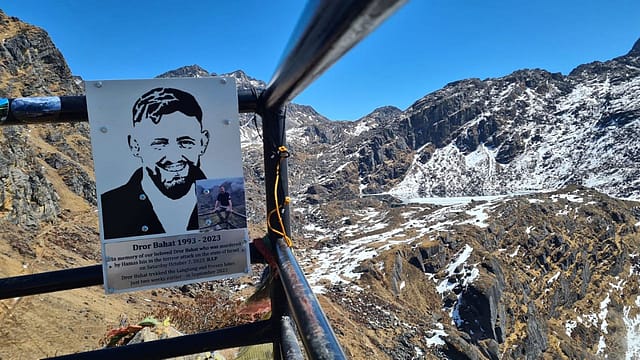
From India, they went on to Nepal. High in the cold, near the edge of a frozen lake, they placed a memorial sign for Dror. A small marker, far from home and far from the field where he died, in a place that holds only quiet.
But the moment the family still talks about most came in Arambol.
Years earlier, Dror had bought a necklace there from a jewellery designer named Lina. It was unusual, one of a kind. It is the necklace in Ela's photograph.
The family set out to find Lina.
They did.
After all those years, they met her again. A stranger who had once sold a piece of jewellery to a young traveller was now part of how his family remembered him.
TWENTY-ONE DAYS TO THE POLLS
Israel votes on October 27, three weeks from now, in its first national election since the Hamas attack. The vote is widely seen as a referendum on Prime Minister Benjamin Netanyahu's leadership since the Gaza war began. Surveys have suggested his coalition of nationalist and religious parties could lose, though his rivals still have no clear path to power. Netanyahu has said he wants to run and win another term.
Idan says his family wants him gone.
"We live in hope that in three weeks, in the Israel elections, this bad government of Netanyahu is ousted and replaced," he says. "It is three years, and still Netanyahu and his ministers are in power and continuing. We are expecting him to go away."
"It will help us if Netanyahu goes so that we can continue with our lives more easily," he adds.
Many Israelis share his anger over the security failures of October 7, and it still weighs on Netanyahu's standing.
The Bahats' loss sits inside a far larger one.
October 7 did not end that day. Israeli officials say about 1,200 people were killed and about 250 taken hostage. Israel's assault on Gaza has since become one of the deadliest and most destructive wars of recent times.
Gaza figures now show 74,243 Palestinians killed and 175,232 injured, with thousands more missing under the rubble. More than 21,500 of the dead are children. More than 58,000 children have been orphaned. The Hamas-run health ministry in Gaza and the UN have long said women and children make up a large share of the dead; the UN says it has confirmed at least 56 percent.
The health system has been shattered. About 1,700 doctors, nurses, paramedics and other health workers have been killed. A total of 38 hospitals and 96 health centres have been destroyed or forced out of service, and 197 ambulances have been hit. Gaza officials say 263 Palestinian journalists have been killed. Foreign reporters have largely been kept out of Gaza throughout the war.
Gaza officials say 82 percent of buildings have been damaged and 134,422 completely destroyed. About 2.15 million people, roughly nine in ten residents, have been forced from their homes, and many live in tents or damaged buildings.
A U.S.-backed ceasefire took effect on October 10, 2025. The ministry says Israeli fire has since killed 1,460 more Palestinians.
Behind each of these numbers is a family much like the Bahats, left with a photograph, a name and a long road of grief.
Three years on, Idan and Ela don't talk about closure. They talk about keeping Dror alive in memory, and everything they have done is one way of doing it: the paintings on a wall, the saplings in the ground, the cycling event still to come, the long trip to India.
They walked the beaches he walked. They stood among the stones of Hampi. They placed a sign by a frozen lake in Nepal. And in a small shop in Arambol, they found a woman who remembered the young man who had loved her work.
Back home, a three-legged dog waits for a man who told his family he would come back.