Nepal flood recovery: PM Modi announces Rs 24,000 crore package, 8 MoUs
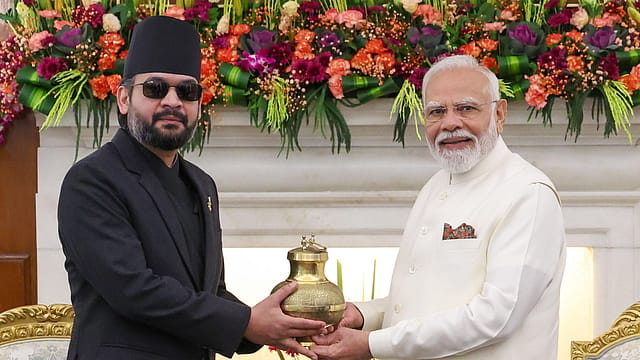
Can a flood-reconstruction package become the starting point for a broader reset in India-Nepal ties? Prime Minister Narendra Modi and Nepal's Prime Minister Balendra Shah have announced a 24,000-crore Nepali rupee development package, alongside agreements and infrastructure projects spanning energy, healthcare, transport and technology.
Shah's two-day visit, his first bilateral trip since taking office in March, comes after devastating floods in Nepal in August. The announcement on Monday, November 23, was accompanied by eight memorandums of understanding (MoUs) and six major connectivity, energy and infrastructure initiatives.
Why has India announced a Rs 24,000-crore package for Nepal?
The package is aimed at helping Nepal rebuild after the August floods, which caused widespread destruction. The disaster reportedly killed around 1,500 people, while more than 5,200 remain missing and are presumed dead.

The Wealth Issue 2026
06 Nov 2026 - Vol 05 | Issue 45
Portraits of Dreamers and Doers under 35
Addressing a joint press statement at Hyderabad House, PM Modi said, "We express our deep condolences for the loss of lives caused by the severe floods in Nepal in August. And today, to provide new strength to Nepal's reconstruction and long-term development, we announce a Development Cooperation Package of 24,000 crore Nepali rupees."
He added that the initiative would help affected families rebuild their lives, create opportunities and strengthen Nepal's ability to respond to future disasters.
What did PM Modi say about Balendra Shah's leadership?
PM Modi welcomed Shah, praising the mandate given to him by Nepal's voters and the vision he had outlined for the country's future. "A few months ago, when he addressed the UN as the world's youngest Prime Minister, we saw a clear glimpse of his vision. And today, during our discussions over the past few hours, I have felt his clear vision and commitment for the future of Nepal and for India-Nepal relations," PM Modi said.
The visit marks an important diplomatic engagement between the two neighbours as they seek to deepen cooperation in development, infrastructure and economic growth.
What are the eight India-Nepal agreements?
The two countries signed eight MoUs covering satellite communications, policing and forensic sciences, civil-service training, healthcare, Ayurveda, sustainable urban development, livestock and fisheries.
The agreements include cooperation between ISRO and Nepal's Ministry of Information and Communication on the South Asia Satellite network, partnerships involving India's National Forensic Sciences University and Rashtriya Raksha University, and training programmes for Nepalese civil servants.
Healthcare agreements cover medical cooperation and traditional systems of medicine, while others focus on urban development and agriculture-related sectors.
Which six major projects were announced?
The leaders inaugurated and advanced projects involving cross-border connectivity, energy and petroleum infrastructure. The Saryu-Kamala Express linking Ayodhya and Janakpur Dham was launched, strengthening pilgrimage connections between the two countries. A motorable bridge linking Dharchula in India and Darchula in Nepal was also inaugurated.
The leaders laid the foundation stone for the 669 MW Lower Arun hydropower project, the Banbasa Integrated Check Post and a petroleum terminal in Jhapa. They also dedicated Phase II of the Motihari-Amlekhgunj petroleum pipeline.
Why are India-Nepal ties strategically important?
India and Nepal share a border, religious traditions, economic links and longstanding people-to-people connections. Nepal is also an important partner for India in hydropower, trade and regional connectivity.
The two countries have been working to expand electricity cooperation, infrastructure and transport links. Nepal has also been seeking additional air routes through Indian airspace, an issue that remained unresolved ahead of Shah's visit, according to the Kathmandu Post.
The latest agreements and projects signal a push to translate the longstanding relationship into more tangible economic and infrastructure cooperation.
(With inputs from ANI)