‘The Revolutionaries’: In the Footsteps of Freedom

“I was the oldest person on the set,” says Nikkhil Advani, the director of The Revolutionaries, a new series on Prime Video about a group of young Indians who took on the British between 1912 and 1919. With a team consisting almost entirely of young heads of departments, Advani spent a year in prepping, a year in shooting and another year in post production, using 120 sets created on Madh Island near Mumbai. The result is something to be proud of: the discovery that the freedom movement was not an event but a series of interconnected struggles, stretching from the First War of Independence in 1857 to Independence in 1947.
The Revolutionaries, based on the eponymous book—Revolutionaries: The Other Story of How India Won Its Freedom (2023)—by Sanjeev Sanyal, presents the young men and women who fought against imperialism between 1912 and 1919, beginning with Rash Behari Bose’s failed attack on Lord Hardinge on December 23, 1912, during a ceremonial procession in Delhi. Playing the revolutionaries Bose, Bagha Jatin (Jatindranath Mukherjee), Sachindra Nath Sanyal, and his wife Pratibha is an extraordinary collection of young actors from the Mumbai film industry. While Bose is played with great élan by Bhuvan Bam, Rohit Saraf plays the young and impressionable Sanyal, grand uncle of the writer Sanjeev. Pratibha, his eventual wife, is played by the luminous Pratibha Ranta and Gurfateh Pirzada embodies Bagha Jatin’s swagger and purpose.
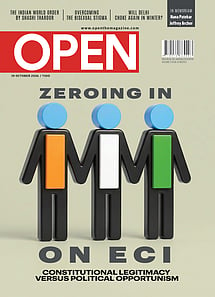
Zeroing In on ECI
09 Oct 2026 - Vol 05 | Issue 41
Constitutional legitimacy versus political opportunism
They were the Gen Z of their time, says Advani, who wanted them to look like cool Bandra boys. The minute they appeared on the set, he told his young actors to forget everything they had read and absorbed and just feel the characters’ fire and enthusiasm. Their love for poetry, for Robespierre, and for India was an element that the young cast took to heart but at the core of their work was yearning. A yearning for a time when they could live and love freely.
The series explores their connections, some known and others not so well known. Several discoveries amazed Advani, among them the transfer of Bose’s pocket watch to Sanyal and then from there to Bhagat Singh. Advani was enthralled by the letters of Lala Hardayal and the poetry of Kartar Singh Sarabha. Lala Hardayal and Bose were key organisers of the Ghadar Mutiny, a pan Indian plan to organise a revolt among the Indian soldiers in World War I who had been promised pensions and land for their service. Sarabha, also a member of the Ghadar Party, was all of 19 when he was executed for his revolutionary activities. Bhagat Singh carried his photograph with him, and was inspired by his immense courage.
For Sanyal, it is thrilling to see his book on screen. “To be sure, it is not a documentary but done as a thriller. Sometimes writers and the director can have artistic frictions, but I had a great experience working with Nikkhil Advani, Prime Video and Emmay Entertainment (a production powerhouse started by Advani, Monisha Advani and Madhu Bhojwani in 2011). Of course, changes had to be made to the story for the medium. So, my grand aunt Pratibha Sanyal was brought forward to 1911-15 whereas she really was involved in the 1920s after she got married to Sachindra Nath Sanyal. But the idea is to get a new generation interested in history,” he says. And yes, those who want to know more can read his book.
Advani has made a habit of making period series, beginning with Rocket Boys (2022) about Vikram Sarabhai and Homi Bhabha on SonyLIV; Freedom at Midnight (2024) on SonyLIV; and now The Revolutionaries. “I wanted to capture their audacity in the face of such odds. And if you look at it, young people have always stood up against autocracy. And we have always captured it, Look at Hazaaron Khwaishen Aisi (a 2003 classic by Sudhir Mishra, Advani’s mentor); almost an entire generation in Bengal chose Naxalism,” he says. The irony is, he says, that those who oppose today’s Gen Z protestors almost invariably opposed the establishment when they were young.
Advani hopes that The Revolutionaries will enable viewers to consider the struggle for independence as a continuous effort rather than view the freedom fighters in silos. The figure of Brigadier General Reginald Dyer is a common thread in the series. The monster of Jallianwala Bagh of April 13, 1919, is seen as being hot on the tail of Bose, who eludes him repeatedly. Jason Shah, who last made an impression in Netflix’s Heeramandi (2024), plays him with a put-on swagger that barely hides his self loathing at his stammer for which he was bullied at boarding school in Ireland and during his early Indian upbringing.
Advani admits he has taken some liberties with the facts but it doesn’t deter from the impact of the series, which is inspiring and relevant, from the akharas of that time serving as social media squares allowing young men to exchange news and ideas, to the aspirations of women like Pratibha Lahiri who were educated only till class 6 but learnt enough to break a British censorship code, to the backrooms of the Sanyal household in Benaras (now Varanasi) which served the revolution in the shadows.
For Advani, it is one straight line from the Ghadar Party exhorting all Indians abroad to fight the British to the Hemkunt Foundation opening the doors of Bangla Sahib Gurudwara to the Gen Z protestors for a much needed hot meal. That was a time when the revolutionaries spoke the inspiring words of Bal Gangadhar Tilak, Aurobindo Ghose and Rabindranath Tagore. “The romance between Sachindranath and Pratibha was conducted almost entirely with poetry,” says Advani.
Poetry, rebellion, young men and women. The chingari (spark) that becomes a mashaal (torch). More than a hundred years apart, The Revolutionaries seem all so real.