Nana Patekar: Ten Men, One Unrepeatable Actor
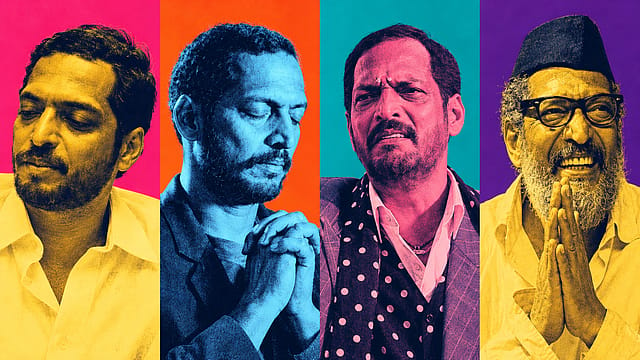
“Control, Uday, control.”
Good advice. The man receiving it is the problem.
In Welcome, Uday Shetty has to talk himself down. A gangster who has spent his life managing other people discovers that the most troublesome man in the room lives beneath his own shirt. Nana Patekar delivers the reprimand with the gravity of a man handling an urgent administrative failure.
Uday would like everyone to behave. Everyone includes Uday.
Now watch the same face in Khamoshi: The Musical.
Joseph cannot hear his daughter sing. He cannot speak to her the way other fathers speak. His hands reach for understanding. His eyes search her face. She is stepping into experiences he cannot share, and every step unsettles the fragile arrangements through which he has learnt to live.
The Modi Years
02 Oct 2026 - Vol 05 | Issue 40
A Nation Rebuilt
The famous voice, the one impersonators could summon in seconds, is absent. Nana still fills the screen.
Between Uday’s exasperation and Joseph’s fear lies the distance this actor could travel. We knew the face at once. There was always more to discover. It could belong to someone terrifying, tender, ridiculous or dangerously certain of his rights. Sometimes several of those men seemed to inhabit the same scene.
Patekar died at 75 on October 8 after suffering a cardiac arrest at his residence.
A voice that had become part of everyday conversation now belongs entirely to memory.
Ten men help explain how it got there.
PARINDA (1989): THE MAN WHO MADE FEAR LOOK FRIGHTENED
Anna knows how to make other people afraid. Nana gives him a fear of his own.
In Vidhu Vinod Chopra’s Parinda, the gangster’s terror of fire cracks his authority. The man who can organise violence and command obedience carries something he cannot master. Nana lets that fear disturb even his moments of command. Anna’s power feels precarious because panic can break through it.
That makes him more unsettling than a villain who announces his wickedness. You watch for the moment command turns into collapse. You wonder who will be standing too close when it does.
The angular face offers little comfort. A look can pin another man in place. A flicker can make an encounter feel unsafe. Anna seems to carry his own weather.
The role won Patekar a National Award for best supporting actor. It also left more than a screen memory. He later recalled being burned while shooting the climax and being unable to work for almost a year.
PRAHAAR (1991): THE SOLDIER WHO COULDN’T COMMAND SOCIETY
Major Chavan walks into Prahaar with his profession stamped on his body.
Spine straight. Movement purposeful. Orders delivered in the expectation of obedience. In his directorial debut, Nana lets us see military discipline before the character explains a word of it.
Then the soldier meets a civilian world where brutality can happen in plain sight and people can choose to look away.
Chavan knows what to do with an enemy he can identify. Public indifference is a different war. There is nobody to order into courage. No formation can make a neighbourhood honourable.
Nana lets the severity bleed into hurt. The officer’s anger grows from his faith in how people ought to behave, and from the discovery that faith carries little weight beyond the institution that formed him.
The bearing remains disciplined even as conviction becomes anguish. Here is a man trained for combat, fighting the habits of ordinary life.
TIRANGAA (1993): THE POLICEMAN WITH TEMPER ON DUTY
Sharing a frame with Raaj Kumar takes nerve. Doing it in a film as gloriously oversized as Tirangaa takes appetite. Nana has both.
His Shivajirao Wagle brings impatience and abrasion to Raaj Kumar’s stately authority, and you can hear the difference. One man makes a sentence sound ceremonial. The other sounds ready to interrupt the ceremony and get on with the job.
Wagle’s temper supplies momentum. His words snap with the impatience of a man whose tolerance has already been tested elsewhere and will not survive much more.
Nana enjoys the film’s emphatic patriotism and larger-than-life showdowns. He gives them a policeman with recognisable heat: pride, irritation and a hunger to act.
Even amid the spectacle, you can feel him deciding that everyone has talked enough.
KRANTIVEER (1994): WHEN THE CYNIC FOUND HIS CAUSE
Pratap Narayan Tilak has a tongue that starts trouble before his conscience decides whether to join in.
In Krantiveer, Nana makes that abrasiveness part of the attraction. Pratap is difficult company. His cynicism has energy, his contempt has teeth, and his urge to provoke stops him from becoming a tidy mouthpiece for the film’s message.
When conviction arrives, the rough edges stay. Pratap does not polish his manners because he has found something worth defending. His unruly force finds a direction.
The dialogue gains its power from this difficult man. Words rush out. Accusations land. His face demands an answer. In the confrontation over communal identity, the argument turns bodily and immediate, forcing hatred to confront the human beings it would divide.
The performance won Patekar the National Award for best actor. More lastingly, it gave audiences a language for outrage. Pratap’s anger walked out of the cinema with them.
AGNI SAKSHI (1996): THE CERTAINTY THAT BECAME A CAGE
Vishwanath believes his claim over a woman outweighs her right to refuse him. Nana makes that belief suffocating.
In Agni Sakshi, the menace grows from the certainty with which he treats possession as love. His attention feels like surveillance. His insistence can sound like a threat before his voice rises.
Nana builds pressure through the possibility of escalation. Vishwanath need not explode in every scene. The knowledge that he might makes his presence oppressive.
The performance shows how frightening conviction becomes when it grants no legitimacy to another person’s wishes. To Vishwanath, refusal is a misunderstanding that persistence will fix.
Patekar won another National Award, again for best supporting actor. The intensity audiences had cheered in his angry heroes became something they wanted a woman to escape.
KHAMOSHI: THE MUSICAL (1996): A FATHER REACHING FOR HIS DAUGHTER
Joseph belongs at the centre of any serious account of Nana Patekar.
In Sanjay Leela Bhansali’s Khamoshi: The Musical, he plays a deaf father who does not speak, opposite Seema Biswas as his wife and Manisha Koirala as their daughter Annie. Music draws Annie towards experiences her parents cannot share. Her growing independence also unsettles a household that depends so deeply on her presence.
Nana makes Joseph’s fear intimate. We understand his dependence without accepting every demand it produces. He loves his daughter enormously. He can also make that love heavy.
His hands press for understanding. His face registers the injury when communication fails. The performance gives shape to the exhausting effort of making another person comprehend what feels urgent to you.
Joseph’s stubbornness matters as much as his tenderness. Nana honours the difficulty of the man rather than smoothing him into a saint.
Watch him closely and the familiar classifications fall away. Anger, vulnerability and affection travel through his whole body. The actor remembered for his words makes a father’s struggle to communicate painfully eloquent.
YESHWANT (1997): THE VOICE OF ACCUMULATED FRUSTRATION
Yeshwant Lohar’s anger seems to have been gathering long before the camera found him.
Nana gives the policeman a delivery built from accusation, contempt and renewed attack. The words sound heavy from years of collisions with the machinery of power.
Part of the appeal is musical. The phrasing has a recognisable rhythm, yet it changes speed and pressure within a single thought. He can rush towards a target, drop sudden weight on a word and let a stare finish the insult.
In Yeshwant, that manner became an outlet. Audiences could borrow the policeman’s voice when their own exasperation needed something stronger.
It is a particular kind of screen influence: a performance that turns into the way people talk, long after they have forgotten the plot.
AB TAK CHHAPPAN (2004): A WORKING DAY IN THE BUSINESS OF DEATH
Sadhu Agashe can talk about killing the way other men talk about office work.
That ease is what makes Nana so disturbing in Ab Tak Chhappan. The encounter policeman has humour, competence and professional confidence. He knows his turf. He knows how things get done.
Under Shimit Amin’s direction, Nana makes violence routine.
You catch yourself enjoying Sadhu’s company. Then the nature of his work comes back into focus, and the enjoyment turns uncomfortable. The performance draws you close enough to feel the man’s appeal while leaving the moral questions around him unresolved.
His authority is lived-in. He rarely needs to announce that he is formidable. How easily he wears the job does it for him.
After the verbal fireworks of earlier roles, Sadhu shows what Nana could do by sounding perfectly at home with terrible things.
WELCOME (2007): THE GANGSTER WHO WANTED EVERYONE TO BEHAVE
Uday Shetty wants respectability, an orderly family future and fewer provocations. Life has other plans.
Nana finds the comedy in Uday’s earnest belief that his predicament deserves to be taken seriously. The gangster can command fear. Arranging a suitable marriage and managing the people around him defeats him spectacularly.
His exchanges with Anil Kapoor’s Majnu carry affection alongside irritation. Each man has vanity to protect and opinions to impose. Their familiarity gives the squabbling warmth; you sense the relationship surviving whatever indignity the latest argument produces.
Nana stays committed to Uday’s grievance. The formidable face that sold so many earlier threats becomes the face of a man who feels repeatedly inconvenienced.
“Control, Uday, control” works because it sounds like advice he genuinely needs. We laugh at the absurdity of his circumstances and recognise the very human struggle to stay dignified amid them.
NATSAMRAT (2016): THE MAN WHO REMEMBERED BEING HEARD
Ganpatrao Belwalkar knows what it means to hold an audience. Retirement teaches him the limits of that triumph.
In Mahesh Manjrekar’s Marathi film Natsamrat, Nana plays a celebrated theatre actor whose wit, generosity and commanding language cannot shield him from the injuries of family life and old age.
The theatrical grandeur belongs to Belwalkar. He has spent a lifetime giving words scale and feeling. Nana lets us revel in that abundance before making us feel how fragile it is.
As loss gathers, the magnificent voice carries a man with fewer places to put his love and less certainty about where he belongs. His command of language turns heartbreaking because it outlives the security that once surrounded it.
Nana gives the decline dignity without making it tidy. Belwalkar has habits, pride and sharp edges. He also has the memory of being wanted.
For an actor formed by Marathi theatre, the role resonates. It sets the pleasures of performance beside the loneliness that applause cannot cure.
THE MAN WHO COULD FRIGHTEN YOU INTO LAUGHTER
Long before Uday Shetty began negotiating with his own temper, Nana had shown how comfortably wit sat on that formidable face. In Raju Ban Gaya Gentleman (1992), Jai, a philosophical street performer who befriends Shah Rukh Khan’s young newcomer, brought warmth, mischief and a knowing eye to the city’s promises. Nana could make an observation sting and still leave room for affection.
By Bluffmaster! (2005), Chandru offered another playground for his theatrical authority and comic timing. These performances make Welcome feel less like a sudden reinvention than the glorious release of something audiences had already glimpsed.
The transition worked because Nana understood how closely menace and comedy could sit together. A hard stare could make somebody nervous; hold that seriousness through an absurd predicament and it could make the audience laugh.
Uday’s wounded dignity was especially fertile ground. Here was a man accustomed to obedience, repeatedly defeated by people who refused to follow the script in his head. Nana played the grievance with complete conviction. In a February 2015 interview, he put his approach simply: “One should do comedy with a straight face.” The laughter belonged to us. The problem remained terribly serious to Uday.
THE LIFE THESE MEN CARRIED
There was a working boy before there was a famous face.
Patekar once recalled painting cinema posters for Rs 35 a month and a meal a day. He studied art, worked as a commercial artist and visualiser at an advertising agency, and eventually chose theatre over the steady job. He credited theatre, and collaborators including Vijaya Mehta, with shaping his craft.
Those memories give context to the wounded pride he could show so precisely. His characters were painfully alert to humiliation: being ignored, losing control, becoming unnecessary, finding that authority could not secure affection.
Their answers differed. Anna terrified. Pratap accused. Joseph reached for his daughter. Uday complained. Belwalkar spoke with the splendour of a man holding on to his place in the world.
Nana made every answer belong to its owner.
The voice made him famous. But the range of these men depended on far more: how he occupied a chair, how closely he watched another person, how seriousness could tip into comedy, how tenderness could surface through stubbornness.
His recognisability invited imitation. A few changes of cadence, a clipped reprimand, a hard stare, and an impersonator could summon the outline. The difficult part was everything that made the outline human.
Calling him unrepeatable honours that particular combination. Indian cinema will have other formidable actors. Policemen, fathers and gangsters will keep finding new faces.
Nana’s characters will keep his.
Somewhere, Uday is still trying to control himself. Joseph is still searching his daughter’s face. Belwalkar still has something magnificent to say. And we are still listening.
Sometimes, when our own temper gets the better of us, we even borrow his voice.
“Control, Uday, control.”