The International Film Festival of Delhi bring the city back into the frame as a hub for world cinema
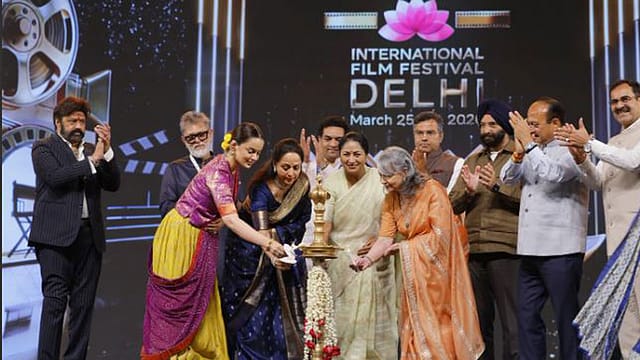
As the International Film Festival of Delhi (IFFD) draws to a close today, it leaves behind more than a catalogue of screenings and conversations—it signals a cultural reawakening, layered with intent, learning and global exchange. In a time when cinema is increasingly consumed in isolation, mediated by algorithms and personal screens, a film festival reminds us of something more elemental: that cinema is, at its heart, a collective experience—an act of gathering, of listening, of seeing together.
After the heady decades of the 1970s and ’80s—when Delhi stood at the heart of India’s engagement with world cinema through the International Film Festival of India—the city seemed to recede from that central cultural role. Those were years when cinephilia had a certain romance: long queues, heated debates, handwritten notes and a palpable sense of discovery. For many, Delhi was not just a venue but a vantage point from which the world could be viewed through cinema.
Losing Memory
16 Oct 2026 - Vol 05 | Issue 42
The making of a medical and social emergency
But as the years passed, the cinematic spotlight shifted. Other cities took on the mantle of hosting global film conversations and Delhi’s once-vibrant identity as a hub for international cinema became more archival than active. It lived on in memory—in stories told by an earlier generation of film lovers—rather than in the lived present of a new one.

Yet, history has a way of returning to its own coordinates. With the emergence of people-driven platforms like the IFFD, the capital is reclaiming its place on the global cinematic map. This resurgence is not merely an exercise in nostalgia—it reflects a contemporary hunger for diverse storytelling, cross-cultural dialogue and curated cinematic experiences that resist the flattening tendencies of algorithmic recommendation systems. In a digital age that often privileges speed over depth, festivals like IFFD reintroduce slowness, reflection and intentionality into the act of watching.
What defines this new chapter is not just the revival of screenings, but the creation of an ecosystem. The production labs at IFFD have emerged as vital spaces of incubation—where ideas are nurtured, challenged and reshaped. These labs move beyond the passive consumption of cinema and place emphasis on creation. Young filmmakers find themselves in dialogue with seasoned practitioners, navigating the complexities of storytelling, financing and distribution. It is here that the future of cinema is quietly being negotiated—not on the screen, but behind it.
This year, the festival’s collaboration with the Singapore International Film Festival added a significant transnational dimension to these efforts. Mentors like Anthony Chen and Jeremy Chua brought with them not just expertise, but a lived understanding of how regional cinemas can travel, connect and resonate globally. Their presence underscored an important shift: that Indian independent cinema is no longer looking inward alone, but outward—towards co-productions, collaborations and cross-border narratives.
Equally compelling was the presence of some of India’s most influential cinematic voices with Rakeysh Omprakash Mehra as the festival director; Nikkhil Advani, Abhishek Chaubey, Shekhar Kapur, Manoj Bajpayee, Piyush Mishra, Guneet Monga and Imtiaz Ali participated as mentors and led masterclasses. Their engagement transformed the festival into a living classroom. These were not sessions of instruction alone; they were conversations—about failure, risk, authorship and the moral responsibilities of storytelling. For emerging filmmakers, such encounters are invaluable, offering not just tools, but perspectives.
The masterclasses stood out as spaces of deep engagement. In an age where information is abundant but wisdom often scarce, these sessions offered something rare: insight grounded in experience. Filmmakers spoke not just about how films are made, but why they must be made. They interrogated form, questioned convention and encouraged a generation to think of cinema not merely as an industry, but as a language—one that must continually evolve.
Then there was the international film showcase, the beating heart of any festival. This year, with Spain as the official focus country, IFFD expanded its cultural horizons in meaningful ways. Spanish cinema, with its rich tradition of visual storytelling and emotional depth, offered Indian audiences a window into another cinematic grammar—one that is at once intimate and expansive. The presence of actor Enrique Arce added a layer of global familiarity, bridging mainstream recognition with more nuanced discussions on performance and narrative. Alongside him, chef Paco Morales contributed to a broader cultural dialogue, reminding us that cinema does not exist in isolation but in conversation with other art forms, histories and identities.
What emerges from all of this is a festival that is not content with being a mere exhibition platform. In its current form, IFFD is a site of convergence—where creation, education and exhibition intersect. It reflects a hybrid energy that is distinctly contemporary: agile in structure, inclusive in spirit and global in outlook. Unlike the rigid frameworks of the past, today’s festivals are porous, allowing for the free flow of ideas, influences and collaborations.
Delhi, in this context, is not simply returning to its past glory—it is redefining it. The city is rediscovering its voice, not by replicating what once was, but by reimagining what can be. It is reclaiming its place not just as a host of cinema, but as an active participant in shaping its future. The conversations that have unfolded over the course of this festival suggest a renewed confidence—a belief that Delhi can once again be a space where cinema is not only celebrated, but interrogated.
And at the heart of this revival lies a deeper, more urgent reminder: Independent cinema is not merely an alternative to the mainstream—it is the conscience of storytelling. In the years to come, as algorithms predict and industries standardise, independent films will remain the last refuge of risk, truth and human nuance, reminding us that cinema is not just about what sells, but what must be said.
As the curtains fall on this edition of IFFD, what remains is not just a memory of films watched, but a sense of possibility. The festival marks not an end, but a beginning—a quiet yet confident assertion that Delhi is back in the frame. Not as a relic of cinematic history, but as a living, breathing space where cinema continues to evolve, challenge and inspire.
In reclaiming its place on the global cinematic map, Delhi is also reclaiming something more intangible yet essential: its role as a site of cultural conversation. And in doing so, it reminds us that while cinema may travel across borders, it is festivals like these that give it a home.
(The author is the artistic director of International Film Festival of Delhi)