After the Fall: Tollywood’s TMC Loyalists Face a New Bengal

The Bharatiya Janata Party’s sweeping victory in West Bengal has done more than redraw the state’s political map — it has fundamentally unsettled the power structure of Bengal’s cultural elite. Nowhere is this rupture more visible than in Tollywood, where a generation of actors, producers, and directors who openly campaigned for the All India Trinamool Congress (TMC) suddenly find themselves politically exposed and professionally uncertain.
For over a decade, Bengal’s film industry and the TMC functioned in near symbiosis. Stars did not merely endorse the ruling party; many became its public face. Actors like Dev, Mimi Chakraborty, Nusrat Jahan, Sayoni Ghosh, Kanchan Mullick, June Malia, and filmmaker Raj Chakraborty were not passive sympathizers — they were active political campaigners, rally faces, electoral candidates, and symbols of the TMC’s cultural legitimacy. Their celebrity became inseparable from the political project of Mamata Banerjee.
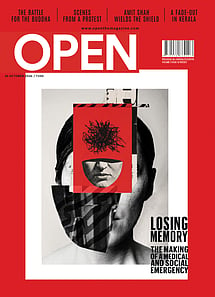
Losing Memory
16 Oct 2026 - Vol 05 | Issue 42
The making of a medical and social emergency
In return, Tollywood under TMC rule evolved into an ecosystem where political proximity often appeared to determine influence. Industry bodies, state-backed cultural events, film grants, festival access, and television visibility increasingly revolved around networks aligned with the ruling establishment. The accusation — repeated quietly for years by sidelined artists and independent producers — was that Tollywood had ceased to function as an open artistic industry and had instead become an extension of Bengal’s political patronage system.
Now, with the BJP in power, that ecosystem is in visible panic. The silence from many TMC-aligned stars since the election has been deafening. Social media accounts once overflowing with political messaging have suddenly become neutral, promotional, or conspicuously inactive. Public appearances have become cautious. Industry insiders speak of frantic attempts to “reset equations” with the new establishment. The swagger of political certainty that once defined sections of Tollywood has evaporated almost overnight.
The fear is not imagined. The BJP’s rise in Bengal has been powered partly by resentment against what it described as a deeply entrenched “cultural syndicate” — an elite club of actors, producers, and intellectuals allegedly protected by the TMC government while dissenting voices remained marginalized. BJP supporters and many anti-TMC cultural figures now openly argue that Tollywood became ideologically monopolized under Trinamool rule.
That anger is now feeding demands for institutional cleansing. The latest flashpoint has been the backlash against Parambrata Chatterjee following his recent media interview, which has triggered massive criticism across Bengali social media and political circles. Parambrata, who had actively canvassed for the TMC during the 2026 election campaign and repeatedly positioned himself within Bengal’s anti-BJP intellectual ecosystem, attempted in the interview to speak about democracy, intolerance, and the “changing climate” in Bengal after the BJP’s rise. But the response was swift and brutal.
Producers and distributors have already begun calling for restructuring within key film bodies such as the Eastern India Motion Pictures Association (EIMPA), accusing previous leaderships of operating through political favoritism and cartelization. The message is unmistakable: the old order is over.
What makes this moment particularly brutal is that Bengali cinema is economically fragile to begin with. Tollywood is not Bollywood. It survives on limited theatrical infrastructure, state support, television syndication, and tightly controlled distribution circuits. Political patronage therefore has enormous consequences. When power changes hands, careers can collapse quickly.
Several actors who once aggressively canvassed for the TMC now face the possibility of becoming politically radioactive. Public anger against celebrity-politicians has intensified, especially among voters who viewed film stars as detached elites lecturing ordinary Bengalis while enjoying access and privilege under the previous regime. Online criticism against figures like Mimi Chakraborty and Nusrat Jahan — both of whom transitioned rapidly from cinema to Parliament — has grown increasingly sharp, with accusations that Tollywood personalities treated politics as a brand extension rather than public service.
At the same time, there is another anxiety haunting Bengal’s cultural class: fear of retaliation.
Many artists worry that the BJP may now replicate the very culture of ideological filtering it once condemned. The concern is that state institutions, grants, censorship systems, and festival circuits may now simply change ideological colour — from green to saffron. If that happens, Bengal’s artistic landscape could descend into a cycle of permanent political vendetta, where every electoral change produces a purge of cultural loyalties.
This is why actors like Dev have adopted carefully calibrated language since the BJP victory — congratulating the new government while simultaneously calling for artistic freedom and warning against “bans” and cultural revenge. It is less a political statement than a survival strategy.
The larger tragedy, however, lies in what this moment reveals about the condition of Indian regional cinema itself. In Bengal — once the intellectual capital of Indian cinema and the home of giants like Satyajit Ray, Mrinal Sen, and Ritwik Ghatak — the line between art and political allegiance appears to have collapsed almost entirely. Cinema no longer merely reflects power; it increasingly depends on proximity to it.
And now, as the political tide has turned, many of Tollywood’s loudest TMC loyalists are discovering a harsh truth about power in India: when politics becomes your stage, electoral defeat becomes your public unmasking.
The lights are still on in Tollywood. But for many of its most visible political stars, the applause has suddenly stopped.