Tamil Cinema Threatens to Switch Itself Off: Why No New Films May Release From September 1
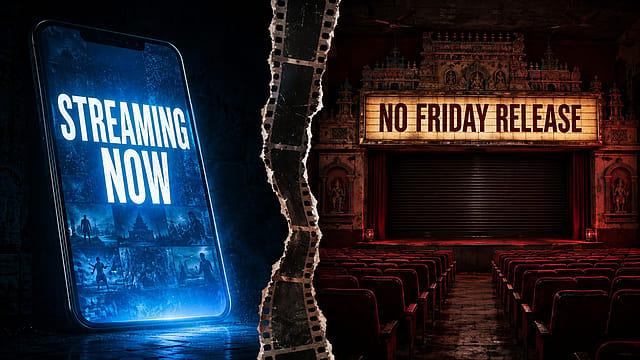
Tamil cinema is threatening to go dark from September 1. No new releases, shooting or post-production.
The Tamil Film Producers Council and the Tamil Film Active Producers Association have announced an industry-wide shutdown after theatre owners and distributors decided to screen only those films whose producers promise an eight-week gap between theatrical and OTT releases. Distributors have also decided to stop paying advances for new films.
At first glance, this appears to be another theatres-versus-streaming dispute. Look closer and a much bigger crisis emerges. Theatres want longer exclusivity because audiences increasingly wait to watch films at home. Producers depend on OTT deals and distributor advances to recover costs and service debt. Distributors want to reduce their exposure when films fail. Smaller filmmakers fear a blanket eight-week rule could leave them trapped between empty auditoriums and delayed streaming payments.

Losing Memory
16 Oct 2026 - Vol 05 | Issue 42
The making of a medical and social emergency
So, what happens when every player in Tamil cinema wants somebody else to carry the risk? The industry threatens to stop making films.
What has the Tamil Film Producers Council announced?
The Tamil Film Producers Council and the Tamil Film Active Producers Association have said that no new Tamil films will be released in theatres from September 1. The decision goes considerably further than withholding new releases. Shooting and post-production work will also be stopped, potentially bringing much of the Tamil film industry to a standstill. The producers’ bodies have sought the Tamil Nadu government’s intervention, warning that the dispute could affect thousands of workers whose livelihoods depend on film production and theatrical releases. The shutdown, however, is still best understood as a pressure tactic. By fixing a deadline, producers have given the government, theatre owners and distributors a narrow window in which to negotiate a settlement.
What triggered the confrontation?
The immediate trigger was a decision by the Tamil Nadu Theatre Owners Association and the distributors’ body to screen only those films whose producers submit a written undertaking promising that the movie will not reach an OTT platform until eight weeks after its theatrical release. Theatre owners had already begun seeking documentary proof of OTT arrangements earlier this year. According to DT Next, exhibitors decided that producers would have to submit clearance letters confirming the eight-week gap before their films could be screened. Producers argue that the latest decision was taken without consulting their associations. They have also objected to distributors deciding that they will no longer provide advance payments for new films. That has turned a debate about release windows into a battle over financing and control.
Why do theatre owners want an eight-week OTT window?
Their argument is straightforward: why would audiences buy a ticket if they know the film will stream at home four weeks later? Tamil films commonly reach OTT platforms approximately a month after entering theatres. Exhibitors believe that this has trained audiences to wait, particularly for films that do not offer a big-screen spectacle or arrive without a major star. M Subramaniam, president of the Tamil Nadu Theatre and Multiplex Owners Association, argued in December 2025 that three-to-four-week OTT windows were contributing to falling attendance. He reportedly said films should remain exclusive to cinemas for eight weeks to give theatres a genuine opportunity to attract audiences.
The problem is particularly severe in smaller centres. Producer-distributor G Dhananjayan reportedly told a TV channel that some producers avoid releasing films in B and C centres because the collections do not justify the additional expense. Audiences there often turn up only for major stars or films powered by exceptional word of mouth. Theatres believe a longer window could break the habit of waiting for OTT and restore some urgency to the cinema experience.
Why are producers resisting?
Because protecting theatres for eight weeks could expose producers to eight more weeks of financial pressure. A producer must pay actors, technicians, financiers, publicity costs and interest on borrowed money. The investment is recovered through several channels, including theatrical distribution, satellite rights, overseas sales and OTT deals. An early streaming premiere can help unlock payment while the film is still fresh in public memory. If the OTT release is pushed back by another month, that payment could be delayed. Streaming platforms may also offer less for a film that has already spent eight weeks in circulation.
The danger is greater for small and medium-budget films. A major Rajinikanth release can command screens and sustain public interest. A small film may disappear from theatres within days. Preventing it from moving to OTT for another six or seven weeks does not extend its theatrical life. It merely blocks its next opportunity to earn money. Dhananjayan has also argued that streaming services have become far more selective. Producers now chase OTT buyers, rather than OTT platforms competing for every completed film. An eight-week restriction, therefore, could further weaken the producer’s bargaining position.
Why is the dispute over distributor advances so important?
Because distributor advances can help get a completed film across the final financial hurdle and into theatres. A distributor may pay an advance or minimum guarantee to acquire the theatrical rights to a particular territory. That gives the producer a portion of the film’s expected revenue before tickets are sold and can help fund publicity, settle pending payments or secure the release.
If distributors stop paying advances, they reduce their own exposure to a film’s failure. The producer must carry much more of the financial burden until the movie reaches theatres and begins earning. The distributors’ position effectively tells producers: carry the production risk yourself, guarantee us eight weeks of theatrical protection and then bring us the film.
The producers’ response is equally blunt: if those are the terms, there will be no films to distribute. This is why the dispute is not simply about when a film appears on Netflix or Prime Video. It is about who finances Tamil cinema and who gets stuck with the loss when audiences stay away.
Didn’t the Producers Council previously support longer theatrical windows?
Yes, and that is the fascinating contradiction at the heart of the standoff. In November 2025, the Tamil Film Producers Council itself proposed a graded theatrical-window system. Films starring A-list actors would wait eight weeks before moving to OTT, while films featuring the next tier of actors would wait six weeks, Cinema Express reported.
The crucial word is “graded.” That proposal recognised that a superstar vehicle and a small independent film do not possess the same theatrical strength. The current dispute centres on a blanket eight-week rule that would apparently apply to every film, irrespective of its budget, cast, screen count or performance.
Producers are also challenging the way the requirement was imposed. Their objection is not necessarily to theatrical exclusivity itself, but to a one-size-fits-all mandate enforced through compulsory written assurances and combined with the withdrawal of distributor advances.
Why has the fight erupted now?
Tamil cinema’s old financial safety nets are fraying. Production budgets and star salaries have climbed. Satellite rights no longer guarantee recovery. OTT platforms, which once bought films aggressively, have tightened spending and become choosier. Theatres complain of weak footfall, long stretches without major releases and audiences unwilling to pay for films they can soon watch at home.
A film can consequently look valuable on paper and still struggle to find the money required to reach cinemas.
The fragility was exposed by Karuppu. Distributor Tiruppur Subramaniam claimed that its producers had expected to earn ₹75–80 crore from OTT rights but received only around ₹30 crore, creating a large deficit and delaying the film. Despite eventually becoming a theatrical success, it reportedly faced a last-minute struggle to bridge the remaining financial gap before release. That episode captured Tamil cinema’s new uncertainty: even a film capable of becoming a hit can stumble before the first show.
Which films could be affected?
The September calendar reportedly includes Karthi’s Sardar 2, Karthik Subbaraj’s Dorothy starring Keerthy Suresh, Soori’s Mandaadi, Meesaya Murukku 2, Demonte Colony 3, Lenin Pandiyan and GV Prakash’s Immortal. Mandaadi had already received its censor certificate and was scheduled to arrive in theatres on September 10. If the dispute remains unresolved, completed films could lose release dates, screens and the money already spent on publicity. The effect would soon travel beyond theatres. A shutdown of shoots and post-production would hit actors, technicians, editors, visual-effects teams, equipment providers and daily-wage workers. Theatre owners would also lose the fresh Tamil content they say they desperately need.
Will Tamil cinema actually shut down?
The announcement is serious, but a prolonged shutdown would damage every side. Producers would continue accumulating interest and holding costs. Distributors would have no new inventory. Theatres would face empty screens. Workers would lose wages. OTT platforms would see their Tamil-film pipeline disrupted.
That mutual vulnerability creates strong pressure for a compromise before September 1. One possible settlement could restore a graded window: eight weeks for large star-driven films, six weeks for mid-sized productions and four weeks for smaller releases. The two sides may also need to negotiate separate terms for films that fail quickly in theatres and establish a mutually acceptable system for distributor advances. Without such flexibility, the same rule would govern both a ₹300-crore spectacle that dominates hundreds of screens and a small film struggling to survive its opening weekend.
What is this battle really about?
It is about who carries the risk when a Tamil film fails. Theatres want a longer exclusive window to lure audiences away from their couches. Distributors want protection from bad bets. OTT platforms want successful films at prices and release dates that suit them. Producers need money from all three while carrying the cost of making the film. Everyone agrees that the current model is broken. Nobody agrees on who should pay to repair it. And so, in an attempt to save Tamil cinema, the industry is threatening to switch itself off.
(With inputs from ANI)