Filling Up the Script: At the peak of her acting career, Shefali Shah puts her life into words
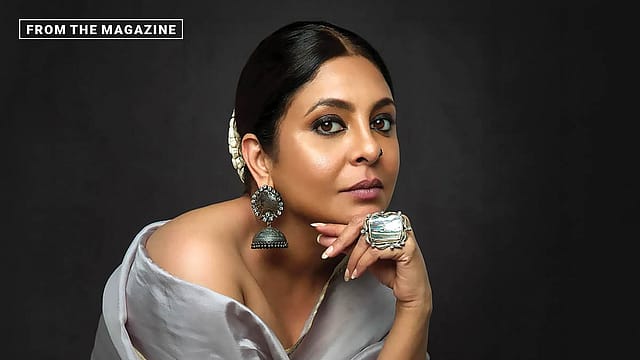
Expectedly, for an actor, Shefali Shah’s “sort-of memoir” begins with a blow dry and a hair touch-up, part of the maintenance kit of any performer. But her first book, The Audacity of Being (Bloomsbury, Rs 599), goes beyond the reflection in the mirror or the image on the screen. It also gives us the loneliness of the solitary, dark-skinned girl with oily hair in school, the heartbreak after her first marriage failed, the stretch marks after delivering her two babies, and the long fallow periods in between busy periods.
The newly published book takes us beyond the polished and primed world of make-believe into reality. Shah has never been one to shy away from difficult choices. Indeed, it could be said that she seeks such roles, playing a sexual abuse survivor in Mira Nair’s Monsoon Wedding (2001); mother to a man (Akshay Kumar) merely five years older than her in Waqt: The Race Against Time (2005); an unloved wife who eats her feelings in Dil Dhadakne Do (2015); and the woman on whom the young handy man has a gigantic crush in Darlings (2022). At 54, despite all the false starts and almost career suicides, Shah has built a formidable body of work, emerging as one of the finest actors of her time.
And all this despite rarely, if ever, playing the conventional heroine—with the little girl wardrobe, the coy glances, and the murmured sweet nothings. Shah’s carousel of performances has been astounding. The slaps she administers to her gangster husband (Manoj Bajpayee) in Satya (1998) when he returns home drunk; her eyes silently accusing her abuser when she meets him as an adult in Monsoon Wedding; her eating cake mindlessly as she wipes its evidence from her face in the mirror in Dil Dhadakne Do; and the self consciousness when stopped mid air on the ferris wheel with Jaideep Ahlawat in Three of Us (2022).
Shah is that rare actor who has matured on screen, with all of us bearing witness to her talent. She has grown from a familiar face on TV to appearing in movies and then becoming a star of streaming with a career-defining role as the committed police officer, Madam Sir Vartika Chaturvedi, over three seasons of Delhi Crime (2019).
In The Audacity of Being, Shah addresses her witnesses directly. She is frank, funny and feisty. She can write a detailed breakdown of her relationship with Spanx with as much felicity as she writes about getting under the skin of ‘Dr Evil’ in the JioHotstar series, Human (2022) by channelling a mix of Princess Diana and the Joker. She writes about 25 years of marriage to her second husband, producer-director Vipul Shah, with as much honesty as she does about speaking through silences and being visible outside the light in a scene, in the shadow.
It is also the struggle of a woman coming to terms with ageing in a brutal industry that treats wrinkles like evidence of a homicide and excess weight like an invitation to a public execution. She writes with pleasure about turning forty and finally arriving where she always wanted to be. “It was exhilarating to be free and stretch luxuriously into the XXL fit of an I-don’t-give-a-f*ck-kaftan. The feeling of being smug and warm in my own skin was truly liberating. Turning forty came with assurances: I am who I am, I will do what I want, and I really don’t care what anyone thinks. I was excited to venture on this adventurous journey with the best company ever: myself.”
She is also candid enough to say this feeling lasted till she was fifty. “There is nothing graceful about wobbly knees and sagging breasts (with due respect, mine always had their heads hung in shame). There is nothing beautiful about pigmented skin and frowns that suddenly seem to be permanently residing on my forehead, comfortably embalmed in the crevices of wrinkles,” she writes, refusing to carry age as a badge of honour, and honest enough to admit she could have done more.
The sort-of memoir is a manifesto of how to negotiate life and the limelight while keeping your humour sharp. Take what she has to say about exercise: “As a woman, I do exercise. I exercise my will, my desires, my right to choose, all without setting foot in a gym.” So what, as she says, if her medicine pouch outweighs her make-up bag.
When I commend Shah on her ability to laugh at herself, she asks: “What option do I have?” Indeed, she places herself among women like her, who feel too much, want too much, and live life in the extremes (ergo, all of us). And like many of us, she suffers from the “imposter syndrome”. As she writes in the book, whenever she joins a new project, she is the same nervous wreck, telling herself repeatedly: “I am not good enough, I will make a fool of myself. All these people are important famous stars and I don’t belong here. I don’t know anything.”
Over the years, Shah has become more patient about the vagaries of the entertainment industry. “I used to be miserable when there was no work.” Now she is more accepting if a scene is cut, or if six releases in a year are followed by a year of no work. She is also frank about the mental health challenges she has faced. “There is no need to hide it,” she says. “We have to normalise it, just as we deal with physical ailments.”
Writing The Audacity of Being was cathartic for her like “talking to a diary”. It would pour out in a stream, sometimes three chapters at a time, at other times nothing. There is a book of fiction waiting to be published, a series for Netflix she has shot, and a heist film directed by her husband, co-starring Ahlawat. As she writes: “I have still too many women I’m left to become. And since I’m an insomniac, I’ve got all the time in this world.”
This is an unusual work by a woman in the prime of her life, at the peak of her acting prowess, willing to take a step back, examine who she is and what made her the way she is. Whether it is embracing her girl group, going on solo travel trips, or loving her dogs, she is more than a wife, mother, actor or daughter. Shah is willing to put her life under a microscope and give us a view of the woman that she is: still standing, with invisible scars, and visible wounds, telling her story like it is.
As she writes, borrowing the lines of one of her most loved characters Shailaja in Three of Us: tomorrow will only come if today is fully lived. “That line,” she adds, “is etched in my memory and informs everything I do.” As she says at the end of her book: I am because you see me.
Playing The Part: Shefali Shah on her most iconic characters
Ria Verma, Monsoon Wedding (2001)
Shah plays the survivor of child sexual abuse by her uncle who confronts him and wins her family’s support. “I learnt the art of disappearing. One of the greatest things it taught me was that as an actor, you have to be able to turn yourself into furniture, to blend into the background when the scene isn’t yours.”
Neelam Mehra, Dil Dhadakne Do (2015)

An overwrought mother and neglected wife trying to keep up appearances. “She is raw, vulnerable, and naked, without any armour of pretence. Stripped of her dignity, respect and self esteem. With no value attached to her being. That’s when she reaches out to her unwavering support...food.”
Tara Shetty, Once Again (2018)
Widowed restaurant owner who meets a lonely film actor in a rare mature romance. “The thing about chemistry is that it can’t be created. It is either naturally and simply there or not...the pull between Amar and Tara was palpable in their lingering looks, softly shared secrets and the longing in their hearts.”
Vartika Chaturvedi, Delhi Crime (2019)
An upright police officer who solves crimes with humanity. “In many ways, it changed my life. It defied the ageist preconceived norms that constrain female actors in our industry and created a narrative of a woman character in power. The power and agency didn’t just belong to the character of Vartika; it managed to rub off on me too.”
Shamshunissa Ansari, Darlings (2022)
A woman helping her daughter out of an abusive marriage. “A total pataka, all things fun and the right amount of wicked. Despite the terrible set of cards she is dealt in life, she somehow escapes a deep sense of bitterness that takes hold of many people and is able to maintain her zest for life.”