‘Rambha Ho’ Again, But No Role for Her: Why Bollywood is Ghosting Kalpana Iyer at 70
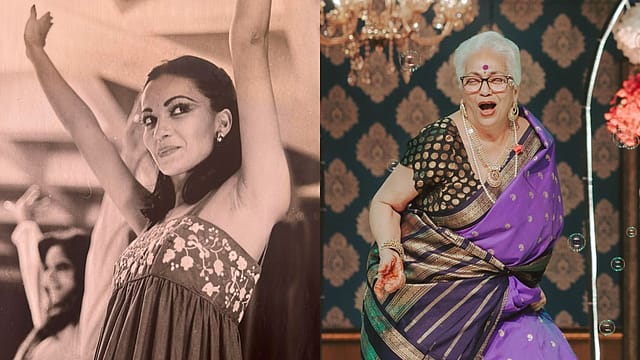
The song has found work again. Kalpana Iyer has not.
More than four decades after Rambha Ho turned her into one of Hindi cinema’s most recognisable dancing stars, the 1981 disco anthem returned to popular culture. A new generation discovered it through Dhurandhar. A video of Kalpana dancing to her old song at a wedding went viral. Social media marvelled at her energy. Nostalgia pages celebrated the “original”. Interviews followed. Casting professionals called.
Then, silence.
At 70, Kalpana is discovering that Bollywood can resurrect an old song much more easily than it can find work for the woman who made it unforgettable.
“I don’t expect everything to work out because it’s a new world order,” she wrote in a recent Instagram post. “I’m human and I’m not asking for any sympathy or special treatment.”

Zeroing In on ECI
09 Oct 2026 - Vol 05 | Issue 41
Constitutional legitimacy versus political opportunism
Her demand was painfully modest. If somebody approaches her for a project and subsequently changes their mind, they should tell her. If the role does not fit, they should allow her to suggest an alternative. If they no longer want her, they should have the decency to say so.
“Please don’t presume or assume. Just ask me,” she wrote. “It is about a 70-year-old saying: Be fair and decent.”
There is no diva tantrum in those words. There is an elderly working woman asking for the professional courtesy routinely denied to those whom show business has finished celebrating.
The Girl Who Worked for ₹75
Kalpana Iyer was working long before Bollywood learnt her name.
Born into a family struggling financially, she was the eldest child and began performing in stage shows when she was around 12. She earned ₹75 for a performance, a small fortune for the household at the time.
“Seventy-five rupees was a lot of money then,” she recalled in an interview earlier this year. “The house was feeling good. Situations were getting better. I could see smiles in the house.”
Those smiles mattered more than applause.
She danced to Helen’s songs as a child and later appeared in stage shows alongside some of Indian music’s greatest voices, including Mukesh, Manna Dey, Mohammed Rafi and Kishore Kumar. She had no formal dance training. Her body understood rhythm instinctively.
“I learnt nothing. I trained in nothing,” she would say years later. “I just dance instinctively.”
In 1978, Kalpana became the first runner-up at Femina Miss India and represented the country at Miss World at London’s Royal Albert Hall, where she reached the Top 15. The pageant gave her visibility. Dev Anand gave her an opening.
She remembers him arriving at her home in a white Fiat and offering her an opportunity.
Kalpana had never spent her childhood dreaming about becoming a film star. She needed to work. When a door opened, she entered.
Dev Anand’s Lootmaar gave her “Jab Chhaye Mera Jadoo”. The song launched her into Hindi cinema with the force of a disco ball exploding over a dance floor.
On the sets of Lootmaar, more offers arrived. “Hari Om Hari” in Pyaara Dushman. “Tu Mujhe Jaan Se Bhi Pyara Hai” in Wardat. “Rambha Ho” in Armaan. “Koi Yahan Nache Nache” in Disco Dancer.
Bappi Lahiri’s music, Usha Uthup’s thunderous voice and Kalpana’s uninhibited screen presence became part of the sound and movement of early-1980s Bollywood.
She was glamorous, energetic and instantly visible. She was also being placed inside a familiar box.
The Woman Behind the ‘Vamp’
Hindi cinema has always known how to divide its women.
The heroine received virtue, romance and the hero. Another woman received the nightclub, the dangerous dress and the freedom to desire.
Kalpana inherited the second category.
She followed a path occupied by performers such as Helen, Bindu and Aruna Irani, women whose charisma could electrify a film while the script kept them safely outside its moral centre. Kalpana played dancers, vamps, troublemakers and supporting characters. Her songs often became more memorable than the films carrying them.
She did not spend her career complaining about the label.
“I was happy in my space whether it was as a dancer, an actress, a vamp or whatever,” she said. “I did what I could and I grabbed what I got.”
The sentence carries gratitude. It also contains the quiet arithmetic of survival.
Kalpana had no secretary shaping her career. She belonged to no powerful clique. She says she did not manipulate, plot or manufacture relationships to get ahead. She accepted the work that arrived because the family needed the money.
That approach gave her more than 100 films. It did not always give her the roles her ability deserved.
Occasionally, a character allowed the dancer to disappear and the actor to take over. In Anjaam, the 1994 film starring Madhuri Dixit and Shah Rukh Khan, Kalpana played a brutal prison warden. The performance was vicious and unsettling, far removed from the exuberant woman dancing beneath disco lights.
She also appeared in Satte Pe Satta, Kudrat, Hum Paanch, Disco Dancer, Zakhmi Aurat, Laadla, Raja Hindustani and Hum Saath-Saath Hain. On television, she worked in shows such as Kashish, Junoon, Chandrakanta, Farmaan and Banegi Apni Baat.
Then the calls slowed down.
After Hum Saath-Saath Hain, Kalpana says, “things just came to a standstill.”
The work being offered no longer satisfied her. The industry and television had hardened around camps and familiar groups. She did not belong to them.
“What was the point in continuing?” she later asked. By the end of the 1990s, she moved to Dubai.
When the Dance Floor Went Dark
Kalpana did not arrive in Dubai as a star seeking a glamorous international life. She has described herself as “broken” when she moved there.
When films and television stopped providing meaningful work, she accepted a job managing a restaurant owned by her friend, former actor and producer Rajan Sippy. The performer who had once danced before cinema halls packed with strangers began looking after diners.
There was no camera. There was work That distinction has defined Kalpana’s life. She never considered honest work beneath her. Childhood stage shows had taught her that earning could restore smiles to a worried household. Stardom never erased the lesson.
The restaurant later developed into a popular dance lounge. Dubai gave her employment, safety and a community. It also gave her some of her happiest years with her mother.
“Dubai is my home,” she has said.
She did not publish a memoir naming those who had hurt her. She resisted invitations to settle scores because many of the people involved were no longer alive to defend themselves.
“My thank you is more important,” she explained.
It is a remarkable line from a woman who could easily have converted old wounds into new attention.
For nearly three decades, Hindi cinema moved ahead without her. New dancers arrived. Choreography changed. The vamp disappeared as heroines claimed the sexuality and dance numbers once outsourced to women such as Kalpana.
Her songs, however, refused to leave.
“Hari Om Hari” kept playing. “Koi Yahan Nache Nache” kept playing. And somewhere at a party, a wedding or a retro night, Usha Uthup’s voice would roar: “Rambha ho ho ho…” Kalpana remained present even when she was absent.
One Viral Dance, One More Chance
In early 2026, Kalpana danced to Rambha Ho at a wedding.
She wore a sari. The steps were graceful, spontaneous and full of the delight that had made the original performance so infectious. The video travelled across social media.
Viewers who remembered her felt young again. Viewers who had never seen her discovered the woman behind the song. The revival of Rambha Ho in Dhurandhar amplified the moment. Another Kalpana song, “Koi Yahan Nache Nache”, received renewed attention after Prabhas danced to it in The Raja Saab.
For a brief, exhilarating period, popular culture seemed to be returning something it had borrowed from her decades earlier.
Kalpana called the viral wedding video her “booster”. “You can still do it,” she said. “I want to be part of joy. I want to be part of work.”
She made her ambition unmissable. “Give me work.” She was willing to act, dance, make a guest appearance or attend a show. She said she would happily accept even a one-minute role. She did not demand the lead, a vanity van or the centre of the frame.
She wanted her 70th birthday to be remembered for new work. Calls reportedly began coming in. Casting professionals discussed possibilities. Reality-show enquiries arrived. After years away, the doors appeared to be opening.
Somewhere between interest and employment, people disappeared. That is why her new appeal hurts. “I have been trying hard to be decent about everything and not get upset about things over which I have no control,” she wrote. “But it’s not fair to me.”
She understands rejection. She survived an industry built upon it. What she cannot understand is erasure.
Bollywood Has Roles for Older Men. Where Are Its Older Women?
Hindi cinema has become better at writing substantial parts for some older women. Neena Gupta’s remarkable second innings is frequently offered as proof. She publicly asked for work on Instagram in 2017 and received it. Since then, films and streaming platforms have allowed actors including Shefali Shah, Ratna Pathak Shah, Dimple Kapadia and Sharmila Tagore to inhabit women with age, desire, authority and complicated inner lives.
Yet these opportunities remain exceptions substantial enough to be celebrated individually.
Older male actors are allowed to continue being police officers, patriarchs, politicians, criminals, industrialists and even romantic leads. Age expands their authority.
For many women, age reduces their casting possibilities to a benevolent mother, an ailing grandmother or a family photograph garlanded before the opening scene.
Kalpana’s earlier screen image may have made her return even harder. Bollywood remembers her as movement. Casting her at 70 requires filmmakers to imagine what happened to the woman after the music stopped.
That should be a creative opportunity.
She could play the ageing performer who knows where every body is buried. The stern matriarch with an anarchic past. The former beauty queen watching an industry repeat its cruelties. The lonely woman who moved countries and rebuilt herself. The prison warden from Anjaam was evidence that Kalpana could disturb an audience without taking a single dance step. Her life has already contained more characters than many screenplays.
Someone only needs to write one for her.
Kalpana Iyer is careful to name nobody in her appeal. She asks for no sympathy. She accepts that times have changed, filmmakers have choices and she may not suit every role. She even offers to change, adjust and consider alternatives.
“Just ask me and I’ll be happy and thankful,” she says.
Forty-eight years after representing India at Miss World, she is not asking Bollywood to restore her crown. Forty-five years after Rambha Ho, she is not demanding that a new generation surrender its dance floor. Twenty-seven years after the work stopped, she is not asking anybody to compensate her for the missing years. She is asking for a reply.
That is what makes her appeal larger than one veteran actor’s comeback. Every industry celebrates experience in speeches while allowing older workers to disappear from consideration. Entertainment makes that disappearance particularly cruel because the forgotten face remains permanently young on screen.
Kalpana Iyer can open the internet and watch herself dance in 1981. She can see millions rediscover her. She can watch an old song secure a new film, new listeners and a new cultural life.
And then she can look at her silent phone. Bollywood has found another use for Rambha Ho.
At 70, the woman who gave the song its face is waiting for someone to say: “Come, we have a role for you.”
She has spent nearly six decades accepting every rope life threw towards her. Someone must first have the decency to throw it.
(With inputs from ANI & agencies)