Wind Energy and Coastal Communities: Development or Displacement?
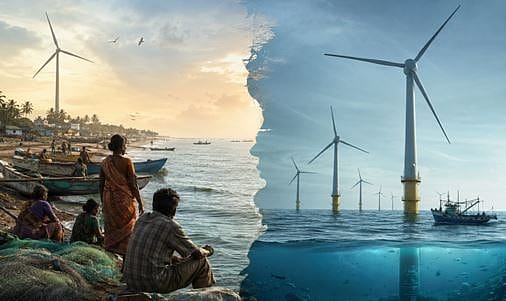
India’s transition towards renewables is increasingly coming ashore. Now, policy makers are looking to the coast to harvest wind energy on a massive scale – from the beaches of Tamil Nadu to the Gulf of Khambhat in Gujarat. Offshore wind projects, once thought to be financially and technically infeasible, are now seen as an integral part of India’s sustainable energy future. The government has set ambitious offshore wind ambitions and foreign companies are looking at potential, while states compete to become centers for renewable energy.
But there is a deeper and more troubling question lurking behind the offshore wind hype: development for whom? The rapid rollout of wind technology tends to produce confusion rather than empowerment in coastal communities, especially for small-scale fishers, indigenous populations and economically fragile towns. The “green growth” story often involves renewable energy as a just and environmentally benign option. But renewable energy projects can mirror many of the inequities of traditional economic models, as India’s experience with massive solar parks and industrial corridors has shown. Offshore wind risks becoming yet another example of national energy ambitions running headlong into local life and environmental realities.
India is planning big for offshore wind. Gujarat and Tamil Nadu have been identified as key growth zones by the Ministry of New and Renewable Energy because of good wind speeds and geography along the coast. Interest in offshore deployment has been spurred by international collaborations with Denmark, Germany and the United Kingdom. Offshore wind is playing an increasingly important role in energy security, industrial competitiveness and India’s efforts to reduce dependency on imported fossil fuels.
Such strategic thinking makes sense. Offshore wind has several advantages over renewable installations on land. Coastal winds are usually stronger and more consistent, so they generate more electricity. Offshore projects also don’t suffer from the land acquisition issues that have bedeviled onshore solar and wind facilities. In theory they provide an opportunity to increase renewable energy without directly displacing agricultural land. But "avoiding land conflict" is not the same as "avoiding social conflict."

The Second Life of Sanskrit
10 Jul 2026 - Vol 05 | Issue 28
Being classical has become cool
The sea is not an empty economic zone waiting to be industrialized for fishing communities. It is a living work space, a cultural landscape, a source of sustenance. Offshore wind farms may influence fishing habits, restrict access to traditional fishing areas, and disrupt marine ecosystems due to underwater construction, turbine bases, and increased maritime traffic. Even minor interruptions during construction periods could have a huge impact on communities that already operate on low economic margins.
These are valid concerns. There has been controversy among local fishermen over access rights and environmental impacts of offshore wind projects in Europe. In India the risks are much larger where millions directly or indirectly depend on small-scale fishing. Unlike industrial fishing enterprises, artisanal fishers may have little political power, legal protection, or other income sources. Their vulnerability has been exacerbated by climate change, dwindling fish stocks, coastal erosion and extreme weather events. “We are now investing in renewable energy infrastructure, which is coming into an already fragile environment.
Tamil Nadu makes a compelling case study. The state has long been regarded as the leader of India’s wind energy industry, home to some of the country’s largest onshore wind farms. However, many coastal communities have expressed concerns about being left out of the decision-making processes for energy and industrial projects. Public consultations are often procedural and not real participatory processes. The asymmetry of information increases mistrust and often the full information on environmental issues, compensation arrangements and long-term effects on livelihoods is not supplied to the local people. This points to a larger problem with India’s renewable energy governance framework: the tendency to see local communities as passive recipients rather than active stakeholders. Rhetoric of national progress often comes at the cost of procedural justice. Policy-makers talk about megawatt capacity, investment flows and carbon reduction targets. The everyday reality of people affected is less well covered. The rhetoric on renewable energy in India has become too technical, with an emphasis on pace of implementation and scale of infrastructure. Too often, this strategy adds social inclusion as an afterthought.
But the success of the energy transition depends not just on how much renewable power is deployed but whether communities believe the transformation is fair. The argument is gaining more popularity worldwide. The “just transition” has become an important frame in climate policy debates. Underlying this is the idea that poor and marginalized groups shouldn’t be more affected by environmental change. A clean energy economy that creates new forms of exclusion or displacement cannot be sustainable.
This is a particularly serious dilemma in India, where coastal communities already face vulnerabilities. Sea level rise, cyclones, salinity intrusion and declining marine biodiversity are putting livelihoods under strain. States such as Odisha, West Bengal and Tamil Nadu are facing a serious governance challenge in the form of coastal adaptation. Large-scale offshore energy projects therefore extend into spaces of high levels of environmental vulnerability.
India’s renewable energy targets are certainly important in an age of accelerated climate change and geopolitical energy insecurity. Offshore wind could become an important part of the nation’s low-carbon future. However, if the transition is managed through exclusionary governance and uneven burden-sharing, it risks undermining the very sustainability that it aims to achieve.
The shoreline is not just a resource frontier for economic expansion. It has villages with generations-old ties to the sea before current energy policy. India’s green energy transition will not be about how much renewable energy it can generate. The real test will be whether it can forge a socially just, environmentally sensitive and democratically responsible energy transition. Otherwise the promise of green growth could be another tale of displacement in the name of progress.