A Tale Of Two Prime Ministers
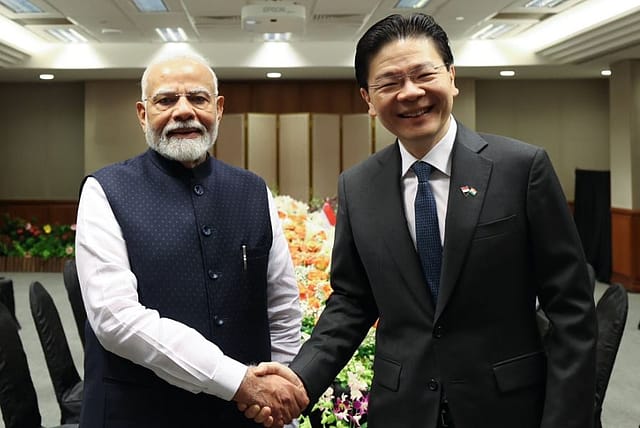
The Singapore Prime Minister, Lawrence Wong, while addressing citizens at the 48th May Day Rally, warned them that the ongoing global crisis arising from the U.S.-Israel-Iran conflict was far from over. He said people should not expect the crisis to end anytime soon. In fact, pressures were likely to intensify, while supply disruptions would persist and could worsen in the months ahead.
According to him, the current crisis could prove even more severe than the oil shocks the world experienced in the 1970s. With the Strait of Hormuz remaining closed for over two months, its impact is being felt not only through higher oil prices but also through tightening supplies. “So, we must brace ourselves and be prepared for a more difficult period ahead,” PM Wong said.
The Age of Anger
31 Jul 2026 - Vol 05 | Issue 31
A raging generation makes the government relent. What's next?
Most world leaders spoke along similar lines and their citizens, as well as Opposition leaders, accepted the warnings without much hue and cry. In fact, the Singapore PM’s key messaging video has gone viral.
But when the Indian Prime Minister, Narendra Modi, cautioned Indians about the ripple effects of the West Asia conflict and appealed for “economic patriotism”, he faced a barrage of criticism.
At a rally in Hyderabad on May 10, 2026, PM Modi offered a series of suggestions. He appealed to Indians to postpone purchases of gold, especially jewellery for weddings and functions, by at least a year. To reduce fuel consumption, he urged people to work from home where possible, use public transport and electric vehicles, practice car-pooling and avoid unnecessary foreign travel. The broader objective was to reduce India’s massive import bill.
Essentially, the Prime Minister was focusing on two major imports — gold and fuel — which together account for nearly 22% or roughly $200 bn, of India’s total imports of $915 bn.
Consider the gold import numbers. In FY25, India recorded a historic high in gold imports at $72 bn (721 tonnes). It was $58 bn (757 tonnes) in FY24 and $46 bn (795 tonnes) in FY23. While the volume of imports has declined, the value has sharply increased.
The oil import bill paints a similar picture. It stood at $122 bn in FY25, $137 bn in FY24 and $132 bn in FY23. Although India managed to contain the FY25 bill at $122 bn, this was largely due to discounted imports from Russia. Before the escalation of the West Asia conflict, Brent crude averaged around $61–63 per barrel. Today, it hovers around $109 per barrel and is unlikely to return to pre-war levels anytime soon.
No wonder PM Wong asked Singaporeans to brace for difficult times ahead — and notably, he was not criticised for saying so.
PM Modi, however, came under heavy attack from vocal sections of the Opposition and Left-liberal critics for what they termed the government’s inept handling of the economic fallout from the West Asia conflict. His appeal triggered a political storm, with Opposition leaders portraying the call for austerity as evidence of governance failure.
Rahul Gandhi said Modi’s appeal was “proof of failure after 14 years in power”. Leaders from the DMK, Trinamool Congress and Samajwadi Party questioned whether the government was concealing a “darker fiscal truth”. Sharad Pawar demanded an all-party meeting to understand what he described as the hidden realities of the impending economic crisis.
Ever since Modi came to power in 2014, the Opposition has politicised virtually every issue — be it the 2019 Balakot airstrike, the handling of the COVID-19 pandemic, Operation Sindoor, or now the West Asia conflict.

Globally, many acknowledged that PM Modi’s handling of the Covid-19 pandemic was commendable, particularly when viewed against India’s death figures relative to its vast population. Added to that was the indigenous development of Covaxin by Bharat Biotech in record time — a significant breakthrough. India, which once imported vaccines and medicines, now exports vaccines even to developed nations. Full credit to the Modi government on that front.
It may be recalled that during the pandemic, Akhilesh Yadav had remarked: “I will not get vaccinated for now. How can I trust the BJP’s vaccine?” He later clarified that he trusted scientists but not the BJP’s “unscientific thinking” or the healthcare system under the state government. That, many believed, reflected the extent to which sections of the Opposition were willing to go in order to discredit PM Modi.
Therefore, it was hardly surprising to see stand-up comedian Varun Grover take a satirical dig at PM Modi’s austerity appeal in his trademark style. That is democracy. Yet, ironically, a section of the intelligentsia continues to argue that there is no freedom of speech and that India faces an Emergency-like atmosphere.
For the last 14 years, Opposition parties have been searching for a “Bofors moment” to politically damage the Modi government — but without success. Meanwhile, the saffron juggernaut, much to their frustration, continues to dominate electoral politics, even in Opposition strongholds.
However, India Inc appeared to understand the gravity of the situation and quickly rallied behind the Prime Minister’s call. Industry leaders such as Sunil Bharti Mittal, Uday Kotak and Harsh Goenka openly backed the appeal.
Harsh Goenka, Chairman of RPG Enterprises, posted: “We in RPG have responded to our PM’s call with austerity and responsible resource allocation. I hope other corporates will follow suit.”
At the CII Annual Business Summit, Uday Kotak, Founder & Director of Kotak Mahindra Bank, remarked: “The economy is on the verge of a significant oil shock as the delayed consequences of the prolonged Israel-U.S.-Iran war begin to unfold. We haven’t seen the full impact over the past two months, but now it is coming — and it is coming big.”
At the same event, Sunil Bharti Mittal strongly endorsed PM Modi’s appeal for austerity. “These are difficult times. As a country, we have been growing at 6–7% and moving at fantastic speed. But certain developments are beyond our control. The West Asia crisis is creating tremendous pressure on global economies. India is no different. We cannot escape its impact,” he said.
Clearly, corporate India is doing its bit and standing shoulder to shoulder with the Modi government. For now, the 70-day conflict involving the U.S., Israel and Iran has already imposed heavy economic costs on the world. The disruption in the Strait of Hormuz brought the global economy close to paralysis, reminiscent of the Covid-19 lockdown period.
So, the economic headwinds are real. But that does not take away from the fact that India remains among the fastest-growing major economies in the world. Everyone wants a slice of that growth story. K Balasubramanian, India CEO and Banking Head at Citibank India, told BusinessLine: “We remain highly bullish on India and see the country as one of the most compelling long-term growth stories globally.” That should certainly be music to the ears of the Modi government.