The Judgment That Proves Much
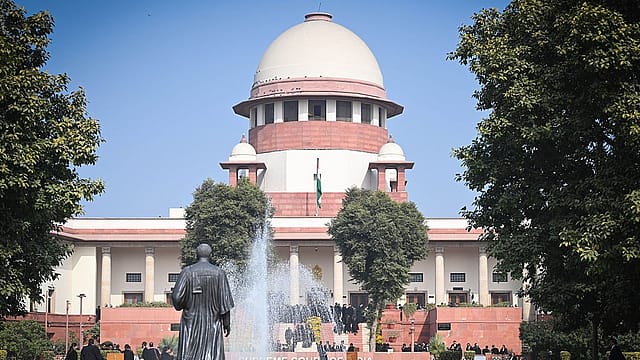
On 24 March 2026, the Supreme Court of India ruled, with unimpeachable legal clarity, that a person who professes a religion other than Hinduism, Sikhism, or Buddhism cannot be a member of a Scheduled Caste. The ruling rested on the Constitution (Scheduled Castes) Order of 1950, which the bench said “is absolute and admits no exception.” The judgment is legally correct. That is the problem.
A legally correct judgment producing an absurd outcome is not a judicial error. It displays a structural contradiction in the applied framework. The Supreme Court’s ruling faithfully expresses the constitutional order without distortion, thereby bringing into full view the real problem: the Indian Constitution attempts to address societal phenomena with instruments of administrative law. These are incommensurable.

Losing Memory
16 Oct 2026 - Vol 05 | Issue 42
The making of a medical and social emergency
I
The court's ruling is a straightforward reading of Article 341 and the 1950 Order. SC status is a legal category, constituted by Presidential notification, available only to communities professing specified religions. A person who converts to Christianity exits the category. The bar, as the bench said, is absolute.
Consider what follows from this: a Dalit Christian in Andhra Pradesh serving as a pastor for a decade is legally ‘not deemed’ a member of the Scheduled Caste. He loses reservation in education, public employment, elected offices, and the protections of the Atrocities Act. Yet his neighbours continue to see him as a Madiga. If he experienced oppression before, it is unchanged. Only the legal recognition has been withdrawn.
The result is both unjust and philosophically incoherent: a person can actually be oppressed through caste while being legally classified as not belonging to an oppressed caste. The law and the social reality are completely severed. This is not an accident but a direct consequence of a foundational confusion.
II
The 1950 Order was built on an unresolved dispute about the nature of caste itself. Two incompatible positions were in circulation at the founding, and the Constitution contains both.
The first position, implicit in the 1950 Order, is that caste is a Hindu religious institution. It originates in, and is sustained by, Hindu religious categories – varṇa, jati, ritual purity and pollution. On this view, conversion severs the individual from the religion that generates caste oppression. Exit Hinduism, exit caste.
The second position, implicit in Articles 17, 15(4), and 16(4), is that caste is an autonomous social structure reproduced through endogamy, hereditary occupation, and enforced social distance. Its ideological justification is Hindu-religious, but its operation is societal and persists after conversion because communities, not beliefs, perpetuate it. On this view, the Dalit Christian remains a Madiga because the village continues to treat him as one.
These positions are mutually exclusive. The Constitution deploys both. Article 17 abolishes untouchability – a universal prohibition that does not ask about the religion of the oppressor or the oppressed. Article 341 makes SC status religion-contingent – a restriction that only makes sense if caste is a Hindu religious phenomenon. The court, correctly ruling under Article 341, endorses the first position, whereas the entire rationale for reservations requires the second. The Constitution is internally divided on the most basic question about what it is remedying.
III
Ambedkar embodies this contradiction, and the ‘why’ is essential here.
In the Annihilation of Caste, he argues that caste is grounded in Hindu sacred texts and cannot be reformed from within Hinduism. Untouchability must be destroyed, not managed. His conversion to Buddhism in 1956 was the enactment of this thesis – a refusal of the identity assigned to him. He did not just convert but asserted: ‘I refuse your account of what I am; I claim the Buddha-nature and the universal capacity for awakening.’
But Ambedkar's constitutional remedy is structurally inconsistent with his philosophical diagnosis. The reservation system he helped design requires the legal perpetuation of the very categories he philosophically refused. To deliver benefits to Dalit communities, the Constitution must name them and must create a legal list of untouchable castes. In doing so, it institutionalises the category it is trying to dissolve. The instrument of redemption is structurally identical to the instrument of oppression: both require identifying who is a Mahar, who is a Madiga, who is a Chamar.
Ambedkar criticised Gandhi for trying to improve the condition of the untouchable while preserving the concept of untouchability. But the reservation system does exactly that: it improves the position of the untouchable while constitutionally entrenching the concept of untouchability. The SC schedule, in formal terms, is a Presidential list of untouchable castes. The Constitution that Ambedkar drafted to protect Dalit communities is built on the same logic as the system he rejected.
IV
This is not a correctable drafting error. It reflects a genuine impossibility: law cannot dissolve a social ontology. The Indian Constitution is, in substantial part, a liberal instrument designed to protect individual rights against vertical state power. Caste is horizontal, operating across communities rather than primarily through the state. It is pre-political, reproduced in kinship, marriage, bodily practice, and daily habit below the threshold of explicit legal norms. A Dalit is not first a free individual who then receives a caste position; they are born into a social position before reflection is possible.
Liberal constitutional instruments have weak purchase on all three dimensions. Reservations are no remedy; it is a communitarian measure (group-based entitlements) grafted onto a liberal framework (individual rights). The tension between them runs through every reservation judgment, and the March 2026 ruling is only the latest, and most transparent, expression of that problem.
V
The Supreme Court’s ruling is a reductio ad absurdum delivered as a legal judgment. It takes the constitutional framework to its logical conclusion and produces an outcome that no defensible theory of social justice can accept: a person subject to caste oppression is stripped of legal protection against it, because they worship on Sunday rather than at a temple.
The court did not create this absurdity. This is inherited from a Constitution that seeks to address the problem of societal recognition as a person through instruments of classification and administrative entitlement. Ambedkar knew that the issue was not the denial of a benefit, but of personhood, of recognition as a complete moral subject. His conversion and his Constitution were the answers. By retaining both, he created an unbridgeable gap between these two answers – the philosophical and the legal, exactly the space in which the judgment of 24 March 2026 was produced, with perfect logic and devastating consequences.