The Saffron Evolution: BJP must now learn to govern more diverse social coalitions
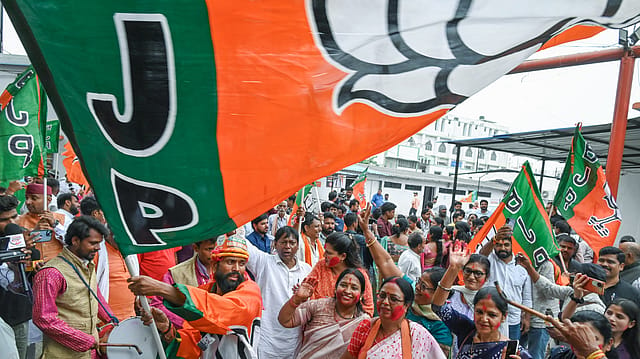
IT’S EASY TO talk up the significance of this round of Assembly elections. After all, polls in five geographies, four states of the Union and one Union territory, amount to a virtual mini referendum. Think about it: one in five Indian voters has spoken across 21 per cent of Lok Sabha constituencies. And who would have thought these voters would show up in record numbers only to topple three chief ministers in one day? The carnage is unprecedented.
The I.N.D.I.A. bloc has borne the brunt. Even in Tamil Nadu, where it was favoured to win, it lost to a rank outsider. A Kollywood superstar, in a harkening back to the MGR age that two generations of Tamils don’t remember. The BJP-led NDA has spared itself the ignominy that the I.N.D.I.A. bloc has arguably inflicted upon itself. BJP has returned to power in Assam; its ally has dodged anti-incumbency in Puducherry. But it is in the veritable Eden Gardens of Indian politics, Bengal, that BJP has scored a polity resetting triumph.
After Anga and Kalinga, it is Banga that has fallen under BJP’s sway. With this, BJP has significantly expanded its footprint in the East, reshaping the opposition’s balance of power.
A weakened I.N.D.I.A. bloc now stands to embolden the Centre, recalibrate coalition arithmetic ahead of national elections in 2029, and shift the ideological narrative. Let’s break this down.
First, BJP’s win in Bengal, against the force of nature that is Mamata Banerjee, catapults it into an orbit of its own. Much like Congress in the 1950s and 1960s, BJP has become the default party of governance. NDA, in some shape or form, governs nearly 75 per cent of India’s population. NDA’s sprawl over so much of India is particularly striking because democratic contestation has deepened since the 1950s and 1960s. The politics of Mandal, and then Kamandal, ensured a fractured polity. That BJP has been able to substantially transcend the jagged social fault lines that for 25 years threw up fractured mandates is the electoral twist. This transcendence is not a rejection of identity politics but its reconfiguration.
Second, this expanding footprint is not without consequence. Though it has captured power through a thorough examination at the ballot, BJP’s consolidation also reduces the ground for alternative options.
For a while, it appeared that parties that didn’t belong to either Congress or BJP-led coalitions were going to contain BJP. These regional identities also represented the diversity of the Indian political tradition. But even these parties—AAP, RJD, BJD, and SP— are folding or barely hanging on. The lack of alternatives holds obvious consequences for democracy, but only if BJP itself ossifies.
Which brings us to the third point. As BJP establishes itself in new geographies, it must acquire the capacity to govern more diverse social coalitions. This will mean reconciling its ideological impulses with different sensibilities. How it balances this will determine its evolution as a political party.
So far, BJP has managed to absorb leaders from different political persuasions and govern new states without compromising on its core Hindu nationalist philosophy. But what if this flexibility at the margins begins to dilute its core? It has happened before with other parties. Sceptics tell us that BJP won in West Bengal on the back of Hindu consolidation triggered by muscular Hindutva. But supporters are at pains to tell us that BJP has pulled into its fold the genteel Bhadralok, the intellectual class in Bengal, too. They will also point to the fact that Assamese Muslims in Assam voted for BJP, that even in the social mosaic that is ‘Gods Own Country’, the party is expanding.
As it readies for Punjab polls later this year, BJP’s agent provocateurs will take the backseat. It remains to be seen whether BJP will revert to type when seeking re-election for a third time in Uttar Pradesh in 2027. The poll in the so-called cradle of Indian democracy will test whether this new softer approach can be sustained. If it does, BJP’s dominance will evolve into something more accommodating. The Bengal breakthrough holds the potential of being a lot more than an electoral moment in time.