The Entrepreneurial Spirit: Modi and Shah keep winning because they are political innovators
THE WORLDS OF politics and profit may co-exist uneasily in India. But there is a common thread that ties India’s most successful politicians and businesspersons—entrepreneurship. By its very nature, entrepreneurship is about disruption, innovation, risk-taking and a never-give-up spirit. It is about altering the status quo and moving the needle forward. At times, it may fail. It will succeed more often. In economics, entrepreneurship is what distinguishes capitalism from feudalism, dynamism from stagnation. In politics, it differentiates the change-makers from the placeholders.
The actor, Vijay, delivered a breakout performance in the theatre of politics not merely because he is a star of cinema. Stardom doesn’t necessarily translate into the victory of a new political party in its debut election. It helps. But it requires a huge effort, particularly in a state which had an entrenched two-sided polity for five decades. Of course, there was a window of opportunity, what you may call “a gap in the market” from the viewpoint of a business entrepreneur. The once ideological Dravidian politics of Tamil Nadu had faded along with its last tall leaders in J Jayalalithaa and M Karunanidhi. The successors were left protecting the status quo, the spoils of power.
However, to outperform both the DMK and AIADMK alliances in a debut election is an act of supreme political enterprise. Even Arvind Kejriwal, the most recent startup from the other end of the country, took more than one election to upset the status quo— AAP was the second-largest party in its debut election in the city state of Delhi and a distant competitor in its first attempt in Punjab.
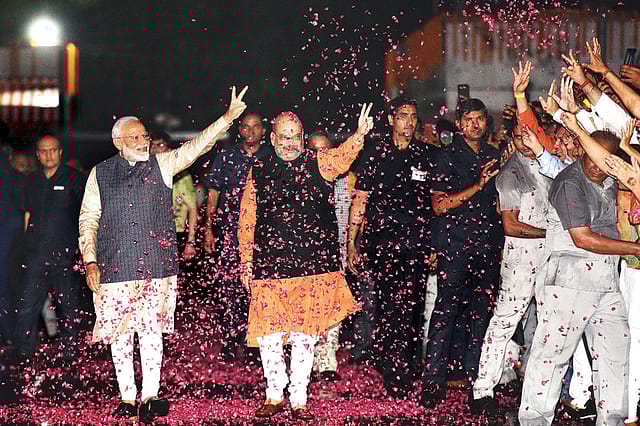
Political startups like Vijay’s TVK and Kejriwal’s AAP deserve their headlines, but the encore belongs to the greatest political entrepreneurs of India in this century— Narendra Modi and Amit Shah. Arguably, in their ability to successfully politically mobilise a cross-section of India—cutting across class, caste, region—they may only be comparable to their fellow Gujarati, MK Gandhi. And that is because they are consistently entrepreneurial. There are no one-off efforts or success for them. They are on a play and repeat mode. Vijay and Kejriwal still have a long way to maturing from startups.
Messrs Modi and Shah have delivered many firsts for BJP. A single-party majority, twice. Consecutive terms in the Union government, three times. A BJP chief minister in Odisha, a first. A BJP chief minister in Bihar, a first. BJP domination of the Northeast, a first. And now, a BJP chief minister in West Bengal, another first. None of these achievements seemed within the realm of possibility for BJP in 2013, when Modi and Shah took over the reins. Until then, BJP seemed destined to govern India in coalitions. It was a party of a particular geography, specific castes and classes. Thereafter, it has become a truly pan- India force, a winning force, replacing the Congress of the original Gandhi.
It would have been easy for Modi-Shah to rest on the laurels of the 2014 victory. By itself, that would have guaranteed their place in history. But the difference between successful political entrepreneurs and run-of-the-mill politicians is their drive to continue to disrupt, take risks and grow. Nothing is deemed impossible. No achievement is enough. The frontiers exist only to aspire and conquer.
India’s traditional politics and politicians, used to a more feudal style of existence and success, have yet to find a way to deal with the rise of political entrepreneurship, other than opposing it. But just like there is no turning back on capitalism, there is no turning back on the new politics. Those who want to compete will have to become innovators, disruptors and risk-takers and not be content with consolation prizes. Those who can’t or won’t, will be the also-rans.
India’s greatest strength is its entrepreneurial spirit. It is the ‘secret’ recipe for success. For India to thrive, entrepreneurs must prosper, in business and in politics.